Tell the Story Through a Midair Journey
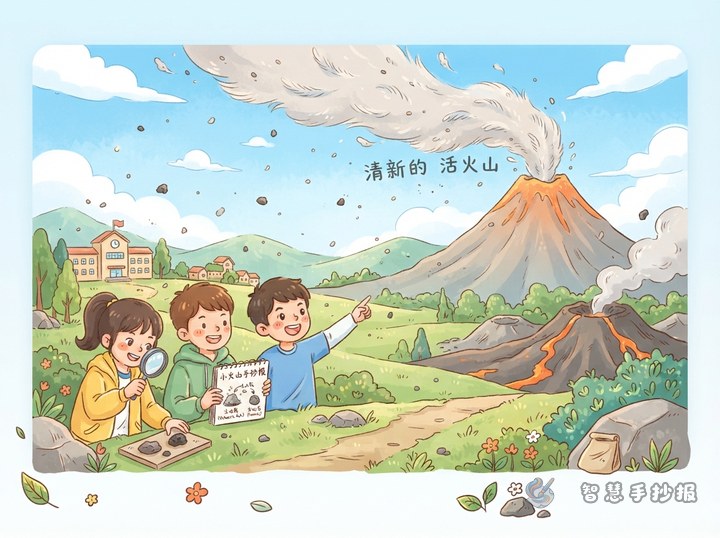
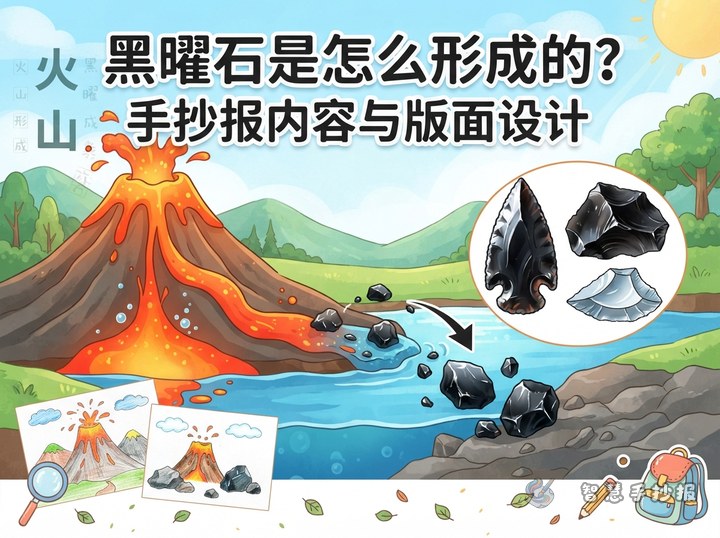
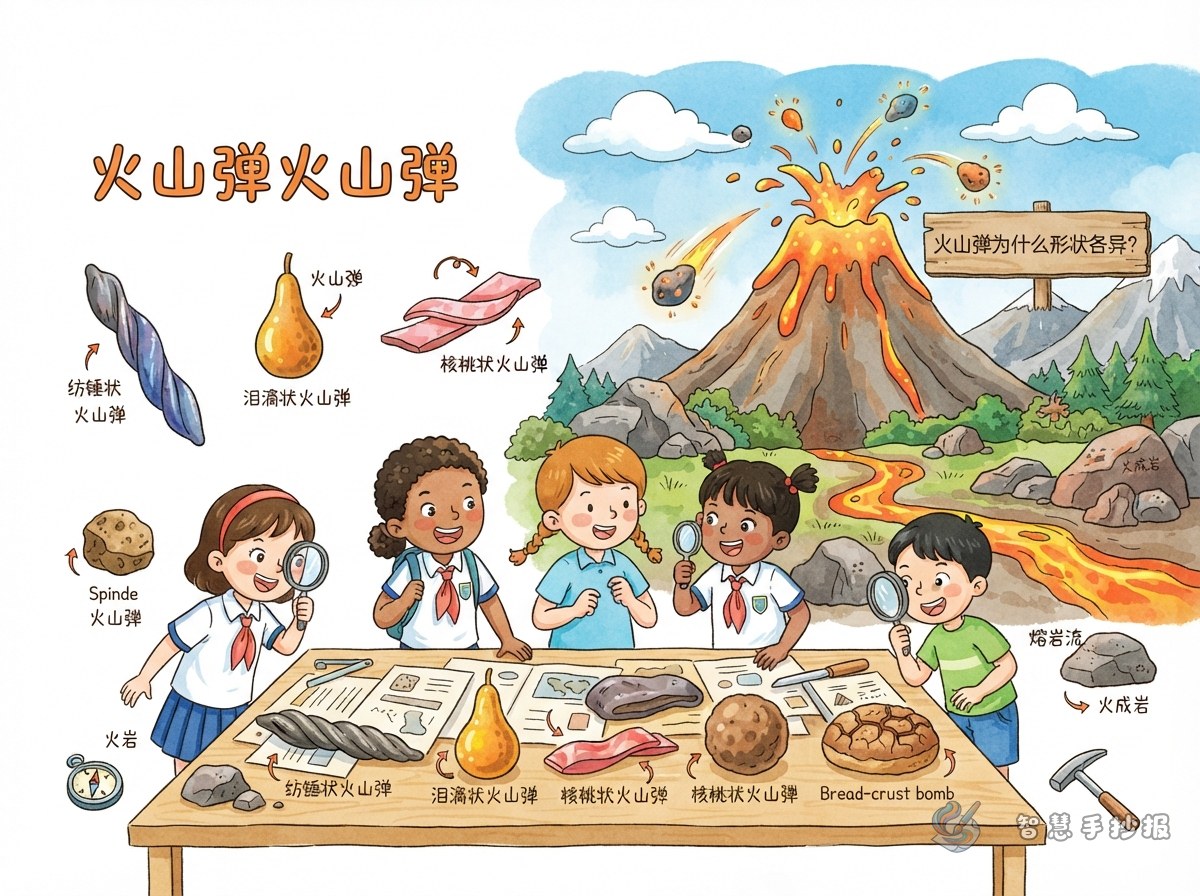
Build the poster around the journey of a volcanic bomb from eruption to landing. During an eruption, a volcano may throw out blobs or chunks of hot, sticky lava. They tumble through the air, begin to cool, and land in different shapes. The word “bomb” describes a large piece of ejected volcanic material, not a human-made weapon.
- Ejection: Draw a crater throwing glowing lava fragments upward.
- Flight: Add a curved dotted line and label it “spinning, stretching, cooling.”
- Landing: Show a fragment that has hardened or still has a partly soft outer layer.
Why the Shapes Are Different
A volcanic bomb's appearance depends on factors such as lava thickness, rotation during flight, cooling speed, and impact at landing. Fluid lava may stretch into an oval or spindle-like shape. If the outside cools before the hot interior, cracks can form on the surface. A piece that remains soft when it lands may become flattened or irregular.
- Spindle-shaped: Thick in the middle and narrower at both ends.
- Bread-crust surface: Covered with cracks as the hot interior expands beneath a cooling shell.
- Flattened form: Changed by impact before the material completely hardened.
Four Useful Content Boxes
Divide the written material into four boxes: “What Is a Volcanic Bomb?”, “How Shapes Form,” “Volcanic Bombs Versus Ash,” and “Safe Volcano Observation.” Volcanic bombs are relatively large ejected fragments, while volcanic ash consists of very fine particles. Color alone is not enough to tell them apart.
The safety box should explain that active volcanoes and recently erupted areas can be dangerous. Students should follow official instructions, stay outside restricted zones, and never collect rocks from hazardous locations.
Turn the Volcano Into the Centerpiece
For a landscape layout, place the title near the upper left and draw a volcano across the center third of the page. Arrange three round fact boxes along the curved flight path of a volcanic bomb. Put a shape-observation card on the right and a safety reminder along the bottom.
- Use lava orange, ash black, and rock brown as the main colors.
- Choose pale yellow or cream backgrounds for readable text boxes.
- Keep eruption lines away from paragraphs and leave open space between sections.
- Add small magnifying glasses, rock textures, and arrows as simple decorations.
Check Before Adding Color
Review the pencil draft before outlining. Make sure the flight path is easy to follow, volcanic bombs are clearly distinguished from ash, and each paragraph is suitable for young readers. Students and parents can then use the Smart Handwritten Newspaper WeChat Mini Program to choose a layout, adjust the content boxes, and continue creating the poster.