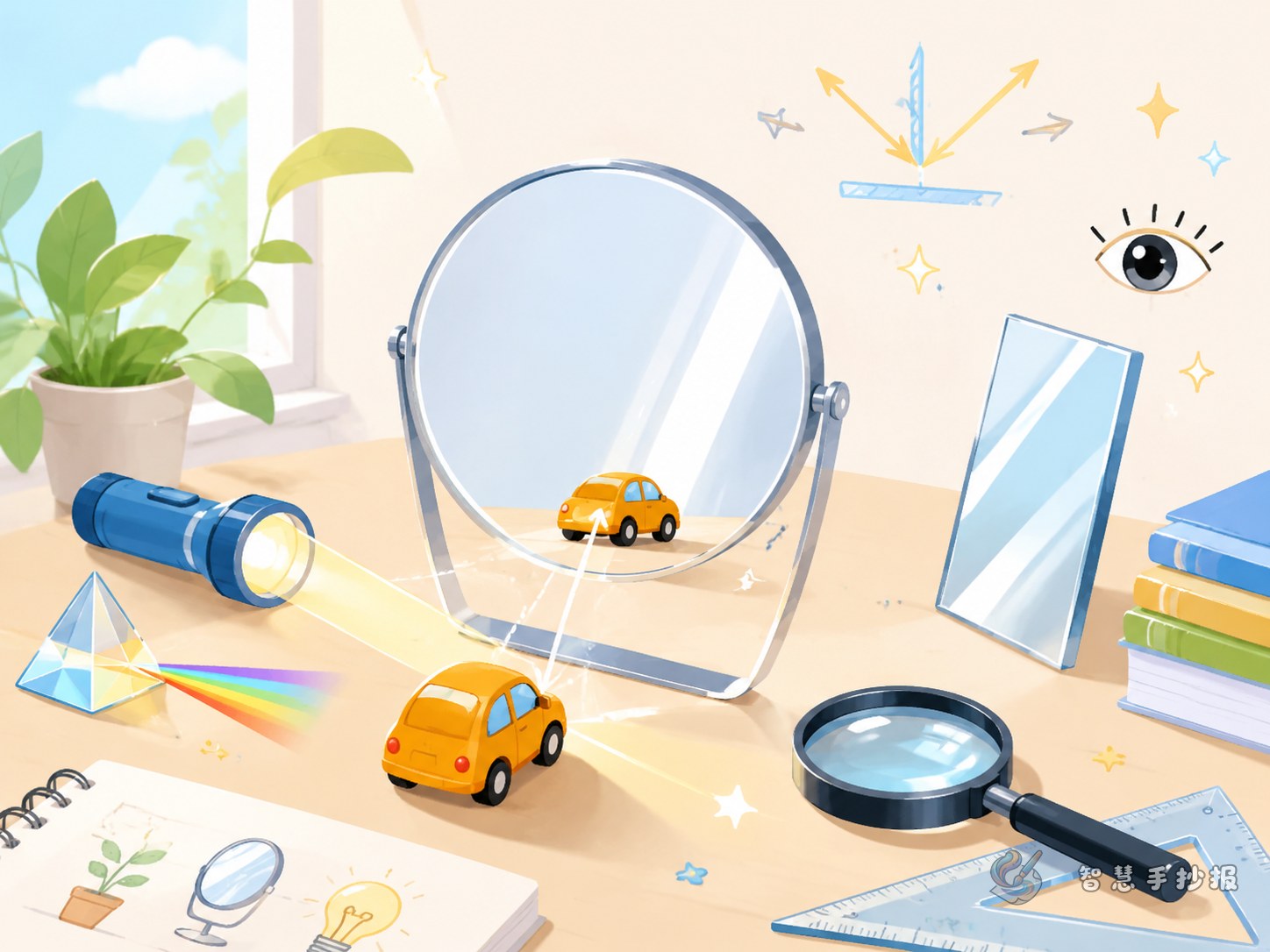
Start with the main question: Why can a mirror show our image?
A mirror image poster works best when the topic is clear and easy to understand. You can focus on light reflection, plane mirrors, and mirror effects in daily life. Good titles include “Why Can a Mirror Show Us?” or “Simple Facts About Mirror Images.” These feel natural for schoolwork and match real search habits.
In the opening part, explain that there is not another person inside the mirror. Light reflects from our body to the mirror, then reflects again into our eyes, so we see an image. This short explanation is perfect for the center section of the poster.
Ready-to-use content blocks
1. What is mirror imaging?
A plane mirror has a smooth surface. When light reaches it, the light is reflected in an orderly way. When the reflected light enters our eyes, we see an image. The image appears behind the mirror.
2. Main features of a mirror image
- The image is the same size as the object
- The image and the object are at equal distances from the mirror
- The image is upright
- It seems to switch left and right
3. Reflection in everyday life
- Looking in a mirror before school
- Mirror walls in stores
- Car mirrors helping drivers see behind
- Still water showing a reflection like a mirror
These sections can be placed in separate boxes so the poster looks organized and interesting.
Poster layout ideas with a science feel
This topic looks great with a large center drawing and smaller side sections. In the middle, draw a child standing in front of a mirror and use arrows to show the path of light. Around it, add short sections such as “Key Facts,” “Examples in Life,” and “Fun Questions.”
- Use light blue, silver, or pale purple for the main colors
- Add borders with stars, light beams, or simple geometric lines
- Highlight words like “reflection,” “plane mirror,” “upright,” and “same size”
- Leave some blank space so the poster stays neat and readable
If you want to keep improving the layout and materials, you can also continue designing in the WeChat mini program of Zhihui Shouchao Bao.
Fun additions for younger students
To make the poster more lively, add a small section about why the image seems left-right reversed. A simple way to explain it is that the mirror does not truly swap left and right. Instead, it changes the front-back direction, so we feel that the sides are reversed.
You can also include an easy experiment. Raise your right hand in front of a mirror and observe the image. Move a pencil slowly toward the mirror and see how the distance between the pencil and its image changes. These activities make the poster more interactive.
How to finish the poster
The ending can be short. Write what you learned from observing mirrors. For example: “By making this poster, I learned that mirror images are related to light reflection. I also found that science can be discovered in everyday life.” This gives the poster a complete ending.