Begin with one clear observation question
An ant observation poster is more engaging when it tells the story of one real observation instead of listing general facts about ants. Start with a simple question: What does an ant do after it finds food, and how does it travel back? This question gives the whole handwritten poster a clear direction.
- Place: Note whether you saw the ants near a tree, wall, flower bed, or path.
- Time: Write down the date and approximate time of day.
- Subjects: Record the number of ants, their different sizes, and the way they carried things.
- Small actions: Watch for approaching, turning, stopping, avoiding an obstacle, or touching another ant.
Make the ant trail the visual center
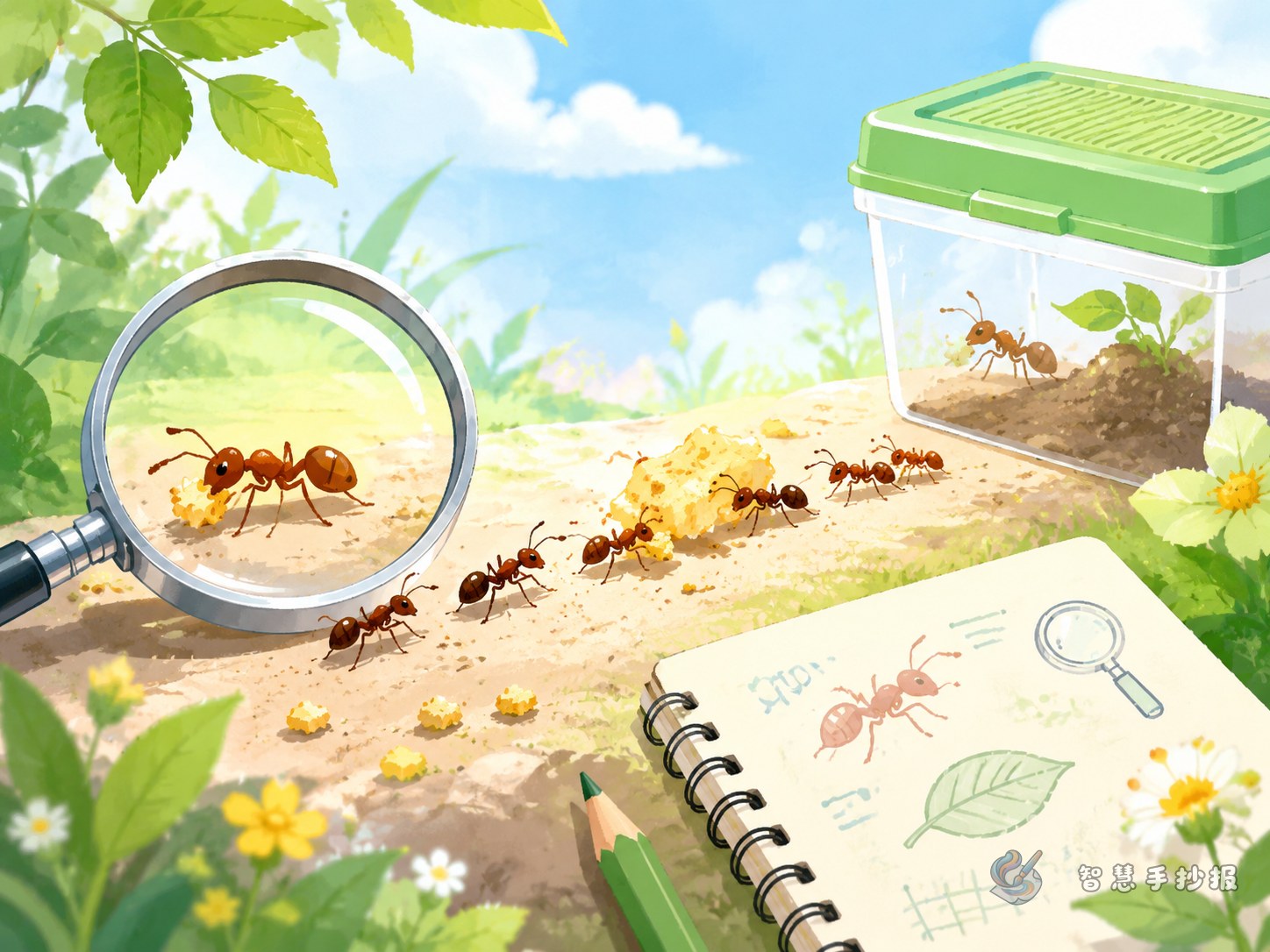
The most memorable part of the poster can be a winding trail showing the ants’ movement. Lightly sketch the starting point, the food location, and the return direction. Use dots for observed ants and arrows for movement. Do not invent a perfect path just to make the drawing attractive. An incomplete trail can still be an honest record.
- Write where you observed the ants and how long you watched them.
- Divide the observation into short stages, such as first noticing the food, beginning to carry it, and the final moment of observation.
- Describe what happened during each stage. Mark uncertain ideas as guesses rather than facts.
- Add tiny sketches beside the trail to show carrying, stopping, or turning.
Build four observation cards around the trail
Try a layout with one large trail in the center and four small cards around it. Put the title at the top, then let the reader follow the path through the different sections.
- My question: For example, “Will the ants return along the same route?”
- Field notes: Include the date, place, weather, observation time, and number of ants seen.
- Movement close-up: Draw one ant approaching, carrying, or turning, with one or two explanatory sentences.
- What I noticed: Describe only what your notes support, such as “Some ants paused at the corner before changing direction.”
Useful sentences for the writing section
Opening: “Today I watched ants near ________. At first, I saw ________. Then one ant moved toward ________.”
Middle: “After ________ minutes, the ant ________. I noticed it stop or turn near ________, so I marked that place on my trail map.”
Ending: “This observation showed me that even tiny animals have interesting actions worth recording. Next time, I would like to observe ________ and test my idea again.” Fill in the blanks with real notes instead of making up details.
Finish with careful color and respectful observation
Outline the ants in black or dark brown, draw the trail with a warm-colored dotted line, and mark the food location with a small orange or red symbol. A magnifying glass, footprints, leaves, and a small mound can decorate the corners, but decorations should not cover the notes. Short sentences, clear sections, and a little empty space will make the poster easier to read.
Do not step on an anthill, catch ants, or block their path for a long time. If a parent or teacher helps set up a very small observation point, clean it up when the observation ends. When the writing is ready, you can use the Smart Handwritten Poster WeChat mini program to arrange the sections and continue making your nature observation poster.