Start with a Small Mystery
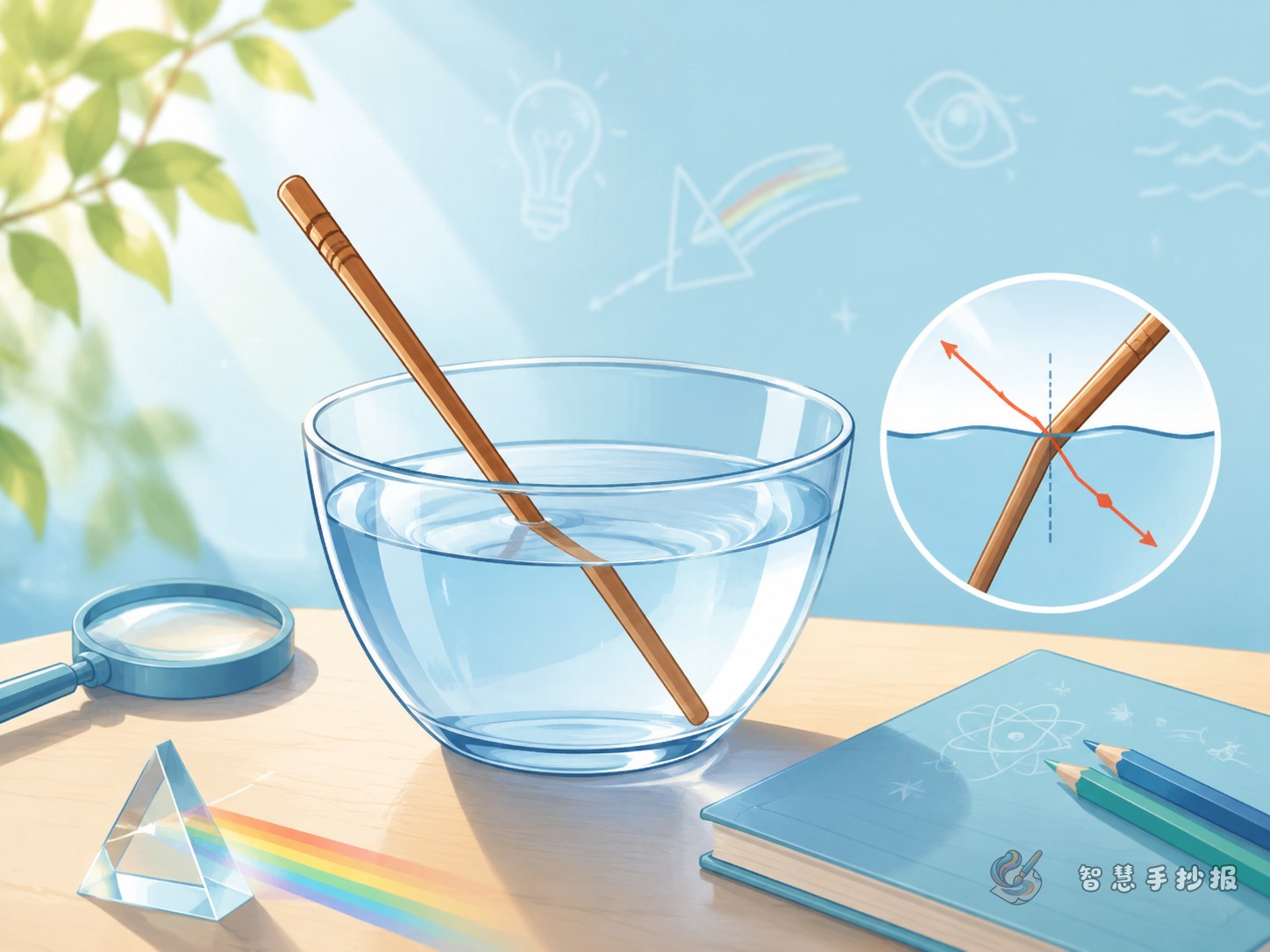
A strong poster can begin with a simple question: Why does a chopstick look bent or broken when it is placed in a glass of water? This question is easy for children to observe at home or in class, and it naturally leads to the science idea of light refraction.
Near the title, students can draw a large question mark, a transparent cup, and a slanted chopstick. This makes the poster feel like a small science investigation rather than a plain fact sheet.
Simple Science Text for the Poster
Science note: Light usually travels in a straight line in the same material. But when light passes from water into air, its direction changes. This change is called refraction. Because of refraction, the part of the chopstick under the water appears to be in a different position, so our eyes think it is bent or broken.
- Key words: light, water, air, refraction, vision.
- One-sentence explanation: The chopstick is not really broken; the light changes direction and creates a visual effect.
- Poster message: Science can be found in an ordinary glass of water.
Turn the Observation into an Experiment Section
- Prepare a clear glass, water, and a chopstick or straw.
- Place the chopstick into the water at an angle.
- Look from the side of the glass and describe what you see.
- Try looking from above, from the side, and at different angles to compare the changes.
A small box called “My Discovery” can say: The viewing angle changes how bent the chopstick appears. A clear glass makes the effect easier to observe.
Add More Examples from Daily Life
To make the poster richer, do not stop at the chopstick example. Students can also mention that swimming pools may look shallower than they really are, fish in an aquarium may appear slightly shifted, and tiny water drops can sometimes make letters look larger. These examples show that refraction is part of everyday life.
- A swimming pool may look shallow, so we should still be careful near water.
- A fish in a tank may not appear exactly where it really is.
- A water drop can act like a tiny lens and make small details look bigger.
Use the Water Surface as the Main Layout Line
This poster works well with a two-part layout. Draw a blue water surface across the middle of the page. Put the question, the basic idea, and the eye diagram above the line. Put the experiment steps, daily examples, and conclusion below the line.
Use light blue for water, yellow for light rays, and brown or black for the chopstick. Wavy borders, bubbles, and small experiment cards can make the page clean, bright, and suitable for primary school students.
Final Checklist Before Finishing
- Does the poster clearly say that the chopstick is not really broken?
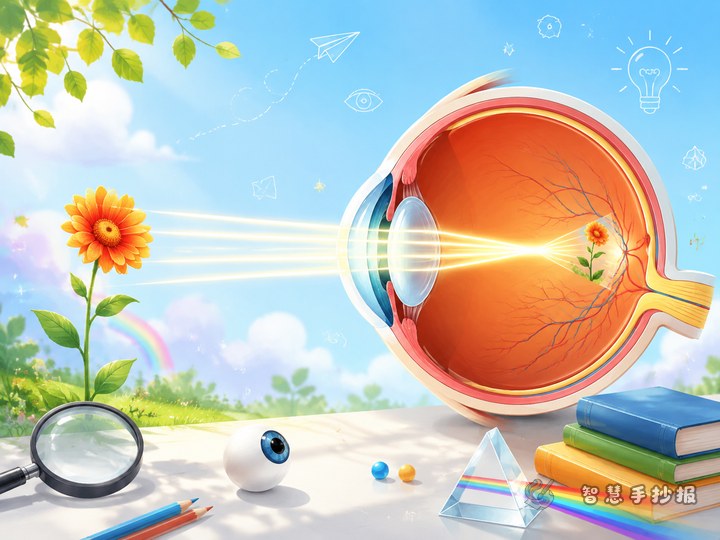
- Is there a diagram showing the glass, chopstick, water surface, light rays, and eye?
- Are the sections balanced, with observation, explanation, experiment, examples, and conclusion?
Students who want an easier way to arrange the sections and polish the poster layout can continue making it in the Zhi Hui Shou Chao Bao WeChat mini program.