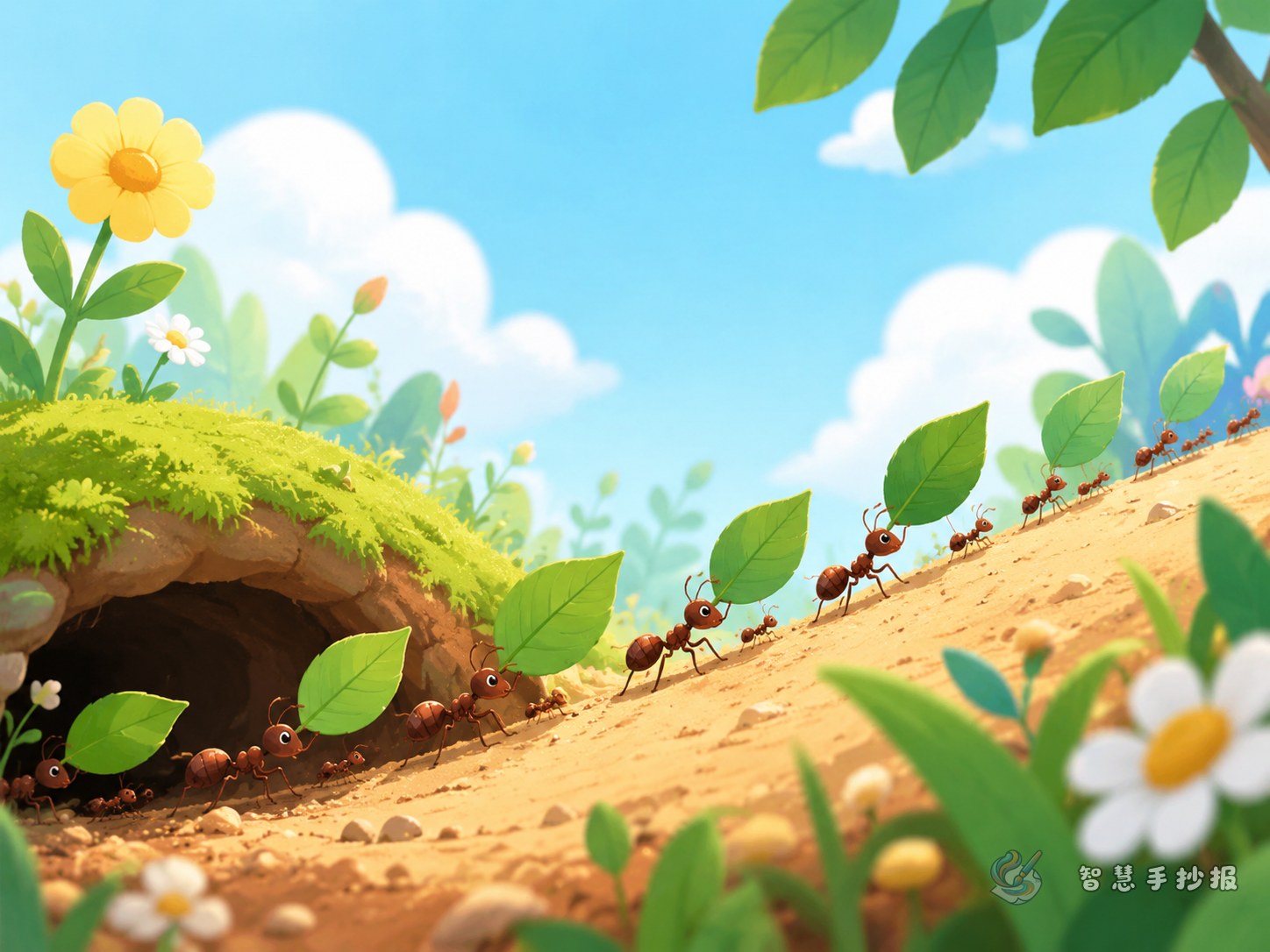
Focus the topic: observe ants, not just say they are hardworking
For a handwritten newspaper about why ants move in lines when relocating, do more than write a simple sentence like “ants are hardworking.” A better page combines what you observed, a simple explanation, and your own thoughts. That makes the project feel like a real nature observation poster.
You can shape the theme around these ideas: the ant trail I saw, why ants follow the same path, and how they work together to carry food. Small drawings of ants, grass, crumbs, and route arrows can make the page lively and easy to understand.
Key content you can include
1. What you observed
- Ants often walk one after another instead of moving randomly.
- After finding food, more ants gather near the same spot.
- When food is large, several ants may carry it together.
- If disturbed, the line may break for a moment and then form again.
2. Why they seem to “walk in line”
Ants can leave scent trails when searching for food or returning to the nest. Other ants follow these chemical signals, so they look as if they are standing in line. It is not a human rule of lining up, but a smart way to find direction and save energy.
3. Why ants may move their nest
- The old nest becomes too wet or damaged.
- Weather changes make the place less suitable.
- They find a safer or better new location.
- Their food route changes and the colony becomes more active.
Good section ideas for a student poster
You do not need too many sections. Four or five are enough for a clear layout.
- Today’s Observation: time, place, weather, and what the ants were doing.
- Ant Facts: walking in trails, working together, and finding food.
- What I Discovered: two or three sentences about what surprised you.
- Think About It: for example, what happens if the scent trail disappears?
- Protect Small Lives: remind readers not to step on ants or destroy their nest.
Ready-to-use writing material
Opening: After school one day, I saw a long line of ants carrying food on the roadside. They moved like a tiny organized team, and that made me want to learn more about them.
Short science paragraph: Ants are small, but they are very good at teamwork. They leave scent trails to share route information with other ants. When one ant finds food, more ants can follow the trail and help carry the food back to the nest. This group behavior helps ants adapt to their environment.
Personal reflection: I used to think ants were just tiny black dots on the ground. After careful observation, I found that their world is full of order and teamwork. Nature has many secrets if we take time to notice them.
How to arrange the page
A two-column layout or a top-middle-bottom structure works well. Put the title at the top. Green, brown, and light yellow fit the natural theme. One side can show observation notes, while the other explains why ants follow a trail. A dotted path through the middle can connect the whole page.
- Use grass, leaves, stones, or soil-like borders for a nature look.
- Draw ants carrying crumbs, an ant nest, or direction arrows.
- Highlight key sentences in bold for easy reading.
- Leave some blank space so the page does not look crowded.
Tips for making the final poster
If the student has already watched ants outdoors, start with real observations and then add short science facts. If not, use the structure of observation, explanation, and reflection. After planning the text, you can continue refining the layout and style in the Zhihui Handwritten Newspaper WeChat mini program to make the final work cleaner and more attractive.