Pick One Angle Before You Start Writing
Huangmei Opera is a friendly topic for a handwritten newspaper: the tunes are bright, the stories are easy to follow, and the costumes are simple rather than fussy. The usual mistake is copying an encyclopedia entry. Choose one angle instead, then let every column support it.
Good options are "From tea-picking songs to Huangmei Opera" for music and singing style, "One classic play, Tianxian Pei" for story, characters and famous lines, or "The women on stage" for role types, hair ornaments and costumes.
Text You Can Copy Straight Onto the Page
- Singing styles: Huangmei Opera singing falls into groups such as flower tunes, colourful tunes and main tunes. Flower tunes come from folk songs and feel lively; the main tunes are slower and suit storytelling.
- Classic plays: Tianxian Pei tells of a fairy and a poor farmer, Nü Fuma of a young woman who dresses as a scholar to take the imperial exam, and Niulang Zhinü of the weaver girl and the cowherd. Two sentences per play is plenty.
- Roles: Early Huangmei Opera was built on the "three small roles" of young female, young male and clown, with more role types added later.
- Costumes and props: Compared with Peking Opera, the costumes are plainer and closer to daily dress, and the common props are fans, flower baskets, carrying poles and tea baskets.
- Dialect and accompaniment: Singing uses the accent of the Anqing area, led by the gaohu fiddle with gong and drum for rhythm.
Column Titles with a Theatrical Ring
A good title does half the decorating for you.
- Notes from the Stage — singing styles and role types.
- One Play, One Story — a short plot summary of a classic play.
- A Few Lines to Hum — two or three quoted lyrics in quotation marks.
- Props and Details — costumes, gestures and stage objects.
- Can You Sing It? — one or two quiz questions for readers.
Colour, Borders and Breathing Room
Because the music comes from country folk tunes, the page should not feel heavy. Use soft yellow, pale green and lotus pink with a touch of vermilion.
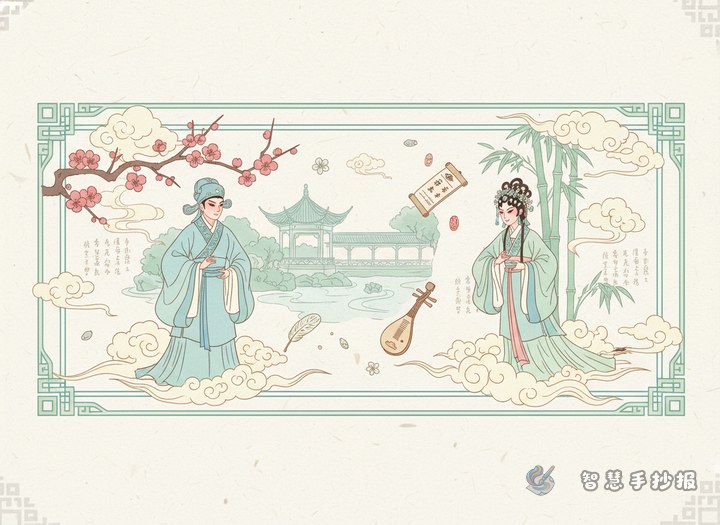
- Borders: plum branches, bamboo leaves, tea baskets or gentle water ripples.
- Titles: vertical lettering or a brush-like look adds charm.
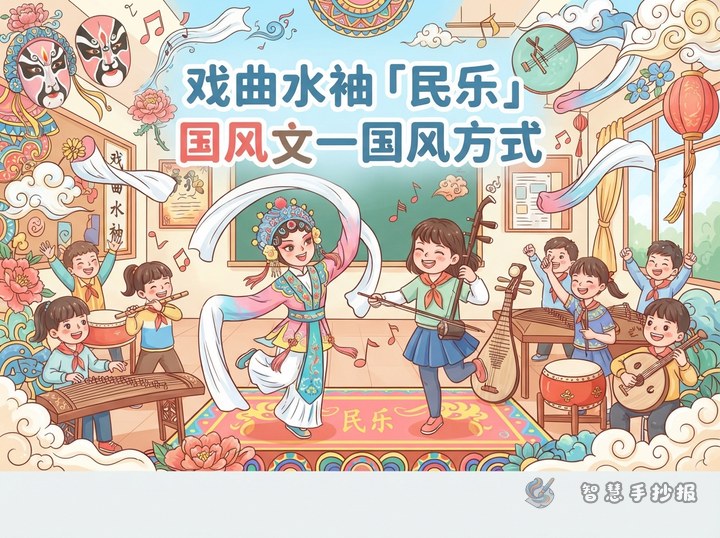
- Centre image: a single silhouette of a performer with a fan or a flowing sleeve.
- White space: leave about a third of the sheet empty.
A Simple Order of Work
- Divide the sheet in pencil into three columns, or one large block with two smaller ones, and mark where each title and block of text will sit.
- Fill in the writing, most important content first, keeping each block to five or seven lines and giving quoted lyrics their own space.
- Draw the borders, colour everything, then erase the pencil lines. Limit yourself to two shades in the same colour family.
If you want to preview the balance first, open the 智慧手抄报 mini program in WeChat, choose a Chinese-opera style template, type your text in and check the layout before copying it onto paper by hand.