Turn the poster into an element treasure hunt
Use “Where Are Chemical Elements Hiding at Home?” as the main idea. Connect familiar objects with the elements related to them. Place the title across the top and draw a magnifying glass, a small periodic-table card, or colorful test tubes nearby so readers can see that chemistry is part of everyday life.
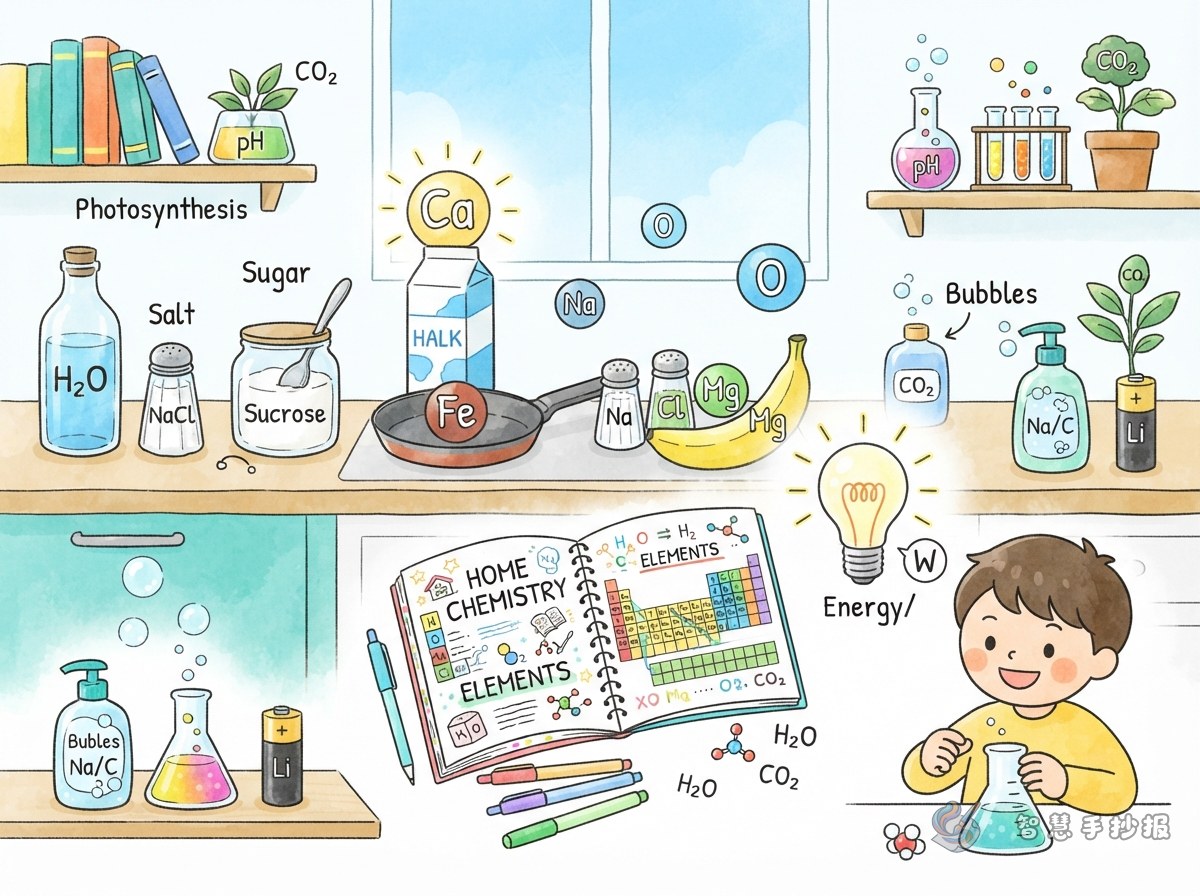
Remember that most elements in daily life do not appear as separate pure elements. They are usually found in compounds or mixtures. For example, table salt contains sodium and chlorine, while water contains hydrogen and oxygen. Saying that an element is “found in” an object is both accurate and easy for children to understand.
Draw a map of elements around the home
- Air corner: Introduce oxygen and nitrogen as important parts of air. Oxygen also supports breathing and burning.
- Kitchen corner: Mention sodium and chlorine in table salt, calcium in milk and soy products, and aluminum in foil.
- Desk corner: Introduce carbon in pencil graphite and copper in electrical wires. Graphite is a form of carbon, and copper conducts electricity well.
- Body corner: Talk about calcium, iron, and oxygen in relation to bones, blood, and breathing. Make it clear that needing an element does not mean taking a chemical product casually.
Give each area a simple icon and connect it to the element name with arrows. The result will feel like an exploration map while still presenting useful science information.
Short facts for your information boxes
Element cards: The symbol for oxygen is O, iron is Fe, calcium is Ca, and copper is Cu. Element symbols usually use one or two English letters, with the first letter capitalized.
Everyday question: Why is table salt not the same as metallic sodium or poisonous chlorine gas? Table salt is a stable compound, so its properties are not exactly the same as those of the elements that form it. This helps readers distinguish between composition and properties.
Safe observation task: Prepare paper, colored pencils, and a few safe household objects. Record which elements may be related to them. Observe, research, and draw only. Never mix cleaning products, burn objects, or taste any experimental material.
Give the layout the order of a periodic table
Try a central-title layout with four surrounding sections. Put “Element Treasure Hunt” in large letters at the center, then place air in the upper left, kitchen in the upper right, desk in the lower left, and body in the lower right. Use a different main color for each section, such as blue for air, orange for the kitchen, green for the desk, and red for the body. Keep the total number of colors under five.
At the bottom, create an “element path” showing symbols such as O, Ca, Fe, and Cu with their Chinese or English names. Decorate the border with small molecule circles, test tubes, magnifying glasses, and stars, but keep the decorations away from the main text. Plan with pencil first, outline with a dark pen, and add color last.
Three safety reminders
- Use only safe paper, pens, and household objects for observation. Do not bring chemical products into the craft activity.
- For topics involving cleaners, fire, or metal powders, present safety knowledge only and do not copy dangerous experiments.
- Check that every element name, symbol, and example match. “Salt contains sodium and chlorine” does not mean “salt is sodium or chlorine.”
When the plan is ready, continue arranging the sections, colors, and lettering in the “智慧手抄报” WeChat mini program. It can help turn these chemistry notes into a clear and colorful handwritten poster.