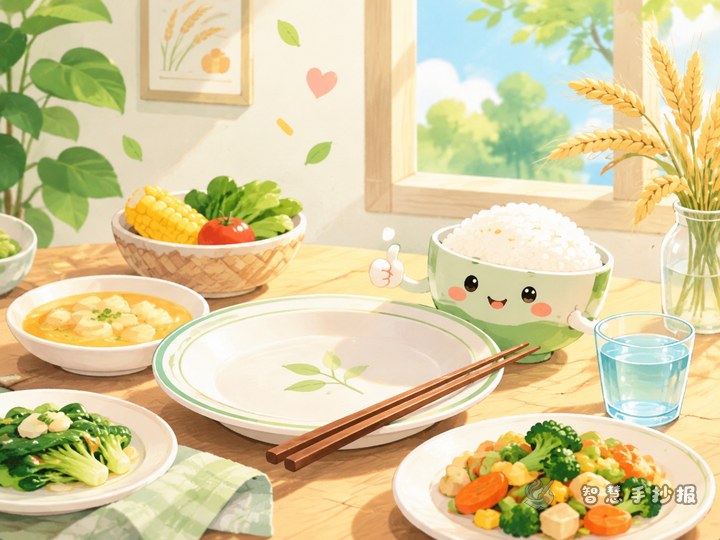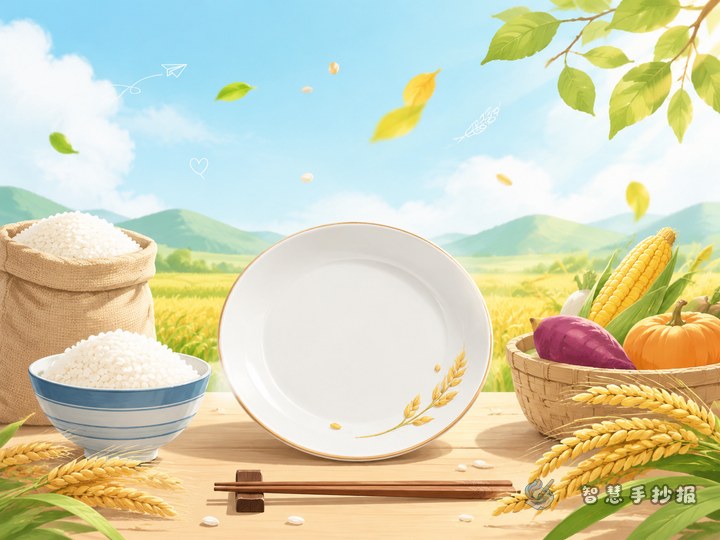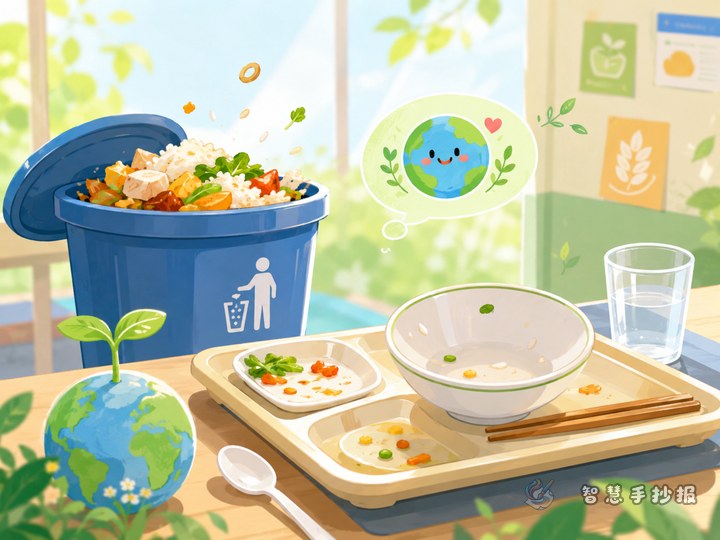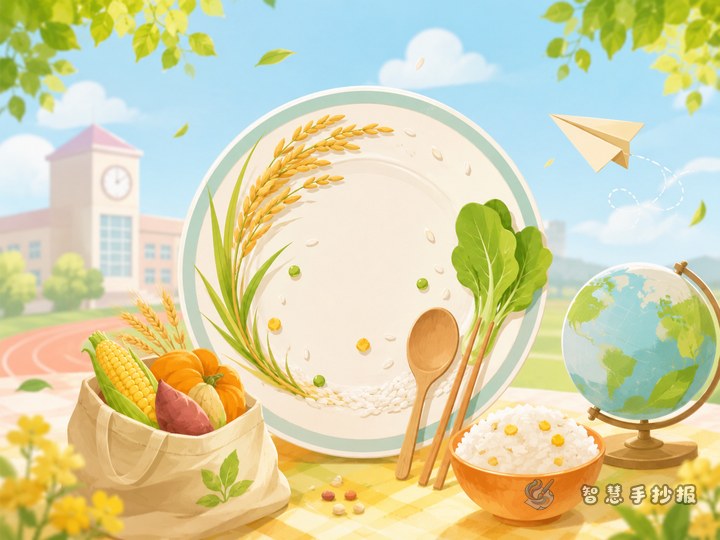
Why a 'journey' angle makes a food-saving page feel real
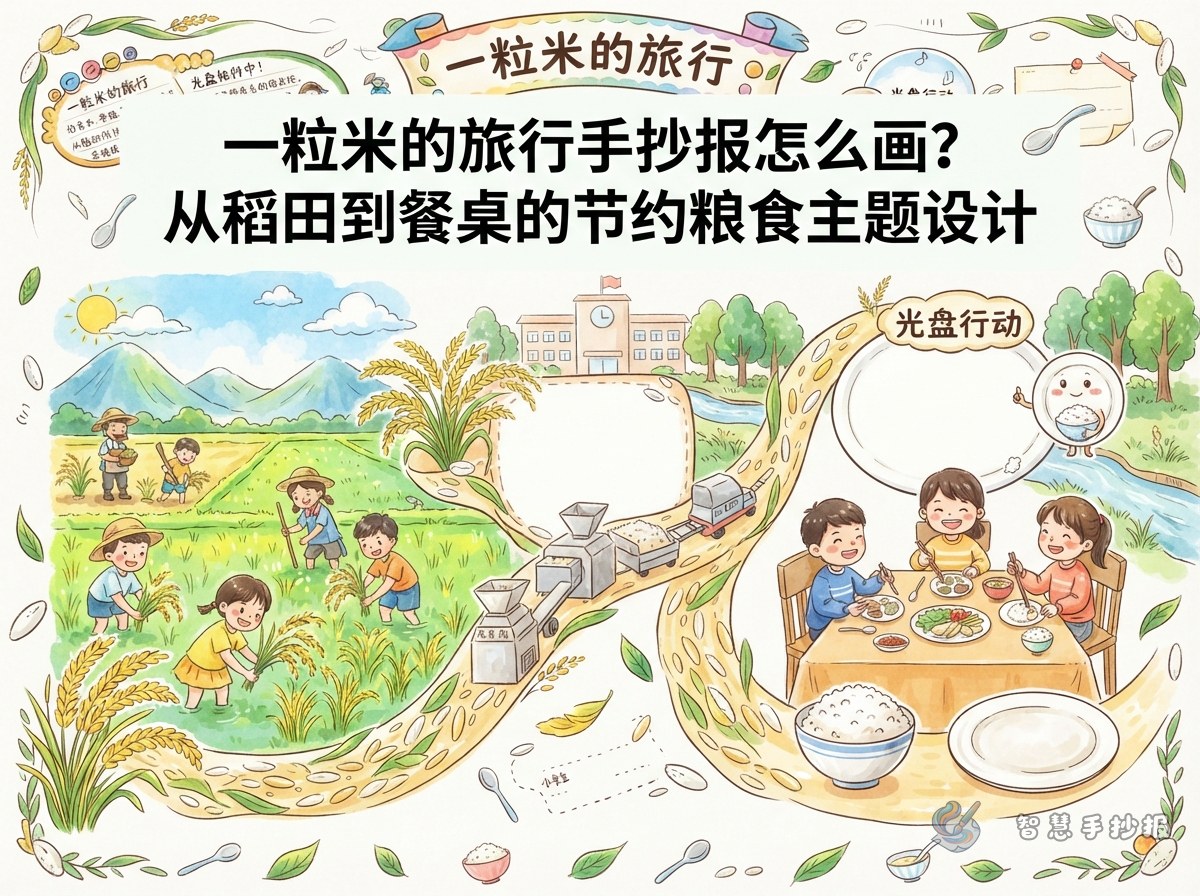
Many food-saving pages end up as a few slogans saying do not waste food. Swap that for the journey of one grain of rice and the topic instantly has pictures. Rice does not appear on a shelf by itself. It starts as a seed, then moves through raising seedlings, transplanting, field care, harvesting, drying, milling, and transport before it reaches the table. Draw that process and the idea of food being hard-won stops feeling abstract.
This angle also lends itself to columns. Every stage of the journey becomes one small block, so you never have to wonder what to put in a panel.
Four stops on the way to your bowl
Four stops keeps the page full without crowding it. Fewer feels thin, more feels cramped.
Stop 1: Raising and transplanting seedlings
Show the farmer sowing seeds in a seedbed, then moving the young plants into the paddy field one by one. Add a simple bent-over figure and a line such as 'a seed has to become a seedling before anything else can happen'.
Stop 2: Growing in the field
Mention sunlight, rain, weeding, irrigation, and pest control. This is a good place to point out that rice does not grow well on its own and people keep looking after it. Sun, canals, and rice ears are easy shapes to draw here.
Stop 3: Harvesting and drying
Describe cutting the ripe rice, threshing it, and drying the grain. A short note like 'harvest has to beat the weather, or damp grain spoils' helps readers see how many steps happen before food reaches a hand.
Stop 4: Milling, transport, and the table
Rice grain turns into white rice, gets packed, moved, and cooked. This stop matters most, because the journey ends in your own bowl. It is the natural place to bring in the clean plate campaign, for example: 'it travelled this far, so do not leave it behind'.
Layout plan: turn the journey into a road
A road-style layout suits this theme better than plain boxes, and it is simple to set up.
- Lightly draw one curved line across the middle of the sheet, from the bottom left corner to the top right, as the route.
- Place four round or square stops along the line, keeping the spacing even.
- Write a short heading above each stop and leave two or three lines for text underneath. Put the drawing beside the stop, never on top of the writing.
- At the end of the road, draw a bowl or a pair of chopsticks and add one clean-plate sentence.
- Keep a narrow column along the edge for a classic quote, slogans, or a small 'what I can do' list.
Stick to rice white, pale yellow, and light green for the fields and grains, then use a little orange or red on the headings and the final stop so the eye has somewhere to land. You do not need to fill every centimeter. Empty space makes the page look clean.
Words you can copy straight onto the page
Quotes and slogans work best in the narrow side column, where the lines stay short and even.
- Who knows that every grain on the plate comes from hard work.
- For every bowl of rice, remember how hard it was to grow.
- Frugality builds character.
- Every grain of rice carries a drop of sweat.
- Take what you can eat, add more if you need it.
- My bowl, my responsibility.
- Cleaning your plate is not being stingy, it is being grateful.
Keep each slogan short, ideally no more than ten words, so it lands with force. Three clear lines with a matching drawing beat ten lines squeezed into a corner.
Small mistakes to avoid
- Drawing rice ears and bowls everywhere while the text shrinks to a word or two. Aim for at least one full sentence at each stop.
- Listing only slogans with no process. Write one line each for seed, seedling, rice ear, and cooked rice, and the content stands up on its own.
- Writing too small. Anyone sitting upright at the desk should be able to read the stop descriptions at a glance.
- Using too many colors. Three main colors plus one accent for the headings is plenty.
Take the idea into daily life
Once the page is finished, add a small clean-plate tracker in one corner: draw seven or ten boxes, and color one in every day you finish your meal without leaving rice behind. Now the page is not just homework, it can hang beside the dining table and be used. If you later want different colors or a different mix of panels, you can browse similar layouts in the Smart Handwritten Newspaper WeChat mini program and rebuild the journey of a grain of rice in your own style.