Let the River Guide the Story
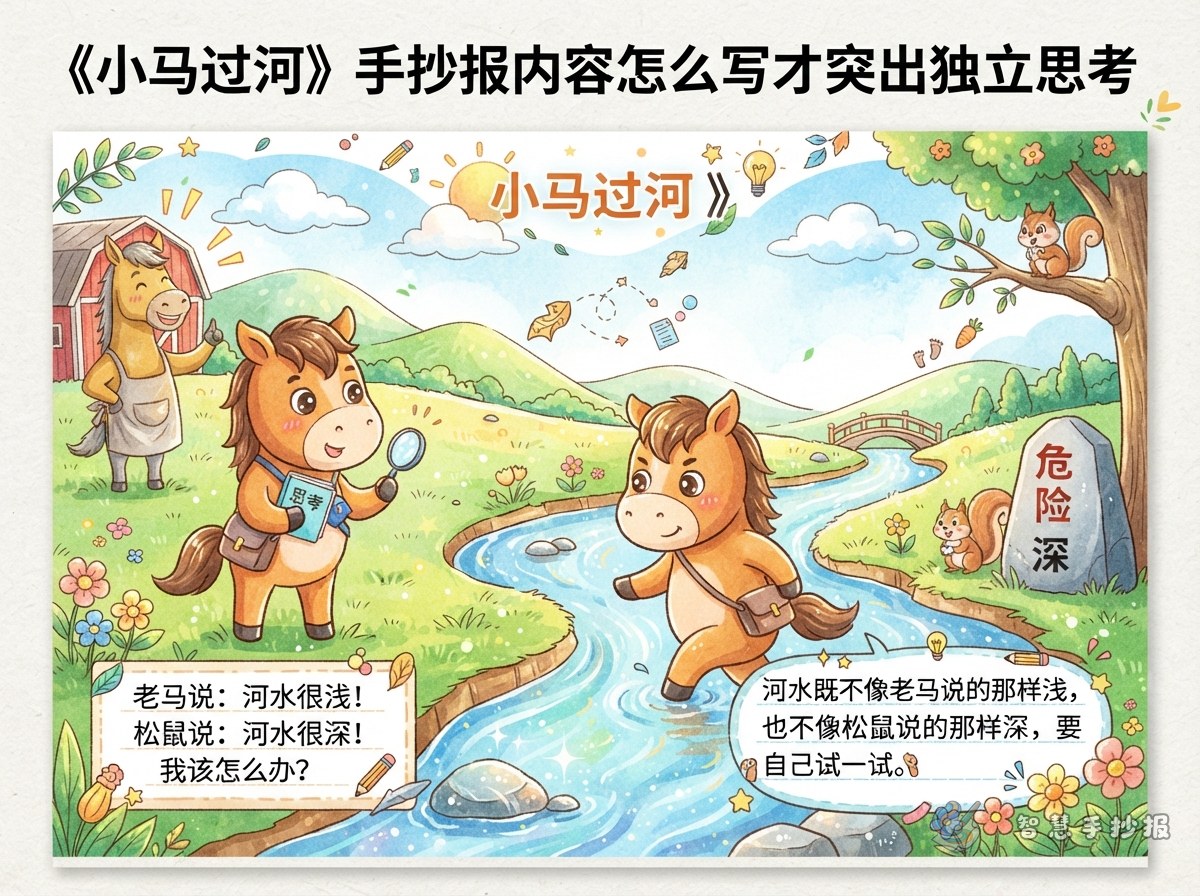
A Little Horse Crosses the River poster can use the river as its main visual path. Briefly explain that Little Horse is carrying grain for his mother when a river blocks the way. Ox says the water is shallow, while Squirrel warns that it is very deep. Little Horse returns home for advice, but his mother encourages him to observe and try safely. He then learns that the river is neither as shallow as Ox believes nor as deep as Squirrel fears.
Build the Message with Three Writing Boxes
Meet the Characters
- Little Horse: He moves from hesitation to careful action and learns to judge for himself.
- Ox: His opinion comes from his large size and personal experience.
- Squirrel: His warning reflects his small size and what he has seen.
- Mother Horse: She guides her child to think instead of simply giving him an answer.
The Main Lesson
Other people's experience is worth hearing, but it should not be copied without thought. We need to consider our own situation, examine the facts, and try things safely before reaching a conclusion.
A Real-Life Connection
Students can connect the lesson to schoolwork. One child may find a problem easy while another finds it difficult, and the same study method may not work for everyone. Advice becomes more useful when it is combined with personal thought and practice.
Show Different Viewpoints in the Layout
Create a horizontal river across the page to divide the poster into a story area, a character-opinion area, and a lesson area. Place Little Horse and the grain sack on one bank and a “What I Learned” box on the other. Speech bubbles for Ox and Squirrel can show their contrasting opinions, while different water-level marks make the idea easy to understand.
- Use light blue, grass green, and warm yellow for a bright countryside mood.
- Decorate the title with ripples, wheat, hoofprints, or small trees without crowding it.
- Keep each paragraph short and highlight key phrases with a colored pen.
- If there is little room for drawing, add a “What Would I Do?” reflection box.
Choose Content Before You Start
- Set the central message as “listen to advice, then think for yourself.”
- Select one short section each for the plot, viewpoints, and lesson instead of repeating the story.
- Sketch the sections in pencil and reserve enough space for the title before writing and coloring.
- Check that the reading order, lettering, and river direction are easy to follow.
For quicker title, section, and layout planning, scan the code to open the Smart Handwritten Poster WeChat Mini Program and continue with a template suited to your paper size.