Let the Silent E Become the Main Character
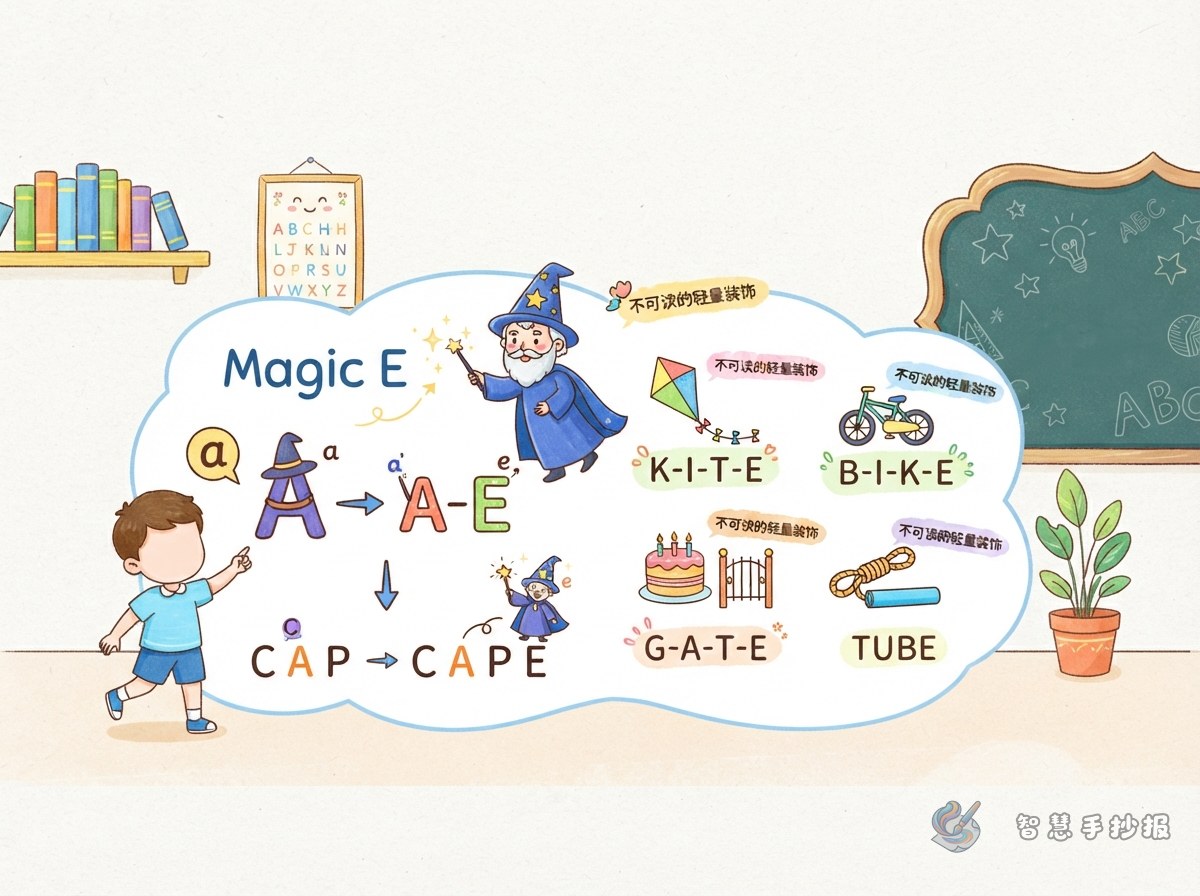
A magic e handwritten newspaper works best when the rule is shown like a small story. The letter e stands at the end of a word. It does not speak, but it helps the vowel before it say its name. A good title could be “Magic E Makes Vowels Say Their Names” or “The Silent E Spell”.
Place a cute letter e with a magic hat in the center. Around it, show word changes with arrows, such as cap to cape, bit to bite, and hop to hope. This gives the page a clear focus and makes the phonics idea easy to see.
Build Word Corners by Long Vowel Families
Divide the vocabulary into small word-family sections. The goal is not to copy too many words, but to make the spelling patterns clear and easy to read.
- a-e words: cake, name, lake, game, face
- i-e words: bike, kite, five, time, smile
- o-e words: home, nose, rope, stone, note
- u-e words: cute, cube, tube, mule, use
If the page is small, choose three words for each group. On a larger page, add simple meanings or small drawings, such as a cake beside cake and a bicycle beside bike.
Add a Short Phonics Chant
A short chant can be placed in a speech bubble or a colorful box. It helps classmates remember the rule quickly:
Magic e, quiet and bright. It makes the vowel say its name right.
You can also add a simple explanation: “The final e is silent, but the vowel becomes long.” Keep this part short so the page stays clean and child-friendly.
Create a Read-and-Match Mini Game
A phonics handwritten newspaper becomes more interesting when it includes a small activity. Put short words on the left and magic e words on the right. Readers can compare the sounds or draw matching lines.
- cap → cape
- pin → pine
- hop → hope
- cub → cube
This section shows both vocabulary building and phonics thinking. It is more meaningful than simply copying a list of words.
Design It Like a Magic Word Map
Use a center-and-corners layout. Put the magic e character in the middle, then place a-e, i-e, o-e, and u-e sections around it. Use different colors for each family, and decorate the borders with stars, books, pencils, and word cards.
Keep the writing clear and not too crowded. Younger students can use larger letters and more pictures, while older students can add sentences such as “I ride a bike” or “The cake is nice.” For more ready-to-use topic ideas and layout inspiration, continue your design in the Smart Handwritten Newspaper WeChat mini program.