Why a Timeline Fits a Maritime Silk Road Poster
The maritime silk road stretches across many centuries and many places, so a long block of text quickly becomes hard to follow. A timeline lines up what happened, when it happened and how it connects to seafaring, which saves space and shows the teacher that you sorted the facts yourself. It also works as a ready-made design skeleton: once the line is drawn, the blank areas around it are already divided for you.
Choose Your Order Before You Draw
Decide which way the line will run, because both options are useful.
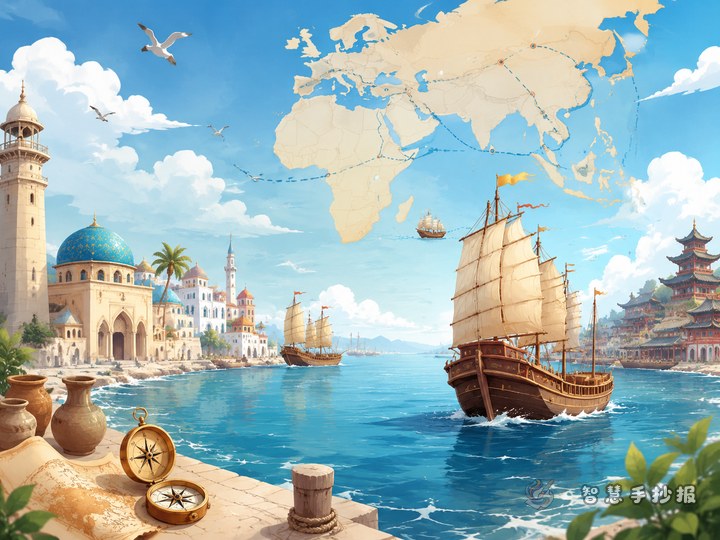
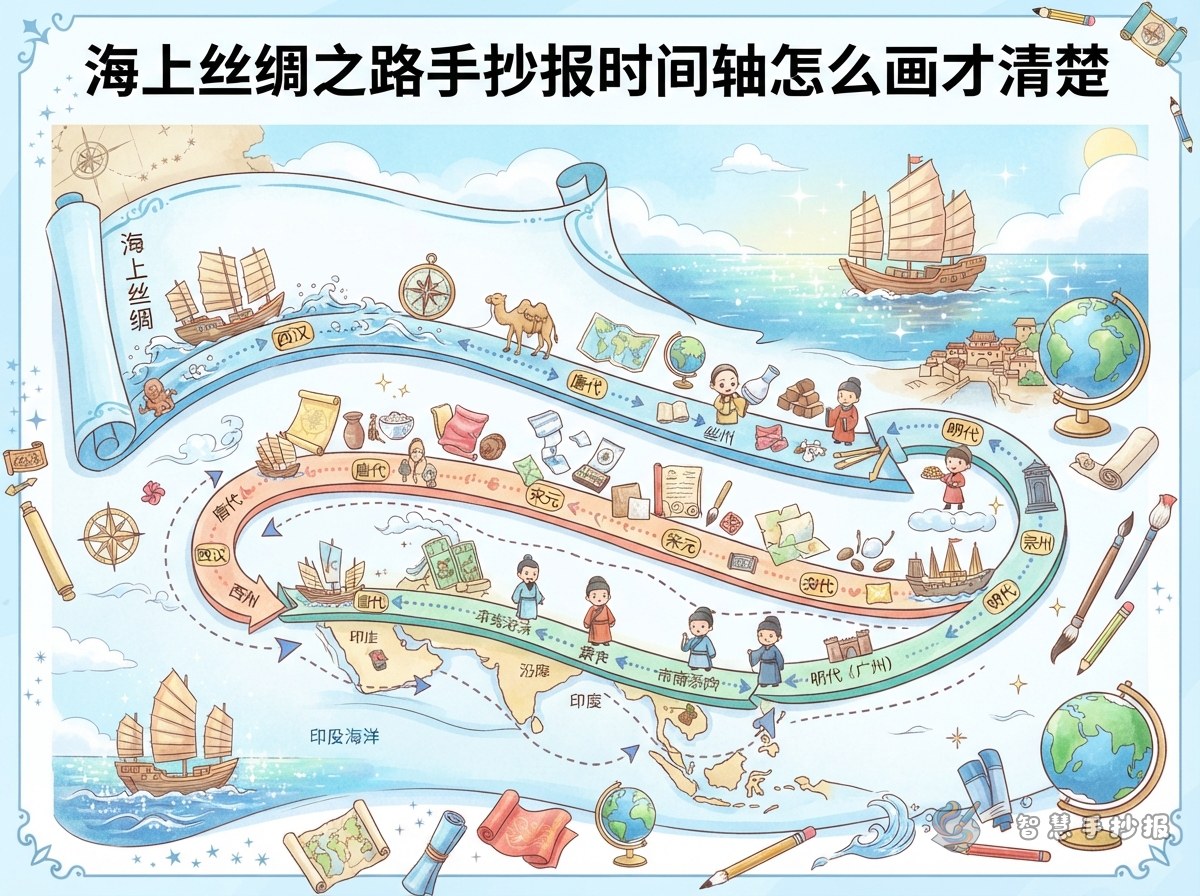
- By dynasty: sea routes grew busier in early times, port trade flourished during the Tang and Song periods, and the Ming voyages under Zheng He reached far across the ocean. This order highlights steady progress.
- By voyage stage: building and loading the ship, setting sail, calling at ports, reaching distant shores and sailing home. This works better when you want to tell the story of one journey.
With only three or four nodes, you can mix the two: use dynasties as large headings and describe voyage stages inside each node.
Three Ways to Draw the Line
The straight line
Draw one horizontal line across the middle of the sheet, mark nodes with small dots, and alternate the captions above and below. It is the steadiest option and stays neat even for younger students.
The sailing route
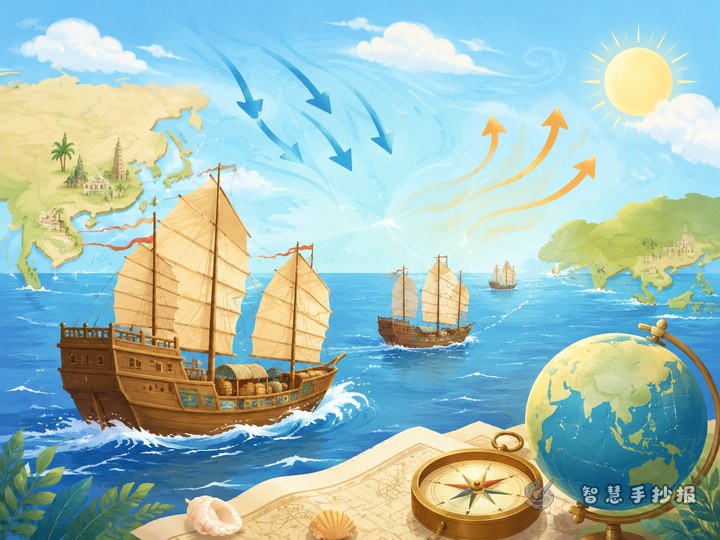
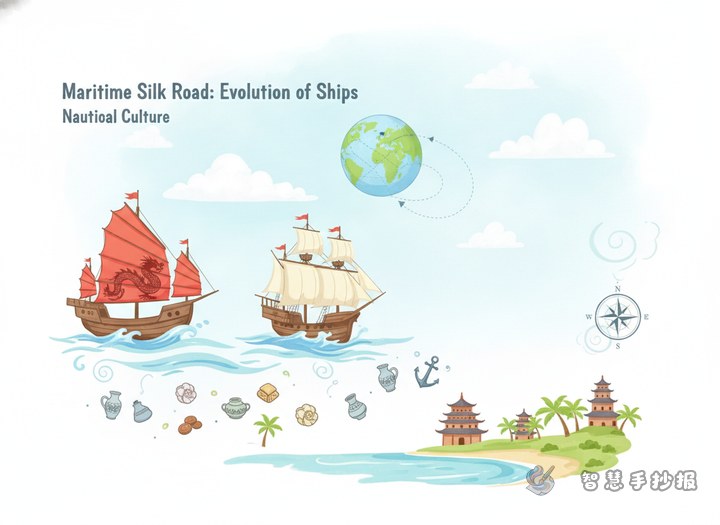
Replace the straight line with a wavy one, and turn the nodes into little boats, compasses or shells, filling spare gaps with waves. This matches the sea theme best, but keep the line thin so it does not bury your words.
The bent route
Let the line turn a few corners like a real route, placing one event at each bend. It suits a poster with more nodes and spreads naturally across the page.
What to Write in Each Node
- Travel: more routes across the sea, merchant ships sailing together.
- Ports: harbour towns grew lively, traders from far away came to exchange goods.
- Technology: the compass was used at sea, shipbuilding skills kept improving.
- Goods: silk and porcelain travelled out, spices and precious stones came back.
Keep every node to one or two lines, with roughly one hundred words across the whole timeline. When you are not sure about a detail, describe the general trend rather than inventing a date.
Sharing the Page With Other Sections
Besides the timeline, a handwritten newspaper needs a title area and one or two text boxes. Use blues for the sea and waves, soft beige or light brown for ship hulls and paper, and a dark tone for headings so the page has a clear focus. A simple arrangement works well: title and a one-line introduction at the top, the timeline across the middle, a small fact box at the side or below, and two or three closing sentences in a corner.
Leave breathing space as well. Keep a little room above and below the timeline, and leave a finger-wide gap between text boxes so nothing looks cramped. If you want the lines, arrows and boxes to line up neatly, you can pick a sea theme layout in the Zhi Hui Shou Chao Bao WeChat mini program, type your node text in, print it out and then trace, colour and decorate by hand.
Quick Check Before You Hand It In
- Does the timeline run in one direction with a single arrow?
- Are the nodes in time order without jumping back and forth?
- Is every caption short instead of a full paragraph?
- Is there clear space between the title, the timeline and the text boxes?