Start with one feeding path readers can follow
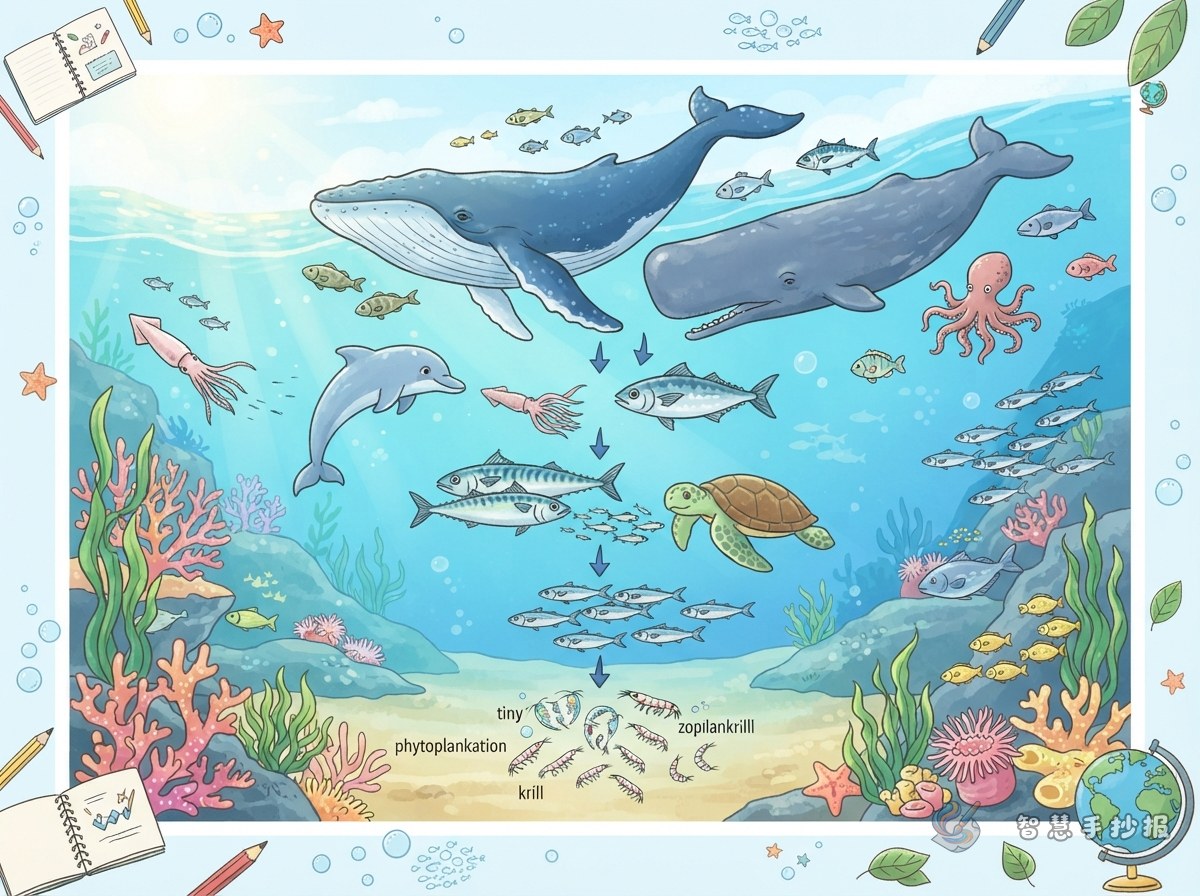
Ocean animals are too varied to describe one by one; the page quickly becomes cluttered. Instead, build the poster around a single energy line: phytoplankton, then zooplankton such as krill, then small fish, mid-size fish, and finally whales or seabirds. Sketch that line on scrap paper first, then decide how many sections the poster needs.
The title can grow out of the same idea, such as "One Energy Line in the Ocean" or "From Tiny Sun-Fed Plants to the Biggest Whales." Once the title is set, every piece of text has a place to go.
Copy-ready profile cards for four ocean layers
Layer one: drifting plants that catch sunlight
Phytoplankton are microscopic algae drifting near the sunlit surface. They make their own food from sunlight and form the starting point of the ocean food chain. A good line to copy: the largest animals in the sea depend on some of the smallest plants.
Layer two: krill and other tiny drifters
Zooplankton and krill feed on phytoplankton and are then eaten by small fish. Krill are transparent, travel in swarms, and are an important food for many whales. Label this layer "the ocean's transfer station."
Layer three: small fish and mid-size hunters
Small fish eat zooplankton and are hunted by larger fish and seabirds. Add a note that small fish are not the end of the chain; they are a link that passes energy along.
Layer four: top predators of the sea
Large fish, sharks, seabirds, and whales sit near the top. Remind readers that baleen whales mainly eat krill rather than large fish, and some sharks feed on plankton too. "Top predator" is a more accurate label than "the strongest animal."
Layout idea: one wave line across the page
Use a landscape page and draw a wave line from left to right. Place the four layers above and below the line, with arrows pointing toward the predator on the right. Divide the page like this:
- Title area: top left, largest lettering, with a simple wave border.
- Energy line area: the center of the page and the backbone of the poster.
- Profile boxes: below the wave line, one sentence per creature.
- Accuracy corner: bottom right, for the facts people often get wrong.
- Action corner: space for concrete ways to protect the ocean.
Keep the palette mostly blue and white, then choose one bright color only for arrows so the reading direction is obvious.
Three facts students often get wrong
- Treating all whales as fish-eaters. Baleen whales filter krill; toothed whales hunt fish and squid. Separate them on the poster.
- Drawing arrows backward. Arrows go from prey to predator, and every arrow should point the same way.
- Writing only "big fish eat small fish." Leave out phytoplankton and the chain loses its starting point and its energy source.
Finish with an action corner, not a slogan
Reserve a small section for "three things I can do," such as using fewer single-use plastic bags, never feeding or chasing wild marine animals, and avoiding coral and shell souvenirs. Specific actions make the poster feel useful rather than preachy.
If you want the wave line, profile boxes, and title area to line up neatly, open the Smart Handwritten Poster mini program in WeChat, choose an ocean-themed layout, and drop your finished text into the sections before adding hand-drawn details.