Turn the Birth of Heaven and Earth into One Clear Scene
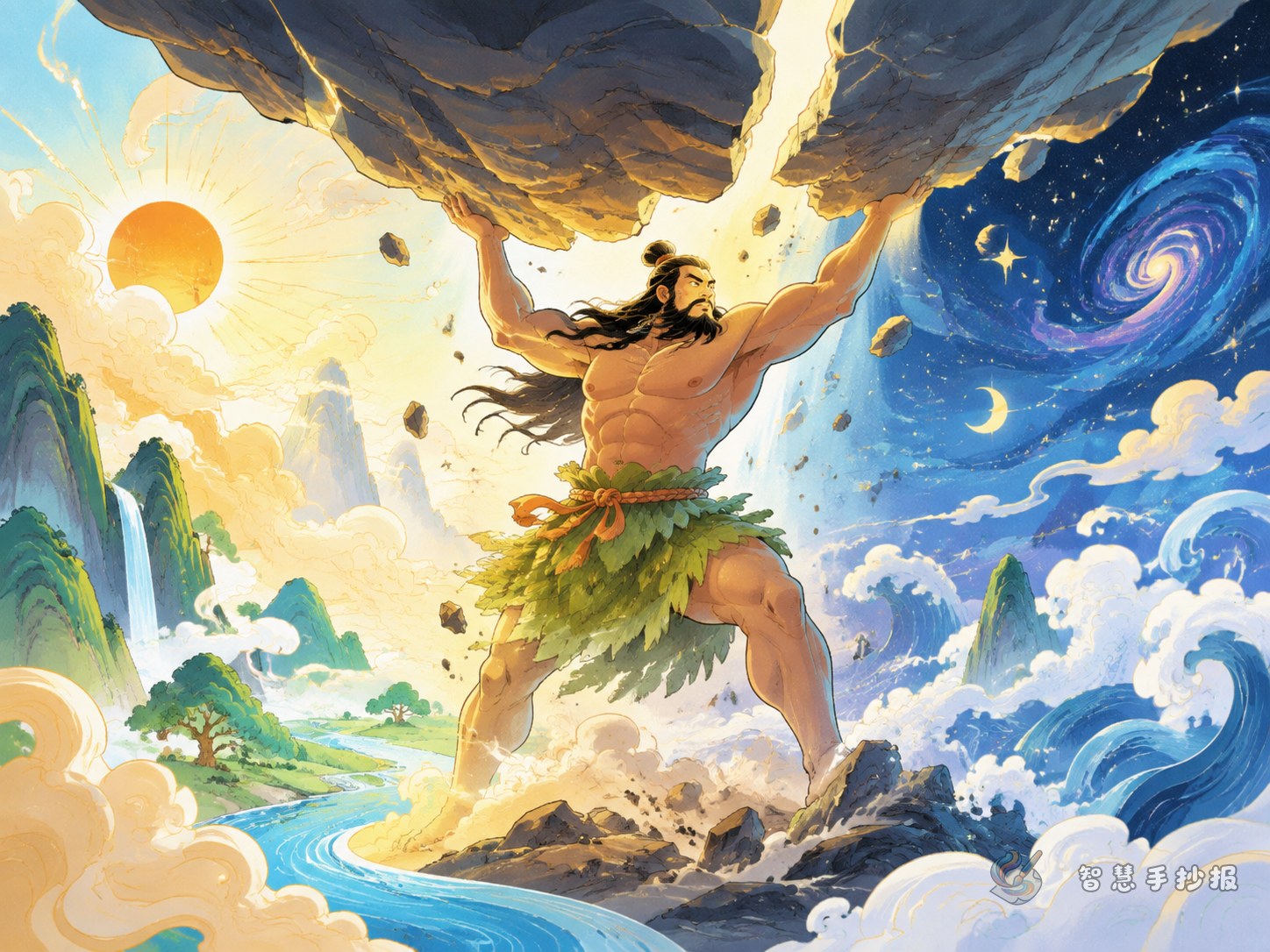
A handwritten newspaper about Pangu Creates the World does not need to fill every corner with drawings. Build the whole design around the visual idea of chaos becoming bright and orderly. Place Pangu standing in the center, with his giant axe splitting the clouds above him. Add stars and the sun in the upper section, then mountains, rivers, trees, and grass below to show how the world is taking shape.
- Upper section: Use deep blue and purple for the original chaos, then add golden light spreading through the sky.
- Center section: Draw Pangu, his axe, and the opening clouds to highlight the key action of the myth.
- Lower section: Use green, blue, and brown for the earth, rivers, mountains, forests, and growing life.
Use Three Short Sections to Tell the Myth
Story summary
In the beginning, heaven and earth were mixed together in darkness, and Pangu slept inside the chaos. When he awoke, he used a giant axe to split it apart. The light and pure part rose to become the sky, while the heavy and cloudy part sank to become the earth. To keep them apart, Pangu grew taller every day until heaven and earth became stable. Summarize this part in five or six sentences and focus on what Pangu did and how the world changed.
Wonderful transformations
You can turn a few imaginative details into small fact cards: Pangu’s breath became wind and clouds, his voice became thunder, his eyes became the sun and moon, and parts of his body became mountains, rivers, and plants. Do not crowd the page with every detail. Choose three or four examples and pair them with small icons so the section stays easy to read.
My reading response
Write about imagination and perseverance. For example, Pangu uses his strength to create space for all living things, which shows how ancient people imagined the origin of the world. It also reminds me to take responsibility and keep going when I face a difficult task. Two or three sentences in your own words will feel more natural than a long copied passage.
Let Axe Lines and Cloud Lines Guide the Layout
For a horizontal page, place the title at the top center and let Pangu extend upward from the middle. Put the story summary on the left, the transformations on the right, and separate the reading response at the bottom with a rolling cloud line. For a vertical page, use the giant axe as a visual line running from top to bottom, creating three levels for the sky, earth, and text sections.
- Lightly sketch the title, main picture, three text areas, and margins with a pencil.
- Set Pangu’s pose and the boundary between heaven and earth before adding details, so the figure does not cover the writing.
- Break long paragraphs into short sentences and place them in circles, cloud shapes, or mountain-shaped boxes.
- Add stars, drifting clouds, rocks, and small trees at the end to create balanced empty space.
Use Color to Create a Mythic Atmosphere
Try a palette that moves from dark chaos to a bright sky and a fresh earth. Golden yellow or orange-red works well for the title because it suggests the light of the axe and new life. Use blue-purple for the sky and green-brown for the ground. Instead of a plain straight border, draw connected clouds, lightning marks, or mountain ridges. Keep these decorations away from the text so the handwriting remains clear.
Check These Four Details Before Finishing
- Is the title easy to notice, and does it clearly identify the Pangu story?
- Does the summary include chaos, the splitting of heaven and earth, and their separation?
- Do the picture, text, and decorations have a clear order instead of filling every space?
- Is the writing neat, with spelling mistakes and color smudges corrected?
Once the idea is ready, continue in the Zhihui Shouchaobao WeChat Mini Program to arrange the sections, adjust the layout, and complete the handwritten newspaper more efficiently.