Build the poster around a rooting journey
The charm of a hydroponic mint project is the visible change from one cutting to a stem with new roots. Instead of filling the poster with plant facts, arrange the story as “cutting the stem, placing it in water, spotting roots, noticing leaf changes, and sharing a discovery.” A clear path helps readers understand the observation at a glance.
Helpful layout idea: draw one curved green arrow across the page and place a date, a tiny sketch, and one observation sentence at each stop. This gives the poster a real sense of progress without using long paragraphs.
Design four observation stations
- Starting point: Draw the mint stem with its leaves and nodes. Add the starting date and explain why you chose this cutting.
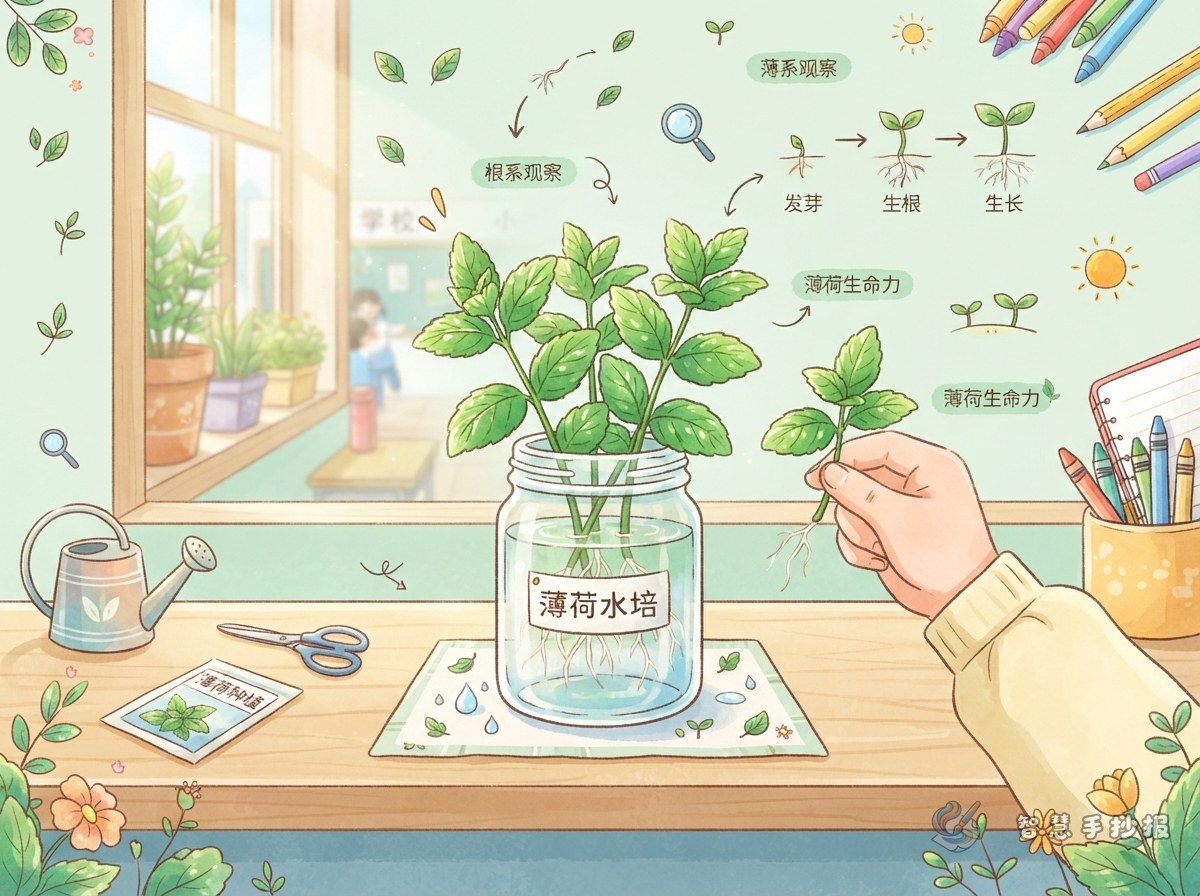
- Water station: Show a transparent cup and a water line. The lower node can touch the water while most leaves stay above it.
- Change station: Use a magnifying circle to show the first root points, fine pale roots, and any new leaf growth. Arrange dated cards in order.
- Discovery station: Write what you noticed about the roots and leaves, as well as how water changes and light affected your care routine.
Text blocks you can adapt
Opening note
My hydroponic experiment: I placed a healthy mint cutting in clean water and checked it from the same position each day. At first it looked like an ordinary stem, but tiny root points eventually appeared. The changes showed me that plants can reveal their growth through small details.
Observation card
Date: ____. What I noticed: Was the stem upright? Were the leaves open and fresh? Did root points appear near a node? What did the roots look like? Care note: Check whether the water is clear and keep the mint in a bright place away from harsh direct sun.
Closing reflection
I learned that recording the process is more interesting than looking only at the final result. Every new root is a clue left by the plant. Careful observation, clean water, and patience help turn a simple cutting into a meaningful poster.
Make the water scene the visual focus
- Place the transparent cup in the center or lower section. Draw the water line, stem, and fine roots, using pale white or yellow to make the roots stand out.
- Use mint leaves around the title and add water drops, date labels, a magnifying glass, and small arrows to reinforce the observation theme.
- Choose mint green, water blue, and warm white as the main colors. Highlight key words in dark green and leave enough empty space around the text.
- Draw leaves in slightly different sizes so the picture suggests change over time instead of looking flat.
Check the details before finishing
- Make sure the title clearly includes both hydroponic mint and rooting observation.
- Put a specific change beside each date instead of using vague phrases such as “it grew.”
- Keep all arrows moving in one direction, from left to right or from top to bottom.
- Add your name, class, and one personal reflection, then check that every sentence is easy to read.
If you want to arrange the observation cards, lettering, and decorations into a finished layout more quickly, open the “智慧手抄报” WeChat mini program and adjust the details with your own real records.