Begin with a Clock That Explains the Idea
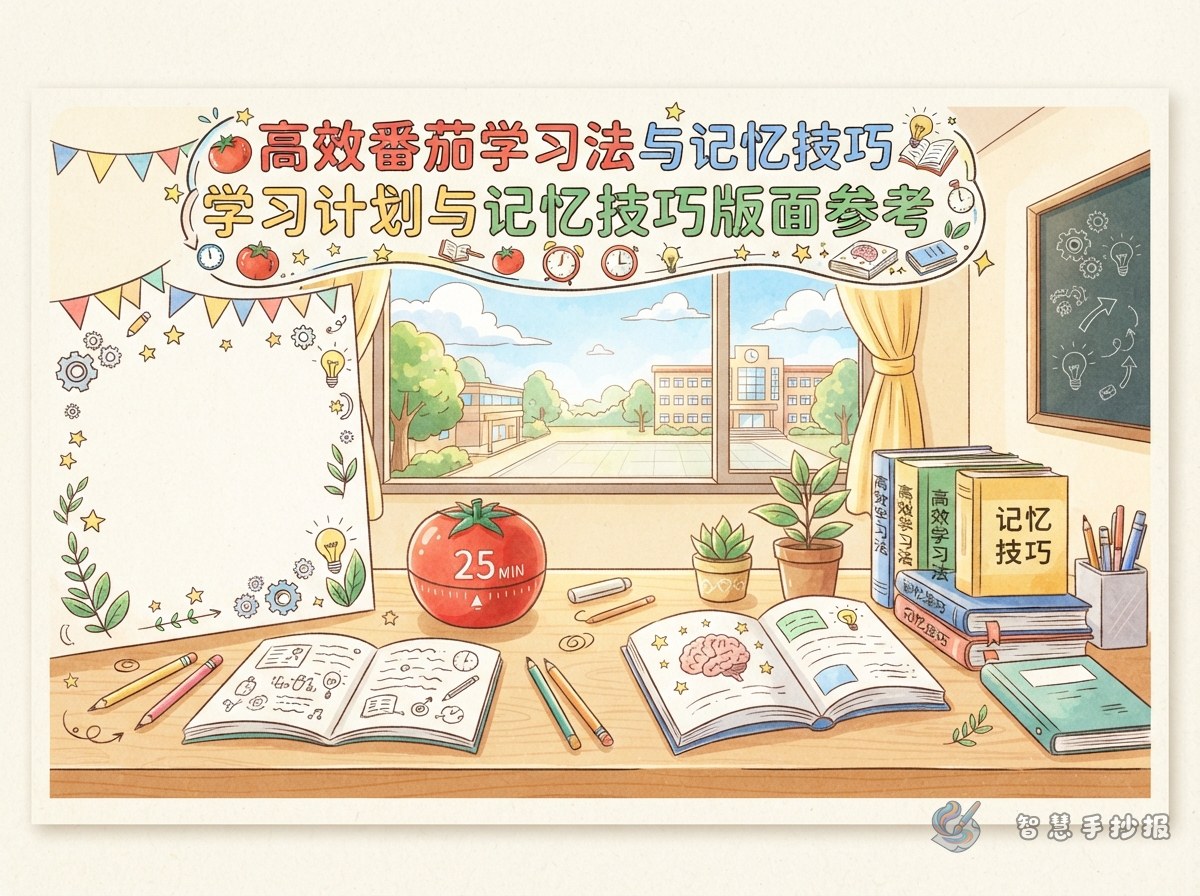
The Pomodoro method divides study time into focused sessions with clear time limits. Place a large tomato or round timer in the center of the handwritten newspaper and write “25 minutes of focus, 5 minutes of rest” inside it. This lets readers understand the theme at a glance. A suitable main title is Make Focus a Habit, with a subtitle such as “Plan well, keep going, and review wisely.”
Under the main illustration, add a short introduction: “Studying does not mean sitting still forever. Learn for a while, take a break, and return with a clear goal.” The sentence is brief enough for a poster and gives the page a friendly tone.
Turn One Pomodoro into a Study Route
Use the left side for a four-step route connected by arrows. This makes the poster practical instead of merely listing definitions:
- Set a small goal: Decide whether to learn ten words, read one lesson, or finish two problems.
- Study with focus: Work for 25 minutes and keep only the needed books and stationery on the desk.
- Take a short break: Stretch, drink water, or look into the distance instead of immediately watching a long video.
- Review and record: Mark what is finished and write down one point that still needs attention.
For younger children, the poster can show a shorter period that feels easier to complete, with a note saying, “Start with a short session and gradually build your focus.” This keeps the message realistic and encouraging.
Keep the Memory Tips Brief and Useful
The right side can hold a “Memory Toolkit.” Give each method one short explanation and leave room for small icons:
- Break it into chunks: Divide a long lesson into several smaller parts.
- Picture the idea: Turn an abstract word into a color, action, or familiar scene.
- Review at intervals: Look back once today, again tomorrow, and check yourself a few days later.
- Explain it aloud: Close the book and describe the key point in your own words.
At the bottom of this section, add a reminder: “Reading something does not always mean remembering it. You truly understand it when you can say it, write it, and use it.” This line connects the poster with real study habits.
Give the Page the Rhythm of a Timer
A useful layout is “large central image, side sections, and an action strip at the bottom.” Put the tomato timer and title in the middle, the four-step study route on the left, and memory tips on the right. At the bottom, draw a “My Focus List” with four fields: study goal, start time, completion check, and next improvement.
Try tomato red, warm white, and deep green. Use red for important numbers and headings, warm white for the background, and green for breaks and completed tasks. Small tomatoes, clock hands, stars, and books can decorate the borders. Leave enough open space so the writing stays easy to read.
Check the Poster Before You Finish
First look at the page from a distance and make sure the title is the largest element and the central illustration is easy to notice. Then check whether the text is too long, the steps connect clearly, and the important colors are used consistently. Make the focus time, break time, and action list easy to read.
A parent or teacher can ask the child to explain the poster in one minute: What will I study? How will I time it? What will I do during the break? How will I review? If the child can answer, the poster has become a useful study tool rather than decoration.
To organize the sections, adjust the title, or refine the sketch more quickly, continue in the 智慧手抄报 WeChat mini program and replace the sample text and colors with your own study plan.