Choose a clear idea: turn the moving night sky into a visual story
A The Starry Night handwritten poster should do more than copy the painting. A stronger idea is to explore how Van Gogh used lines and colors to express feelings. You can use the theme “Finding imagination in the night” and connect the artwork facts, the artist’s story, and your own response.
- Learn about the painting: introduce its year, main elements, and visual features.
- Learn about the artist: briefly describe Van Gogh’s love of painting and his dedication to creating art.
- Share a response: write what you feel when looking at the swirling sky, bright stars, moon, and quiet village.
A small artwork profile you can place on the poster
Basic facts
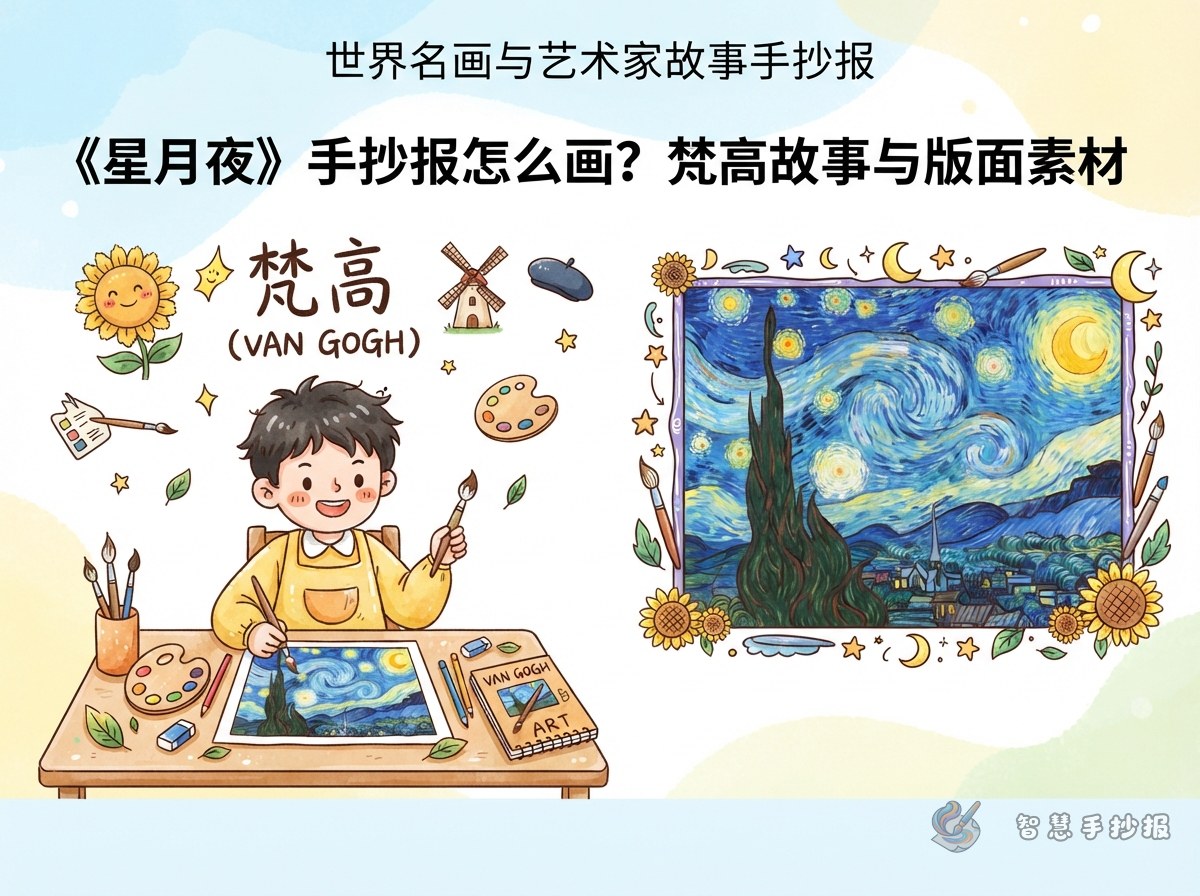
Title: The Starry Night; Artist: Vincent van Gogh; Year: 1889; Scene: Swirling cloud patterns and bright stars and moon fill a deep blue sky, while a tall cypress tree stands in front of a quiet village.
Van Gogh’s artistic story
Van Gogh loved painting and often used vivid colors and energetic brushstrokes to show the world as he experienced it. He painted The Starry Night in 1889 while staying in Saint-Rémy, France. The work began with a view outside his window but also includes an imaginative sky and moon, showing that an artist can paint inner feelings as well as visible scenery.
Three ways to look at the painting
- Study the sky: curved, swirling lines make the night seem alive and full of movement.
- Study the colors: deep blue and bright yellow create contrast and make the stars and moon stand out.
- Study the composition: the tall cypress, distant village, and wide sky create a sense of depth.
Design a layout that moves like the night sky
Try a text-on-the-left, picture-on-the-right layout with a strong focal point. Place a simplified detail of The Starry Night in the center or on the right, then put the artwork profile and Van Gogh’s story on the left. Add a section called “My Starry Night” along the bottom. A curved title can echo the motion of the sky, but the letters must remain easy to read.
- Title area: Use large yellow or white lettering against deep blue to highlight The Starry Night.
- Artwork section: Use three small circles or boxes for lines, colors, and composition.
- Artist section: Add simple decorations such as a paintbrush, palette, or small stars.
- Reflection section: Leave a light-colored space for two or three sentences about your response.
A steady color plan and drawing order
- Use a pencil to mark the border, title, and sections first so the sky illustration does not crowd the writing.
- Use deep blue, indigo, or blue-purple for the sky, yellow for the stars and moon, and dark green for the cypress.
- Use short curved strokes to suggest clouds and wind, varying the thickness instead of making every line identical.
- Add white or pale yellow star points at the end, then check that the body text has enough spacing.
Do not cover large areas of text with decoration or squeeze the entire painting onto the page. Choose one detail as the visual focus and explain the artwork in your own words. This will make the poster feel thoughtful rather than crowded.
What can you write at the end?
You could write: I like the swirling lines in The Starry Night because they give energy to a quiet night. Van Gogh reminds me that when we look at the world, we can not only observe what we see but also use imagination and color to express how we feel.
If you need help arranging sections, choosing colors, or leaving enough writing space, continue creating in the WeChat mini program from 智慧手抄报 and turn this Van Gogh project into a complete poster.