Start with one idea: water is the main character
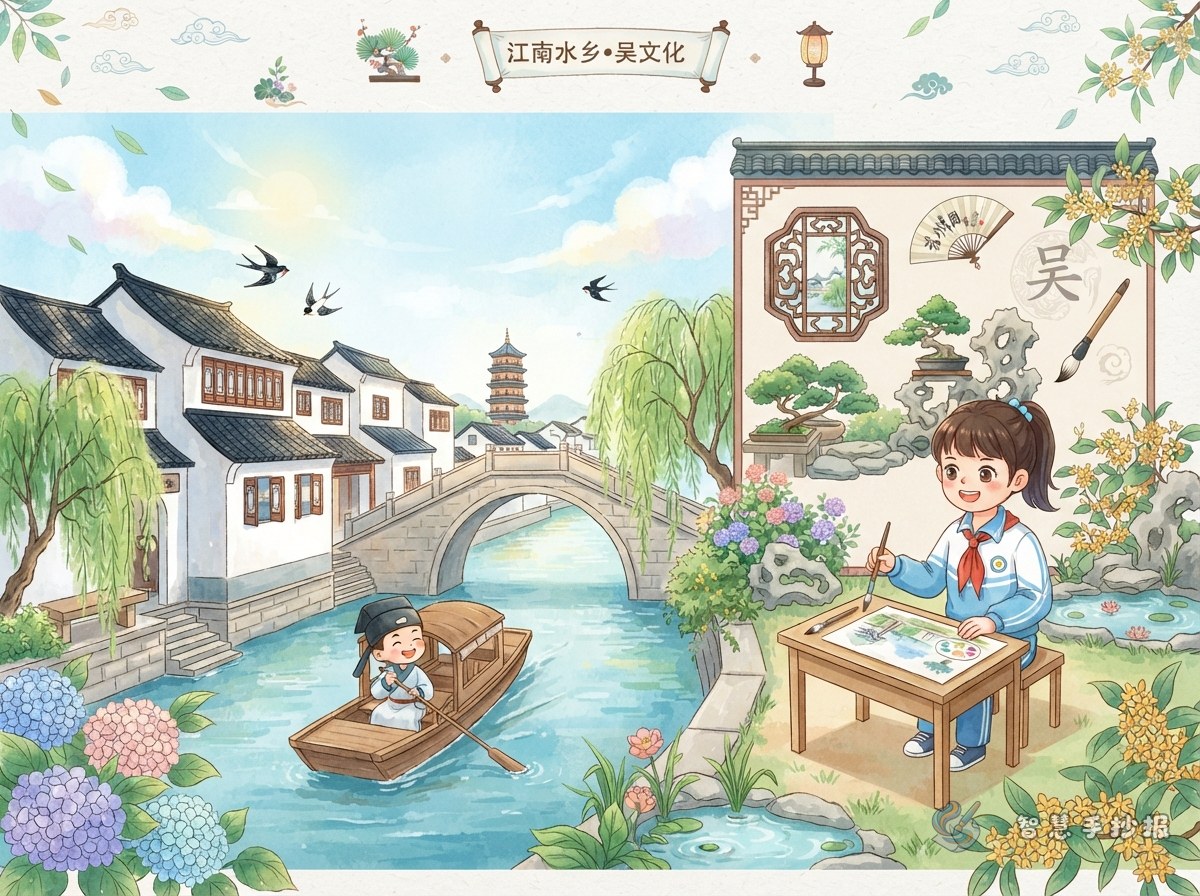
Many students draw a row of houses and stop there, and the page ends up looking like any other city. Suzhou is different. Its old town grew along canals, so water lanes, stone bridges and white walls with dark roofs instantly read as Jiangnan. Before drawing anything, decide that a winding canal will run through the middle of your page and arrange everything else around it.
Designing a title banner that feels like Gusu
Title ideas
- Gusu: A City of Canals
- Bridges, Boats and White Walls
- Half a City of Water, Half a City of Bridges
- Walking Through 2,500 Years of Suzhou
Subtitles and small decorations
A subtitle such as "Jiangnan Water Town and Wu Culture" works well. Instead of a busy border, draw a short wavy line for the river and two or three tiny arched bridges near the title. It is simpler and much closer to the theme.
Four column blocks that fit on one sheet
- Old city file: Suzhou was laid out very early, and in the Spring and Autumn period Wu Zixu directed the building of the city of Helü. Its location and street pattern have lasted for a very long time.
- Canals and bridges: Streets and waterways run side by side, so people once lived right on the water and travelled by small rowing boats.
- Clever garden design: Suzhou gardens use lattice windows, borrowed views and rockeries to make a small courtyard feel layered. Several of them are listed as World Cultural Heritage sites.
- Wu culture and local crafts: Kunqu opera, Su embroidery, Taohuawu woodblock prints, Shantang Street and the Grand Canal section through Suzhou all add human interest.
Short facts you can copy straight onto the page
- Wu Zixu surveyed the land and water before building the city of Helü, giving Suzhou a history of more than two thousand years.
- When Bai Juyi served as governor of Suzhou in the Tang dynasty, he had the Shantang canal dug, and the street grew along the water.
- Suzhou gardens are not about size but about skill: one lattice window frames a picture, one covered walkway changes the view.
- Kunqu opera has a gentle, flowing singing style, and Su embroidery is known for its fine, dense stitching.
- The Grand Canal passes by Suzhou, linking this water town with places far to the north and south.
Colors and drawing: three strokes make a water lane
Leave the paper mostly white. Use pale blue or soft teal for the water, grey and dark green for roofs, and add a little red on lanterns, doors or the title. One canal, two bridges and three rows of houses are enough for the main picture.
- Arched bridge: one curve plus two short vertical lines, with a few ripples under the arch.
- House: a square, a slanted roof line, and one or two small square windows.
- Lattice window: a circle or polygon with a few crossed lines inside.
- Boat: a crescent shape with a short line as an oar. No people needed.
Making order and quick fixes
- Draw the border lightly in pencil, then sketch one winding canal across the lower middle of the page.
- Place the title and four text blocks along both sides. Keep them different sizes so the page does not look like a grid.
- Write the headings and text first, then add bridges, houses and boats.
- Check three things: does the canal stay unbroken by text, is any block too crowded, and are you using more than four colors?
If you want to save time, open the Smart Handwritten Newspaper mini program in WeChat, choose a Suzhou ancient city layout, and type in the sentences you prepared. It is much faster than ruling every line by hand.