Begin with a Question About Black Holes
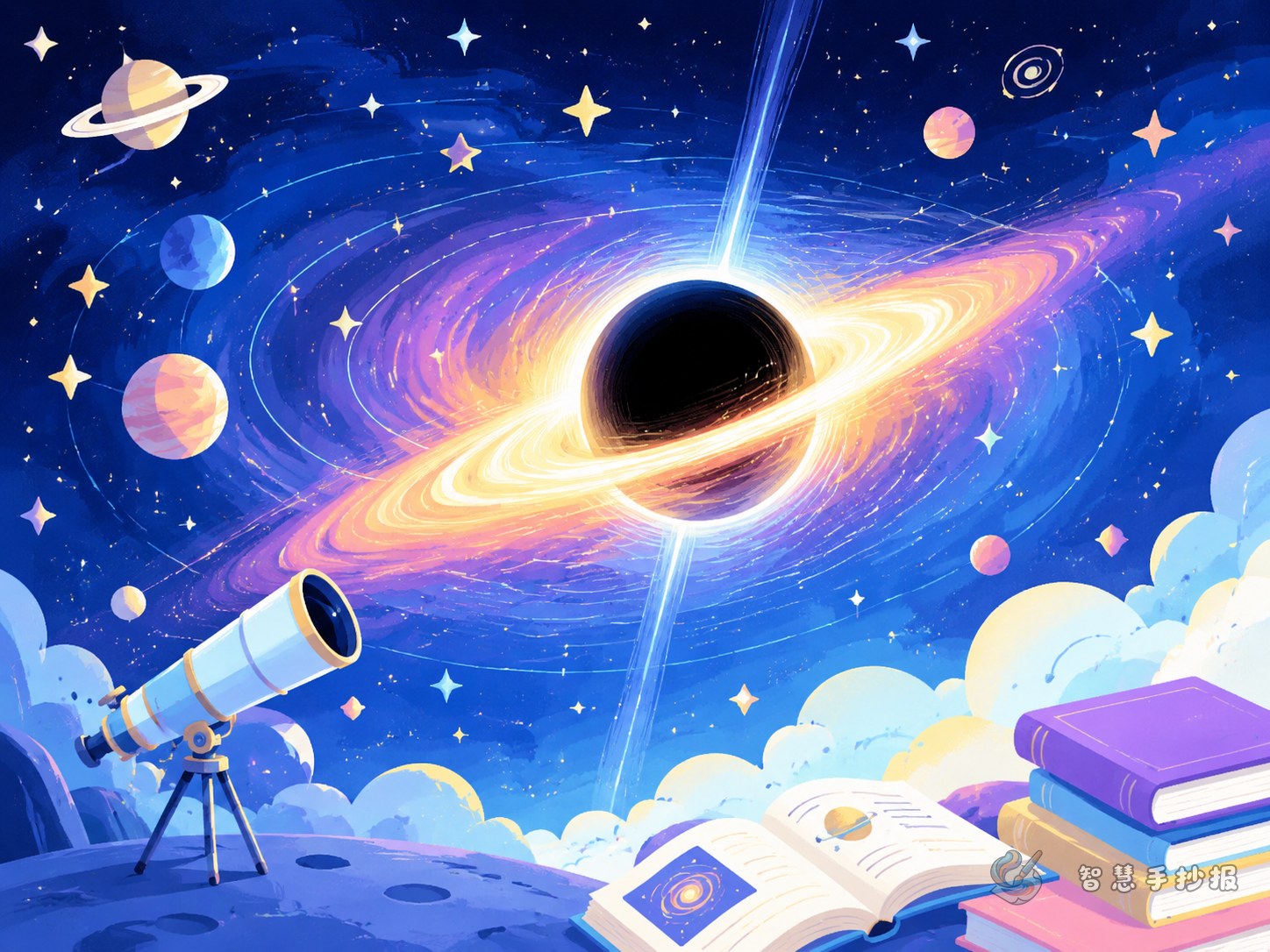
Open the poster with the question, “Is a black hole really a hole?” A black hole is not an empty opening in space. It is an object with extremely strong gravity. Around it is an imaginary boundary called the event horizon. Once matter crosses this boundary, it cannot easily escape.
Show the Main Ideas in Three Layers
A simple outside-to-inside diagram can make the topic easier to understand. Add arrows and keep each label short.
- Accretion disk: Gas and dust spinning around a black hole may become very bright as they heat up.
- Event horizon: The boundary beyond which even light cannot return.
- Central region: Label this as an area scientists are still studying instead of drawing it as an ordinary solid ball.
Use a dark circle for the black hole and curved white, yellow, or orange bands for the accretion disk. Add a note explaining that the picture is a scientific illustration rather than a direct view.
Tell the Story of How One Can Form
Create a four-panel sequence for a stellar-mass black hole: a massive star forms, produces light and energy, runs low on fuel, and undergoes core collapse that may create a black hole. Include a note that black holes have different masses and origins, so they do not all form through exactly the same process.
Short Facts for a Knowledge Box
- A black hole does not pull in the entire universe like a vacuum cleaner.
- Objects at a sufficient distance can orbit a black hole.
- Scientists look at nearby motion and radiation to find evidence of black holes.
- A black hole does not release light from inside its event horizon, but nearby matter can shine brightly.
Build a Trail of Observational Clues
Across the center of the page, draw a discovery trail with a telescope, an orbiting star, a glowing accretion disk, and a final conclusion based on the clues. Place a question box beside it asking, “If we cannot see a black hole directly, how do we know it is there?” This gives the information a clear narrative.
Keep the Dark Space Design Readable
Use three vertical or horizontal sections. Reserve about one fifth of the top for the title, place the main black hole diagram in the center, and use the side areas for formation, detection, and quick questions. Keep most text panels white or pale while using navy and black only for selected background areas. White title letters with orange outlines can stand out, and small stars should stay near the edges instead of crowding the writing.
After preparing the facts and pencil sketch, scan the code to open the WeChat Mini Program, choose a black hole layout, adjust the sections, and continue making the handwritten poster.