Choose One Star Dish Before You Start
Many students begin a hometown food project by listing every snack in town. The page ends up looking like a menu and feeling cold. A better plan is to pick one dish with a story — a braised dish your grandmother always makes, a bowl of tofu pudding from the corner shop, or a rice cake steamed only for the new year — and let every column on the page grow out of that one dish.
Ask yourself three questions while choosing:
- How many times a year do I actually eat this?
- Who usually makes it, and on what occasion does it appear?
- What is the first picture that comes to mind when I think of it?
The dish you can answer all three for is the right one for your page.
Turn “Delicious” Into Five Senses
Writing “it is really delicious” tells the reader nothing. Split the dish into colour, smell, shape, sound and feeling, then write one or two sentences for each direction. The paragraph fills itself.
Colour and shape: let the eyes eat first
Describe what it looks like: “the surface shines when it comes out of the pan, with slightly browned edges”, or “the soup is milky white with a few chopped spring onions floating on top”. These lines create a picture far better than a pile of adjectives.
Smell and taste: show the change
For smell, try “I could smell it before I even reached the door”. For taste, try “the first bite is a little salty, then it turns sweet as you chew”. Showing the change makes readers feel the food is really in their mouth.
Sound and feeling: keep the kitchen noises
The sizzle in the wok, the thud of the chopping board, someone calling “dinner is ready” — these sounds bring the page to life. Add one small moment with your family and the whole piece becomes warm.
Four Small Columns That Fit Any Layout
- Taste profile: the dish's name, main ingredients and the season it belongs to, in three or four lines.
- One line of praise: a local saying or family phrase, such as “this one bite beats everything”.
- One memory: a single scene — who made it, where you ate it, what the weather was like.
- Draw it yourself: a small box with a simple sketch of the bowl, plate or steamer, plus one caption line.
Four columns are plenty. More than that and the page starts to look crowded.
Layout Ideas That Make Steam Rise Off the Page
Divide the paper into three areas: a title area at the top, a main text area in the middle, and small columns along the sides or at the bottom.
- Write the big title in the top area and add a wavy line or a curl of steam underneath as decoration.
- Split the main text area with straight lines, leaving room for one short article and two small columns.
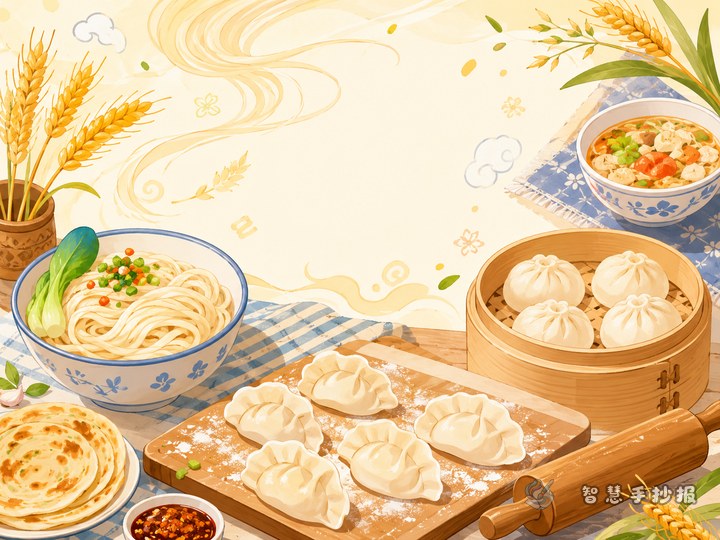
- Use simple shapes as borders: chopsticks, the rim of a bowl, steamer grids or a string of chillies. They are quick to draw and look good.
- Keep to three colours or fewer, mostly warm tones, and leave a little white space so the page can breathe.
Placing the columns on a phone screen first saves a lot of erasing later.
Sentences You Can Copy Right Away
Opening: “My hometown is not big, but it has one flavour I can never forget.”
Description: “As soon as the lid lifted, white steam poured out and the smell drifted all the way to the gate.”
Closing: “One day I may live far away, but the moment I smell this, I will know where home is.”
Rewrite these lines in your own local way and they will sound much more real. For more column styles and layout references, open 智慧手抄报 in the WeChat mini program, arrange the columns, and then copy the plan onto paper.