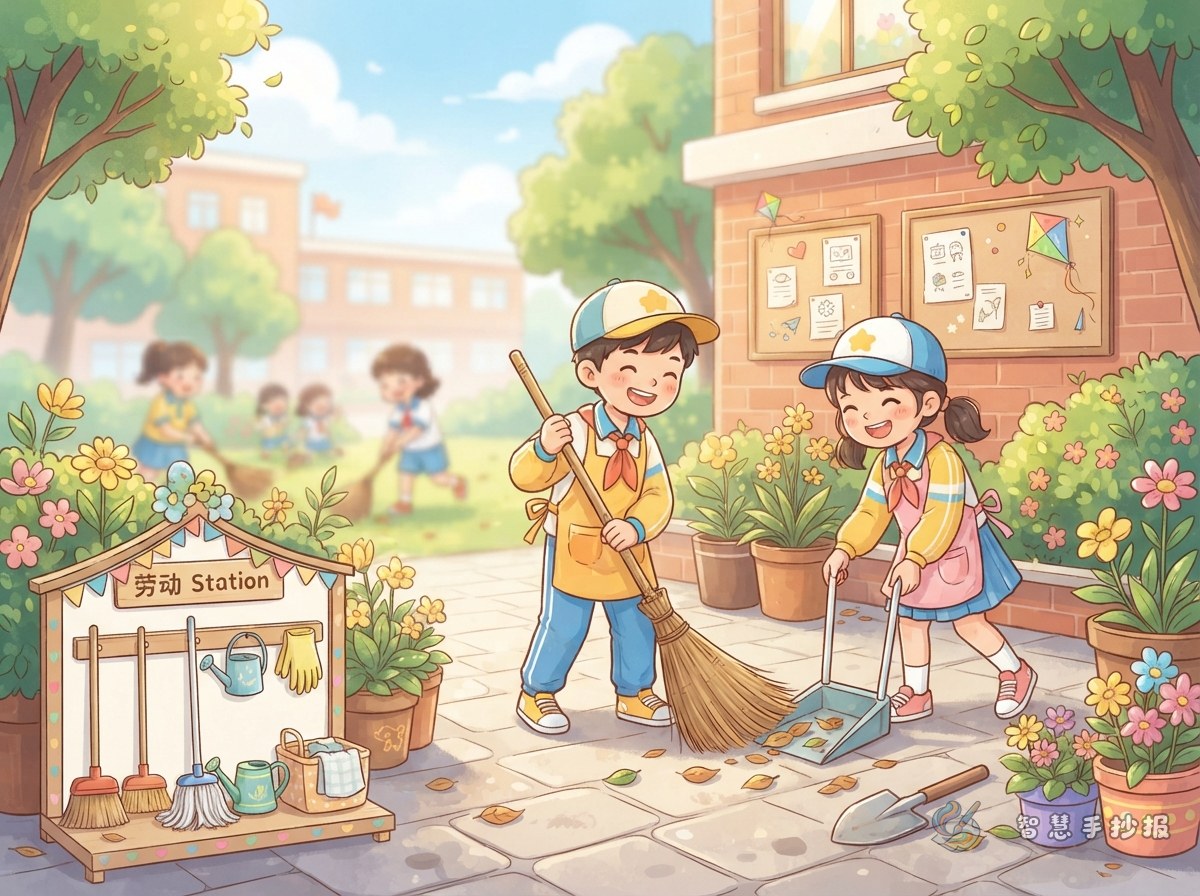
Start with One Tool and One Labor Story
A labor tools observation handwritten newspaper does not need to introduce many careers at once. Choose one familiar tool as the main character, such as a broom, cloth, shovel, screwdriver, or gardening shears. Then follow the questions “What does it look like? What is it used for? How should it be handled? Who often uses it?” This connects everyday work with early career awareness.
If you choose a broom, draw a school cleaning scene or a tidy room in the center. You can then introduce cleaners, property service workers, or gardening staff. The page will show real-life observation instead of becoming a simple list of job names.
Create a Small Tool Profile
Add a “Tool Profile” section with short, clear facts. Keep each point brief so readers can understand it at a glance.
- Tool name: Write its common name and add a simple illustration.
- Main purpose: Explain whether it is used for sweeping, organizing, digging, repairing, or carrying.
- How to use it: Describe the grip, direction, or order of use in one or two sentences.
- Where it is used: Connect it with a classroom, home, school garden, or small flower bed.
- Related careers: Name workers who use this kind of tool and explain the responsibility they carry.
Short Text You Can Adapt
The tool speaks: “I may be a small tool, but I can make work safer and more effective when I am used correctly.”
What I learned: “An ordinary tool can help workers complete important tasks. Respecting tools is also a way to respect every kind of work.”
Make Safety Part of the Picture
Career awareness is not only about knowing job titles. It also means understanding why workers need to be careful, responsible, and willing to follow rules. Add a “Safety Helper” section with small drawings of wearing gloves, keeping tools clean, and returning them after use.
- Check whether the tool is in good condition before using it.
- Keep a safe posture and never chase others or wave tools around.
- Clean the tool after work and return it to its proper place.
- Ask a teacher or parent for guidance before using an unfamiliar or risky tool.
These ideas are easy for children to understand and show the responsibility found in cleaning, repair, gardening, and other jobs.
Make the Tool the Visual Center
Try a “large tool in the middle, four sections around it” layout. Put the enlarged main tool in the center, the tool profile in the upper left, safety tips in the upper right, related careers in the lower left, and “My Labor Action” in the lower right. Use arrows to point out details such as the handle, bristles, blade, or wheels.
For a more playful design, draw different tools as a “labor tool path.” Let the broom lead to cleaning work, the shovel lead to gardening, and the screwdriver lead to repair work. Bright blue, green, and orange can make the page lively. Use a large title and keep each paragraph to two or three lines for easy reading.
End with a Personal Observation
Leave space for a section called “What I Discovered” or “What I Will Do.” Write about a small experience from housework, classroom duty, or school activities. For example: “I used to think sweeping was easy, but after trying it, I learned to clean the corners first and gather the rubbish carefully.” A real observation gives the page more feeling than a general slogan.
After finishing the text and sketch, you can continue arranging the layout, sections, and colors in the 智慧手抄报 WeChat mini program. Add details from your own labor experience so the finished page combines career awareness with a personal point of view.