Begin with One Big Idea: How a Capital Became an Ordered City
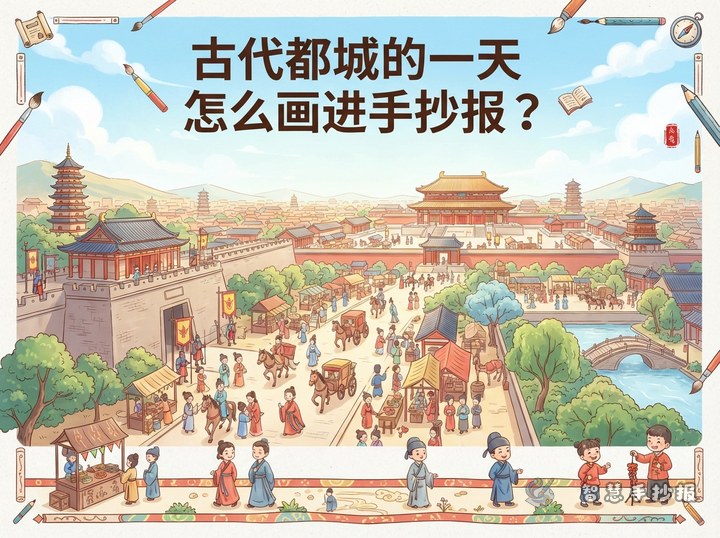
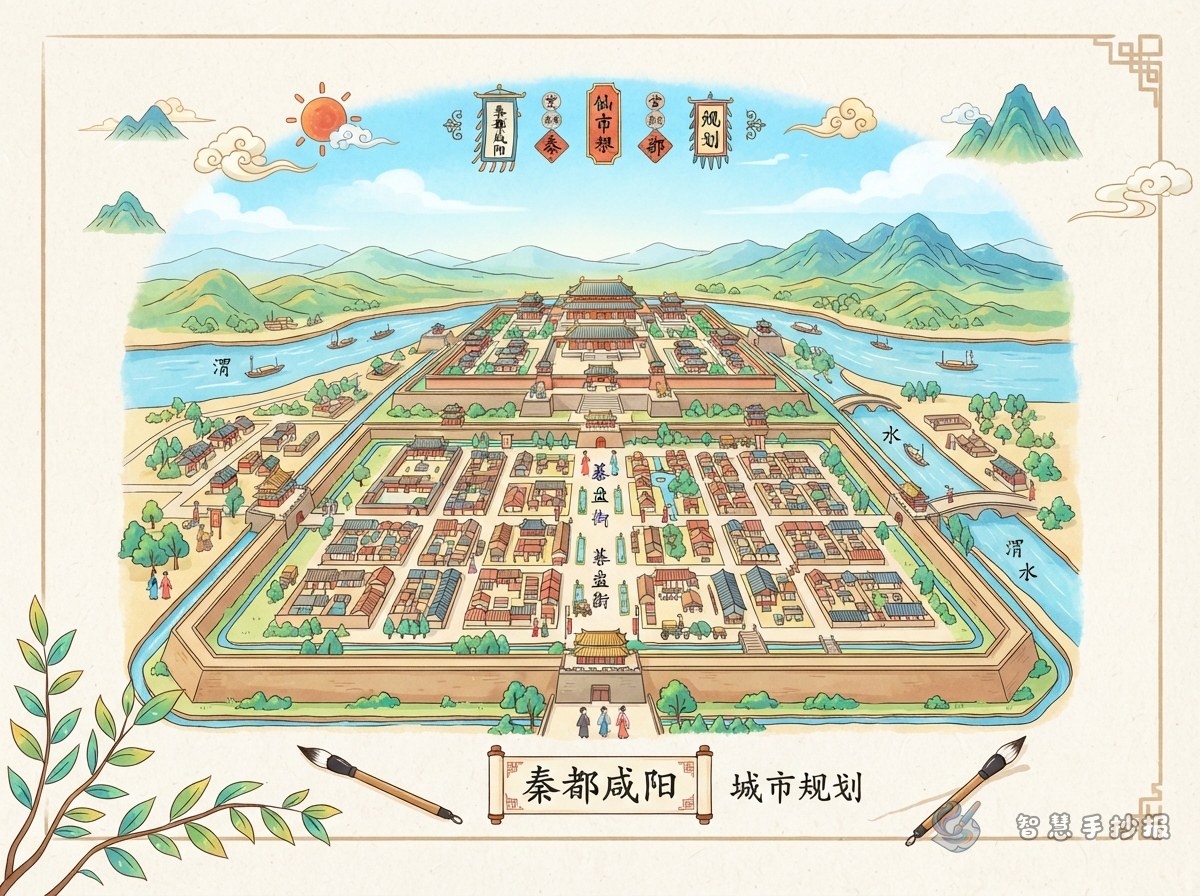
A handwritten newspaper about Qin Xianyang does not need to focus only on palace buildings. Build it around the question of how an ancient city arranged its spaces and daily activities. Xianyang was the capital of Qin, and after Qin Shi Huang unified the six states, it continued to serve as the capital of the unified dynasty. Placing palaces, roads, gates, waterways, and people in one picture can clearly show the organization of the city.
Under the title, add a short introduction: Qin Xianyang was not only a political center, but also an ancient city connected by palaces, roads, waterways, and everyday life.
Four Groups of Materials for Building the City
- Capital background: Explain Xianyang’s role as the capital of Qin and its importance after the unification of the six states.
- Urban spaces: Use palace areas, roads, city gates, and activity areas to show how different functions could be arranged. There is no need to recreate an exact ancient map.
- Natural setting: Draw the Wei River as a blue curve, then add trees, distant hills, or fields to show the connection between the city and its surroundings.
- Civilization details: Include carts, travelers, gate guards, craftspeople, or people writing on bamboo slips. These details make the city feel human rather than turning it into a collection of buildings.
Use the Wei River and Roads as the Layout Framework
A horizontal composition works well. Place the title at the top and draw a gentle curve for the Wei River through the center, dividing the picture into several areas. Put palaces and a city gate on the left, roads, carts, and daily activities on the right, and add a small “City Civilization Notes” section at the bottom.
For more depth, outline the palace buildings in a darker color, use light blue for the river, ochre for walls and roads, and a small amount of vermilion for the title, banners, or seals. Simple eaves, steps, and gateways are enough. The goal is to show each function clearly rather than fill the page with architectural details.
Four Short Sections with Complete Information
- Xianyang at a glance: Qin Xianyang was the capital of Qin. After Qin Shi Huang unified the six states, it became an important political center of the unified dynasty.
- How was the city arranged? Palaces represented the political center, roads connected different areas, gates controlled entry and exit, and the river provided a natural background.
- What can we learn from the city? A city needs more than grand buildings. It also needs roads, order, production, and the shared lives of its people.
- A question to think about: If you designed an ancient city, where would you place a school, market, road, or water source? Why?
Place these sections in the corners or sidebars of the page. Keep each one to two or three sentences so the page remains easy to read and leaves room for illustrations.
Three Finishing Tips
- Make the title stand out: Try “Qin Xianyang: An Ordered Ancient City” in large decorative lettering.
- Let pictures explain the text: Add small labels beside the road, palace, and Wei River so readers can understand each element at a glance.
- Leave breathing space: Do not fill every empty area. Light backgrounds between groups of buildings will make the page cleaner.
First sketch the title and main illustration, then outline and color them, and finally add the section text and borders. When you need more layout ideas or handwritten newspaper materials, you can continue making the project in the WeChat mini program “Smart Handwritten Newspaper.”