Build the Story Around an Ancient Capital
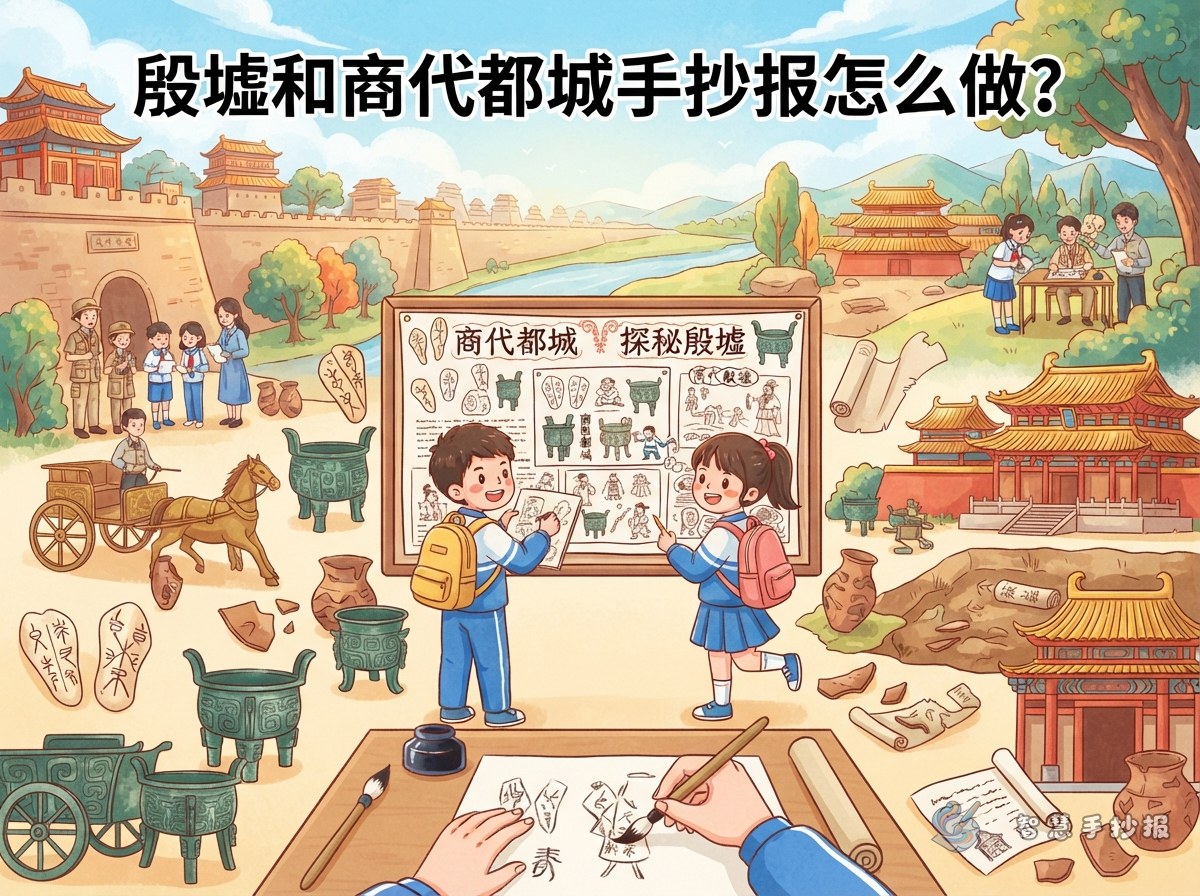
Instead of filling the page with disconnected facts, guide readers through four steps: discovering the ruins, reading oracle bone inscriptions, exploring city zones, and understanding Shang civilization. A gate silhouette, an oracle bone fragment, or a simple bronze pattern near the title will make the subject clear at first glance.
Four Sections That Bring Yinxu to Life
Where Was the Capital?
Yinxu is located in present-day Anyang, Henan. It contains important remains from a late Shang capital. Palace and ancestral temple areas, royal tombs, craft workshops, and traces of roads help us imagine how the city was organized.
Messages on Oracle Bones
Oracle bone inscriptions were carved on turtle shells and animal bones. They preserve valuable evidence about Shang society and the early development of Chinese writing. Add a small matching activity that pairs several ancient character forms with their modern meanings.
Work and Life in the City
The capital included ceremonial spaces as well as areas for bronze casting, bone working, and other crafts. Showing these different functions helps explain that an ancient capital was a complex city rather than a single palace.
Civilization Through Objects
Bronze vessels, jade objects, pottery, and bone tools reveal aspects of craftsmanship and daily life. Choose two or three examples and explain their use, shape, or decoration instead of listing many artifact names.
Short Texts Ready for the Newspaper
- Opening: Visiting Yinxu is like opening an archive of the Shang capital hidden beneath the ground. Ruins, writing, and artifacts tell its story together.
- Fact card: Oracle bone inscriptions are important sources for studying Shang history and the long development of Chinese characters.
- City observation: Palaces, ancestral temples, royal tombs, and workshops occupied different areas, showing an organized use of urban space.
- Closing thought: Protecting ancient capital sites preserves valuable clues to the origins and growth of Chinese civilization.
Turn the Layout into a Capital-City Discovery Map
Use either three horizontal columns or a central map with sections radiating outward. Place a simplified site sketch in the middle, then add panels such as “Oracle Bones Speak,” “Shang Crafts,” “Spaces in the Capital,” and “Archaeology Notes.” Simplified bronze motifs or crack-like lines can frame the page, but decoration should never crowd the text.
- Mark the title, illustration, and text areas lightly in pencil.
- Use ochre, reddish brown, and bronze green to create an archaeological atmosphere.
- Keep paragraphs short and separate them with headings, boxes, or color blocks.
- Check names, spelling, spacing, and historical accuracy before erasing guide lines.
Add a Small Interactive Challenge
Create a “Read an Ancient Character” box or invite readers to act as junior archaeologists. They can match simple forms for the sun, moon, or mountain with modern characters. After selecting the material, scan the code to open the Zhihui Handwritten Newspaper WeChat mini program and continue refining the sections, colors, and layout.