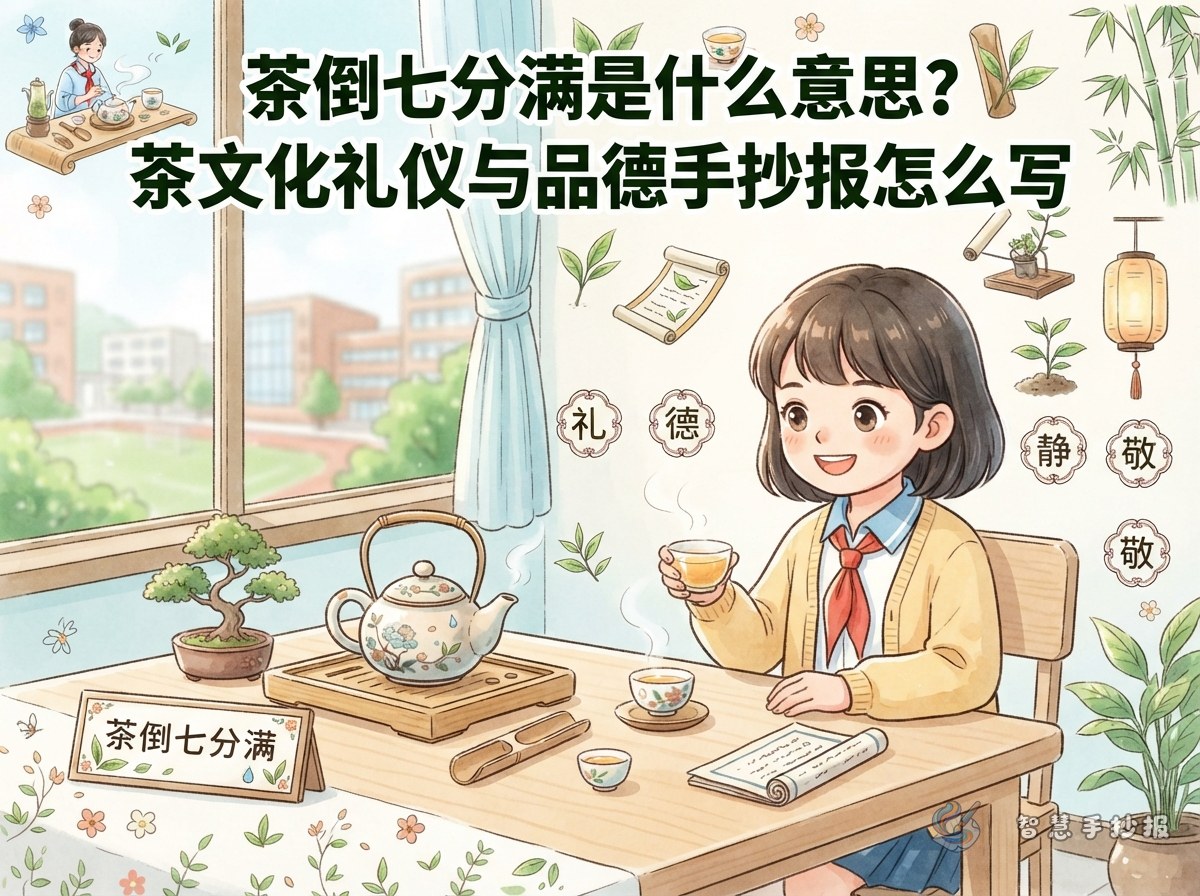
Why "Seven-Tenths Full" Deserves Its Own Page
When students search for tea culture material, they often find big words like harmony and respect, which are hard to write about in a concrete way. A single visible detail works better: pour only seven-tenths of the cup. The empty space keeps the cup cool to hold and hard to spill, and it stands for a sense of measure toward others.
That naturally connects the theme to character: politeness is not only spoken, it shows in your hands and in the cup. A good subtitle is "Seven-Tenths Full, Three-Tenths Kindness."
A Simple Four-Block Layout
- Meaning block: explain what "seven-tenths" means in two or three sentences, with a small drawing of a cup marked at the seven-tenths line.
- Action block: list serving actions, one short line each, like a checklist.
- Language block: collect polite phrases from the tea table.
- Story block: write how an elder at home pours tea and who gets served first.
The blocks do not need to be equal. Put the meaning block at the upper left as the theme area, make the action block a tall strip, frame the language block in a small box, and let the story close the lower right corner.
Details and Polite Phrases You Can Copy Onto the Page
Serving actions
- Pour only seven-tenths, leaving space so the cup is steady.
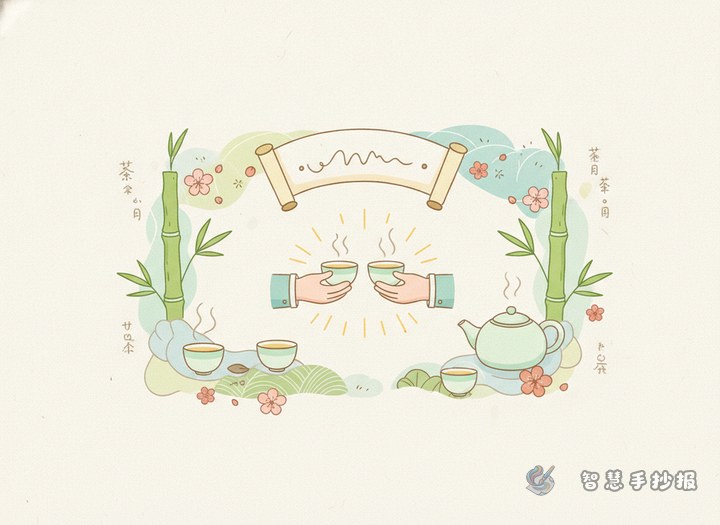
- Offer the cup with both hands, handle facing the guest.
- Serve guests and elders before family, and elders before younger people.
- When refilling, give a light signal instead of interrupting.
Kind words at the tea table
- "Please have some tea."
- "Thank you, I can help myself."
- "Would you like another cup?"
- "After you, please."
These lines are short, but they show what politeness looks like in practice. Add a tiny teacup symbol after each one to keep the page lively.
Using Sayings and Stories Without Sounding Like a Copy Machine
Do not pile up sayings. Two or three are enough, each followed by one sentence of your own understanding.
- "Fullness invites loss; humility brings gain." A full cup spills, and a person who is too full of themselves cannot listen.
- "A full cup of wine honors; a full cup of tea offends." With tea you leave room, and that is what thoughtfulness looks like.
- "Serve tea when a guest arrives." One cup is a warm welcome.
For stories, choose something you have seen: a grandmother asking whether a guest prefers stronger or lighter tea, or the moment you handed the first cup to someone at home. Real details are more convincing than copied tales.
Colors, Drawings, and the Order to Work In
- Sketch the border and four blocks lightly in pencil, then decide the title size.
- Write the title in dark green or dark brown, keep the body text in black, and avoid coloring every word.
- Limit colors to three: off-white paper, tea green, and ochre or pale yellow. Leave plenty of white space.
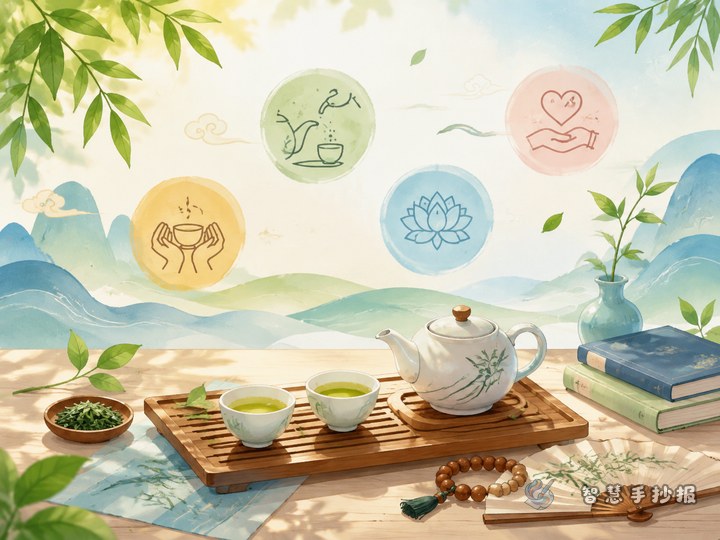
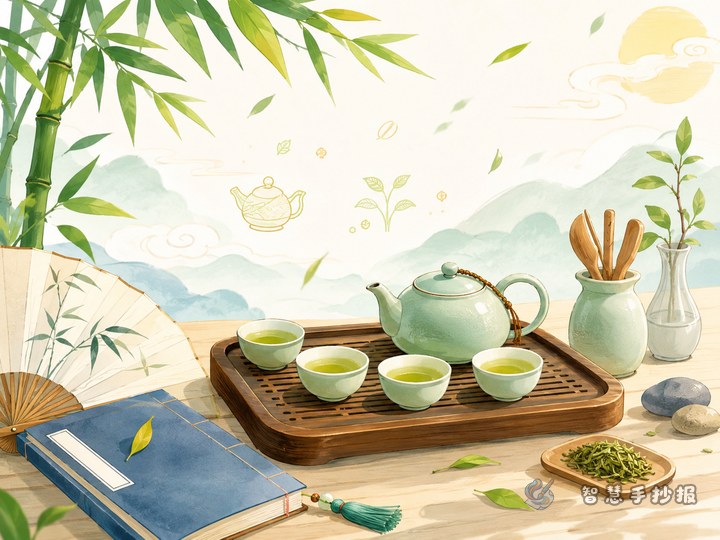
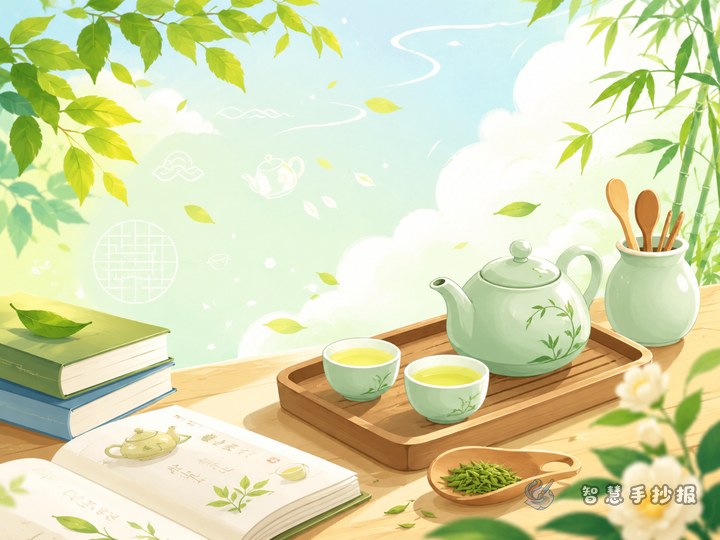
- Draw only a teapot, a cup, a few tea leaves, and a simple tablecloth border in the corners.
- Finish with a closing line, such as "Tea manners are not about how much you say, but about thinking of others."
A Quick Check Before You Hand It In
- The title clearly shows tea etiquette and character, not tea culture in general.
- The four blocks do not overlap in content, and the writing is even with open line spacing.
- Sayings are real, not invented "ancient" lines.
- The page is clean, with no heavy erasures, and drawings never cover the text.
If you want more title styles, borders, or small illustrations, open the WeChat mini program "Smart Handwritten Newspaper" to finish the layout, then print it or copy it by hand.