Turn an Everyday Refrigerator into the Main Idea
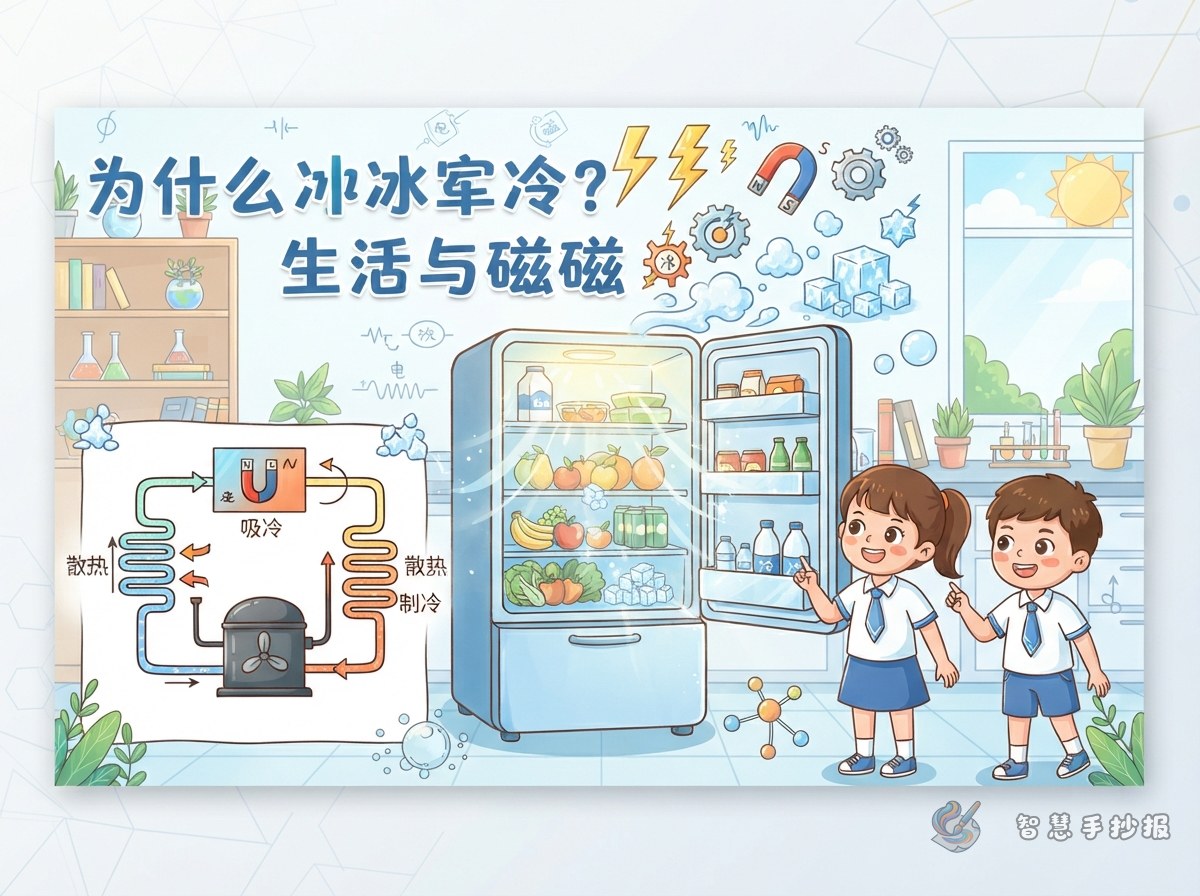
Build the handwritten newspaper around the question “Why does a refrigerator get cold?” A familiar appliance can introduce electricity, motion, magnetism, and safe use of electrical devices. Start with a simple key sentence: a refrigerator does not create cold from nowhere; it uses electricity to move heat from inside the cabinet to the outside.
Use pale blue, fresh blue, and white as the main colors for a cool feeling. Add orange arrows to show heat moving outward, so readers can quickly understand the relationship between a cooler inside and a warmer outside.
Show Cooling as a Heat-Moving Journey
- Power turns on: Electrical energy enters the refrigerator and the control system starts the compressor.
- The compressor works: The compressor pushes the refrigerant into a high-pressure, high-temperature state.
- Heat leaves outside: The refrigerant releases heat through the outside pipes and gradually cools down.
- Heat is absorbed inside: After passing through a special part that lowers its pressure, the refrigerant absorbs heat from inside the refrigerator, making the food area cooler.
Draw these four steps as a circular arrow diagram. Short labels such as power starts it, pressure rises, heat escapes, and heat is absorbed can go beside the arrows. They are easy for children to understand and work well as the main text of the page.
Bring Electricity and Magnetism Together
How Electrical Energy Creates Motion
The compressor is driven by an electric motor. When the motor works, the current and magnetic field interact to create a turning force, changing electrical energy into mechanical energy. Draw a simple coil and magnet with the caption “Current and a magnetic field make the motor turn.”
The Magnetic Helper in the Door
The sealing strip around many refrigerator doors contains magnetic material. It attracts the frame and helps the door close tightly, so less cool air escapes. Draw a partly open door, mark the sealing strip with a small magnet symbol, and add this short line: A small magnetic force helps keep the refrigerator cold.
Safe Electricity Tips
- Never touch a plug or switch with wet hands.
- Do not put metal objects into a socket or inside an appliance.
- Leave space around the refrigerator so heat can escape.
- Ask an adult to check a damaged wire or a hot plug.
Design the Page as a Refrigerator Science Investigation
Try a balanced left-and-right layout. Draw an open refrigerator in the center. On the left, show an arrow from the socket to the appliance. On the right, use an orange arrow to show heat leaving the refrigerator. Color the inside blue for heat absorption and the back of the appliance red or orange for heat release.
- Top: Write the main title and decorate it with a snowflake, a lightning bolt, and a small magnet.
- Lower left: Add a numbered “four-step cooling journey” with arrows.
- Lower right: Add a small electricity-and-magnetism card explaining the motor and magnetic seal.
- Bottom: Place safe-use reminders and one final summary sentence.
Three Details That Make the Handout Stronger
First, create a clear text hierarchy: the main title should be largest, section headings can use colored frames, and explanations should stay in short sentences. Second, keep all process arrows moving in one direction, preferably clockwise. Third, choose decorations that support the science, such as plugs, coils, magnets, snowflakes, and thermometers, rather than covering the important information with patterns.
Before finishing, check that the page includes words such as electrical energy, magnetic field, or magnetic seal, then add one sentence about what you discovered. If you want to organize the sections and layout more quickly, continue creating the project in the 智慧手抄报 WeChat mini program.