An Old Book Page Looks Like Grid Paper
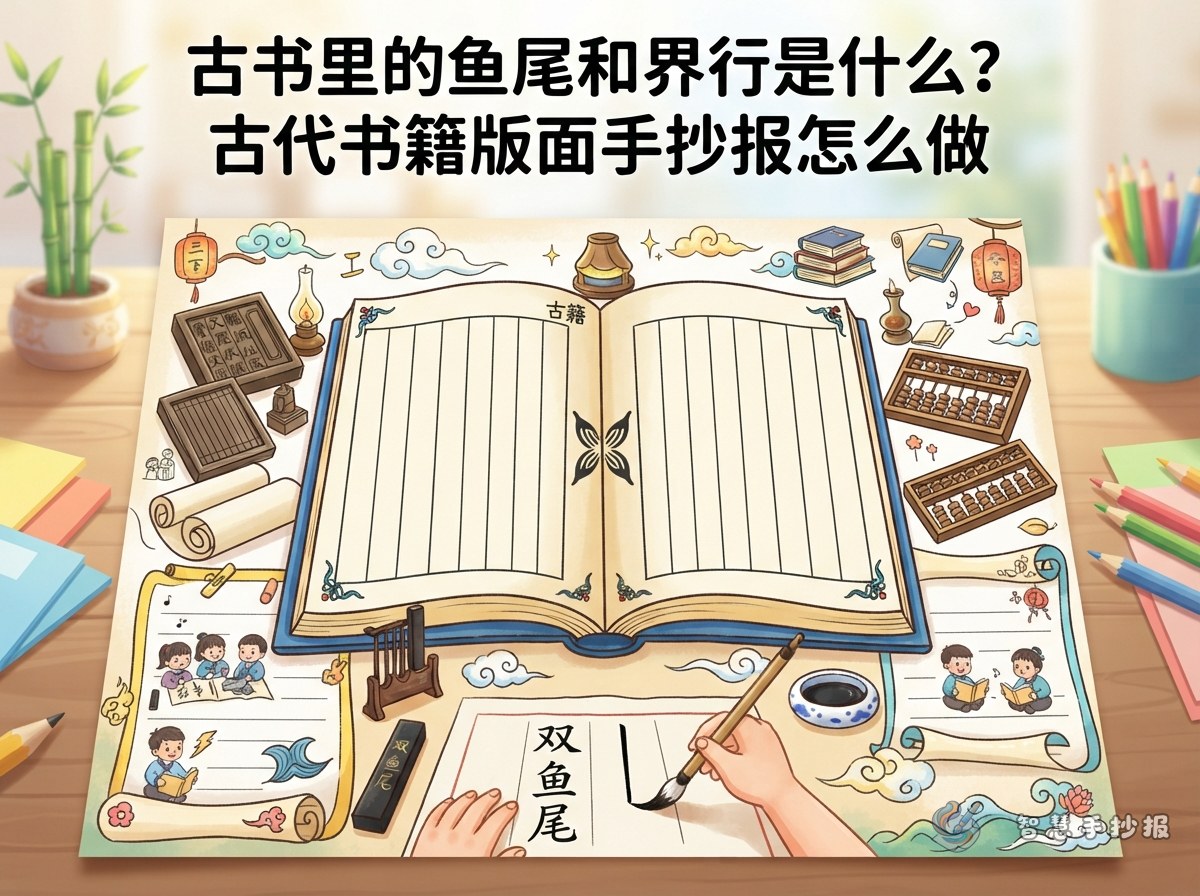
When you open a copy of an old Chinese book, the first thing you notice is the neat grid: a black border around the text, straight vertical lines between the columns, and wide empty strips at the top and bottom. That grid is a ready-made idea for a handwritten newspaper, because it also solves two common problems: how to divide the page and how to keep the writing straight.
Three useful words
- Frame: the black border around the text area, like the outer edge of your poster.
- Column lines: the vertical lines that split the text into columns.
- Top and bottom margins: the blank strips above and below the text.
Write these three words in a “Did you know?” box and add a simple box diagram so readers understand at a glance.
Fish Tail, Page Center and Side Label
Old books were folded and bound at the middle. The strip along that fold is the page center, and it often shows the book title, the volume number and the page number. In the middle of the page center there is a small mark shaped like a fish tail. Some pages also have a tiny box outside the frame, near the top corner, that gives the name of the section. These are not just decoration; they work like signposts that help people fold, find and identify the pages.
Put them to work on your poster
- Draw a tall strip as the page center and write your topic, class, name and date inside it.
- Place a fish-tail shape in the middle of that strip to separate the upper and lower parts of your poster.
- Draw a small box in the top corner as a side label and write “Page 1” or “Did you know?”.
Three Layout Ideas You Can Try
- A frame inside a frame: sketch a light pencil frame first, then add column lines inside it. Give each section two or three columns.
- Fish tail as a divider: use a small fish-tail drawing between two sections instead of a straight line. It saves space and looks like an old book.
- Keep the margins empty: leave a finger-wide blank strip at the top and bottom of the poster. Titles and decorations should not touch the edge.
If everything is written vertically, the text can look crooked. A good compromise is a vertical title with horizontal body text, so the page stays readable.
Short Text You Can Copy
- The frame is the outer edge of an old book, and the column lines are its dividers.
- Wide margins make an old page feel open and easy to read.
- The fish-tail mark works like a signpost and helps you find your place.
- Woodblock printing made lines of text even, so book pages became more regular.
Add a few simple drawings: a woodblock, a stack of paper, a brush and a thread-bound book. Clear outlines are better than complicated details.
Draw the Grid First, Then Write
- Choose your title and write it in large letters above or outside the frame.
- Sketch the frame and column lines in pencil, then decide what goes in each section.
- Write the small body text first, add the big title afterwards, and colour at the end.
- Fill the page center with your name, the date and a fish-tail shape.
If you would like ready-made layout ideas and text for this theme, open the 智慧手抄报 WeChat mini program, plan the page there, and then copy it onto paper.