Start with the Main Character: the Body’s Command Center
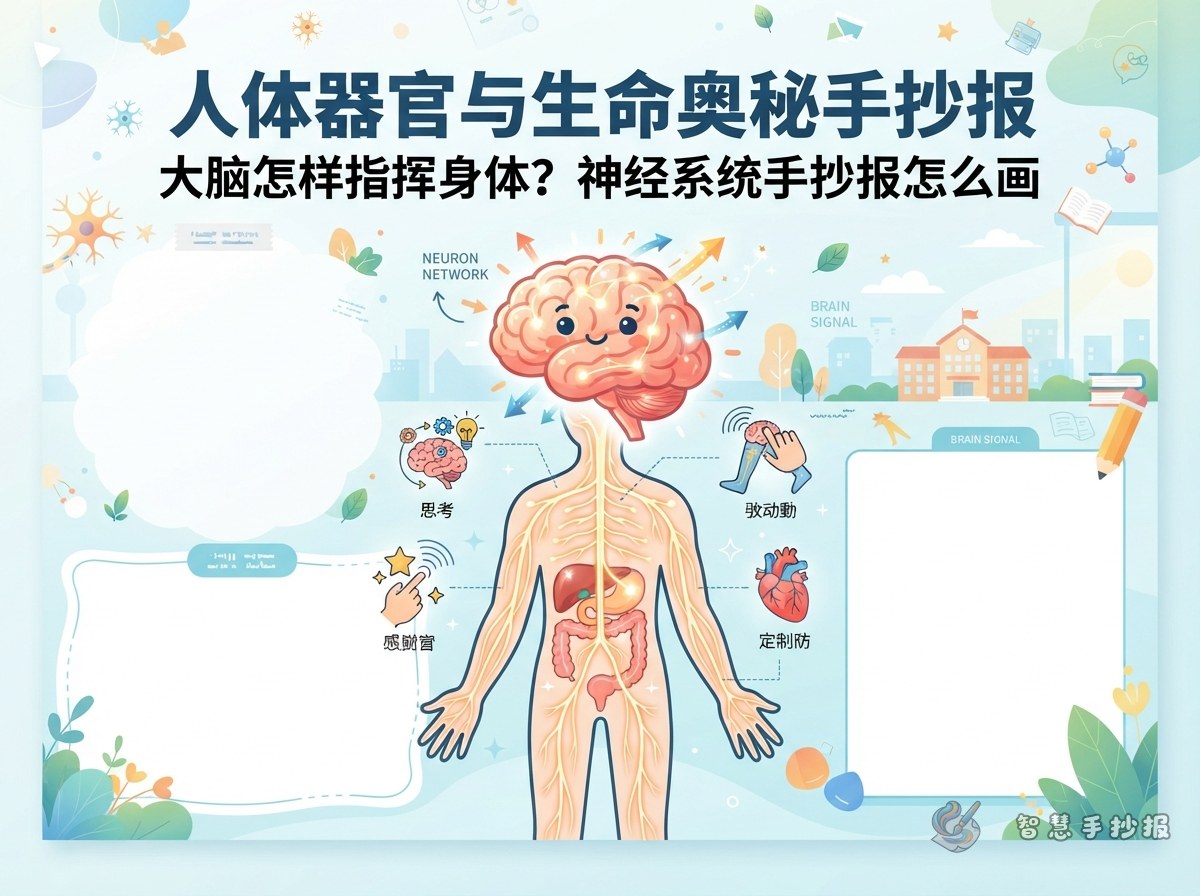
Build this poster around the question, “How does the brain control the body?” You can imagine the human body as a team that works together: the brain thinks and sends instructions, the spinal cord acts as an important communication pathway, and nerves carry messages to different parts of the body. This idea keeps the poster focused and makes the nervous system easier to understand.
Draw a simple brain outline in the center, then connect it to small icons of an eye, an ear, a hand, and a foot. Use arrows to show the direction of information. There is no need to draw complicated anatomical details; the most important process is “receive information—send information—respond.”
Four Sections for Exploring the Nervous System
1. The Brain: a Thinking Command Center
You can write that the brain helps us think, remember, learn, speak, and control actions such as walking or picking things up. It also helps us understand colors, sounds, smells, and other information from the world around us.
2. The Spinal Cord: an Information Pathway
The spinal cord is located inside the backbone and helps carry important messages between the brain and the rest of the body. Draw it as a vertical colored pathway with branches on both sides to show how it connects different areas.
3. Nerves: the Body’s Message Lines
Nerves are like many tiny communication lines. They carry information from the eyes, ears, skin, and other sensory organs to the brain and spinal cord. They also carry instructions to muscles and other body parts. A simple example could be “see a ball—brain makes a decision—hand reaches out.”
4. Amazing Reflex Actions
When a hand touches something very hot, the body may pull it away quickly. Show this as a three-panel cartoon: the hand touches a hot object, a message travels quickly, and the hand pulls back. Add the caption “A fast response that helps protect the body.”
Turn the Knowledge into an Information Journey
- Receive: The eyes, ears, skin, and other sensory organs notice a change.
- Transmit: Nerves carry the information toward the spinal cord and brain.
- Decide: The brain analyzes the situation and chooses an action.
- Act: Instructions reach the right body parts, which then move or respond.
Place these four steps in the middle of the poster and connect them with circles or arrows in four different colors. Keep each step to one or two sentences so the page stays easy to read and the main story remains clear.
Layout Tips for Making Invisible Messages Visible
A “central picture with surrounding sections” layout works well. Put the title at the top, draw the brain and nerve pathways in the center, place a “brain facts” section on the left, and add a reflex-action cartoon on the right. Use the lower area for the information journey and healthy brain reminders. Blue or purple can be used for the title, orange for pathways, and red for key words. Three or four main colors are usually enough.
For borders, try neurons, lightning shapes, message arrows, or small stars. These details match the life-science theme without distracting from the writing. First divide the page lightly with a pencil, then add the text and outlines, and finish with color. This order helps prevent a crowded layout.
End with Friendly Brain-Care Reminders
The final section could say: “Getting enough rest, exercising regularly, protecting the head, and keeping a good posture are all ways to care for the nervous system.” You can also add an interactive question: “What actions could we complete easily without a nervous system?” After preparing the words and sketch, continue arranging the page in the WeChat mini program “智慧手抄报” and turn this exploration of the human body into a clear, creative school project.