Choose a Story Before You Draw
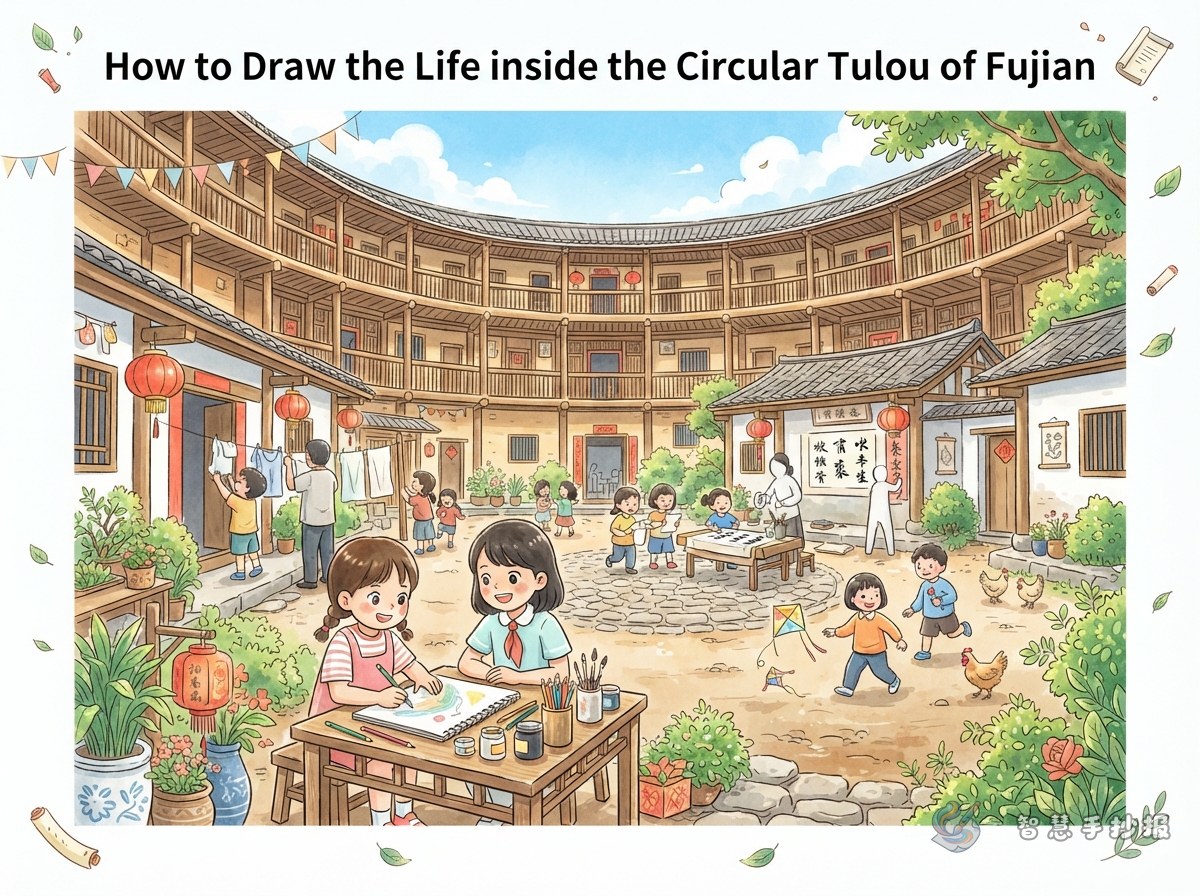
A Fujian tulou newspaper works best when it presents the building as a shared home rather than a list of facts. Use the idea “Life Inside a Round House” to connect its shape, building materials, communal courtyard, daily life, and cultural value. A large round tulou with an open gate can immediately establish the subject.
Build the Page Around Four Views
Its Distinctive Shape
Tulou buildings can be round, square, oval, or arranged in other forms. A round tulou resembles a ring from above, while a square one looks orderly and solid. Thick outer walls and an open central courtyard create a strong visual contrast for a school newspaper.
How It Was Built
Traditional tulou builders commonly used local earth, timber, and stone. The rammed-earth walls were formed by compacting materials layer by layer, while timber frames supported the interior floors and corridors. Use words such as “often” or “commonly” because individual tulou buildings are not identical.
Life Around the Courtyard
Rooms and wooden corridors face a shared inner courtyard. Families have their own living spaces while using communal areas such as halls, wells, and courtyards. This layout reflects cooperation, close family connections, and a tradition of neighbors helping one another.
Why Tulou Matters Today
A tulou combines housing, protection, and community life within one structure. It also demonstrates how people adapted local materials to their environment. End this section with a simple message about respecting and protecting historic buildings.
Short Text Ready for the Page
- Scene description: Thick earth walls surround a broad courtyard, and rows of wooden corridors face the open sky.
- Quick fact: Fujian tulou buildings are not all round; square and oval examples can also be found.
- Cultural message: One tulou connects many households and preserves memories of shared life.
- Protection tip: Learn about historic buildings and never carve or write on their walls.
Turn the Layout into a Tulou
Place a bird's-eye view of a round tulou in the center. Divide the ring into three or four text areas, or arrange the sections along a clear path from the outer wall to the courtyard. Introduce the appearance at the upper left, materials at the upper right, and daily life and preservation along the bottom.
Use earthy yellow, brick red, and dark gray as the main colors, with a small amount of green for the surrounding landscape. Roof tiles, wooden windows, and stone paths can form a restrained border. Keep enough blank space between drawings and text. Students who want to refine the columns, lettering, and colors can continue the design in the Zhihui Shouchaobao WeChat Mini Program.
A Three-Point Final Check
- Include architectural features, community life, and cultural meaning.
- Make the courtyard, surrounding rooms, and thick outer wall easy to recognize.
- Keep the writing concise, the colors consistent, and the reading order clear.