Start with the right focus: this is a cultural relic poster, not just an art page
A Dunhuang mural poster should do more than look pretty. Its main goal is to show the feeling of museum relics, historical discovery, and cultural heritage. Good titles include “Exploring Dunhuang Murals,” “Stories of the Silk Road in Dunhuang,” or “The Art of the Mogao Caves.” These help keep the page centered on relics and history.
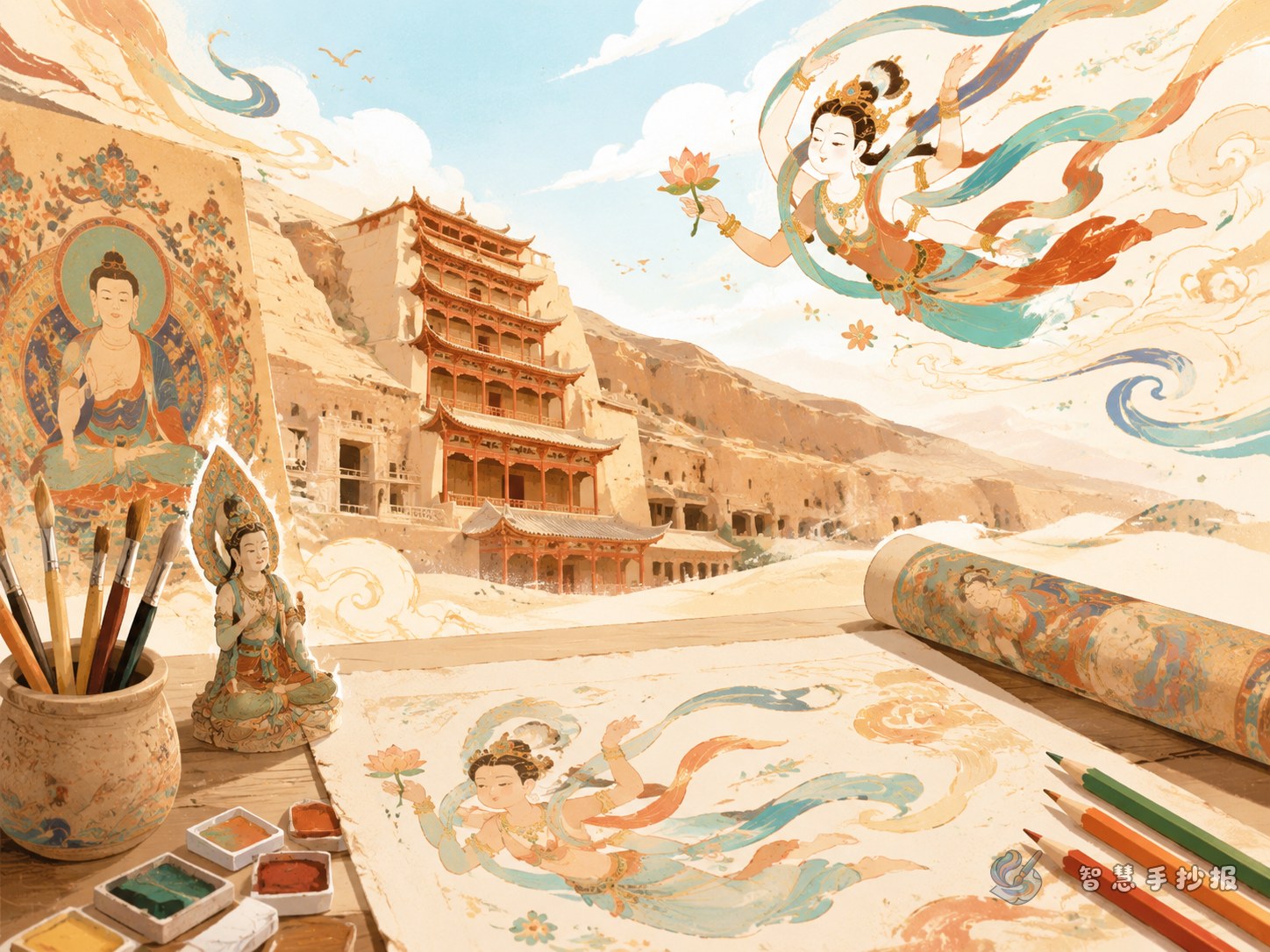
Your opening lines can explain that Dunhuang murals are found in the Mogao Caves in Gansu, China, and are treasured ancient artworks that preserve scenes of life, belief, clothing, music, and cultural exchange.
Use four clear sections to make the poster easy to read
1. Where are the Dunhuang murals?
Write that the Mogao Caves are in Dunhuang, Gansu, an important place along the ancient Silk Road, which is why the murals reflect cultural exchange.
2. What can we see in the murals?
- Flying apsaras with flowing ribbons
- Religious story scenes
- Ancient clothing, music, and dance
- Lotus, cloud, and decorative patterns
3. Why are the murals valuable?
You can explain their value from three angles: history, art, and culture. They help us understand ancient painting, ancient life, and connections between regions.
4. How should we protect cultural relics?
This is a good final section. Students can write about visiting museums politely, not damaging relics, following rules, and learning to respect history.
Short text materials you can place directly on the poster
Text 1: Dunhuang murals are bright and vivid treasures of ancient Chinese art, carrying memories from hundreds of years ago.
Text 2: In these murals, we can see flying figures, musicians, dancers, people, and decorative designs that show the style of ancient times.
Text 3: Because Dunhuang stood on the Silk Road, the murals also reflect cultural communication between different regions.
Text 4: Cultural relics do not speak, but they tell history. Protecting Dunhuang murals means protecting precious human memory.
Layout ideas that feel like a museum display
You can place the main title in the center and arrange four content boxes around it. Decorate the title with flying ribbons or a cave entrance shape. Put “Where It Is” on the upper left, “What It Shows” on the upper right, “Why It Matters” on the lower left, and “How to Protect It” on the lower right.
- Main colors: earth yellow, orange red, muted green, brown
- Border ideas: lotus petals, clouds, geometric lines
- Small drawings: apsaras, camel caravans, ancient lamps, cave doors
- Writing tip: keep each section to 3 to 5 sentences
If the page feels empty, add small title boxes and decorative dividers so it looks more like a museum information board.
Add a sense of discovery to make the poster stand out
This topic becomes more interesting when it feels like a journey into history. You can include a line like “Dunhuang murals are not just paintings on a wall; they are clues left by history.” That gives the page more depth.
You can also add a small section called “If I Were a Junior Museum Guide” and write one or two sentences introducing your favorite mural scene.
A simple ending that feels complete
Your ending can say that by making this poster, you learned that cultural relics are not only beautiful to look at but also important to respect and protect. History lives inside murals, and it also appears in careful observation.
If you already have the theme but want to improve the layout, sections, and title design, you can continue creating in the Smart Handwritten Newspaper WeChat mini program.