Decide What the Page Is Collecting Before You Draw
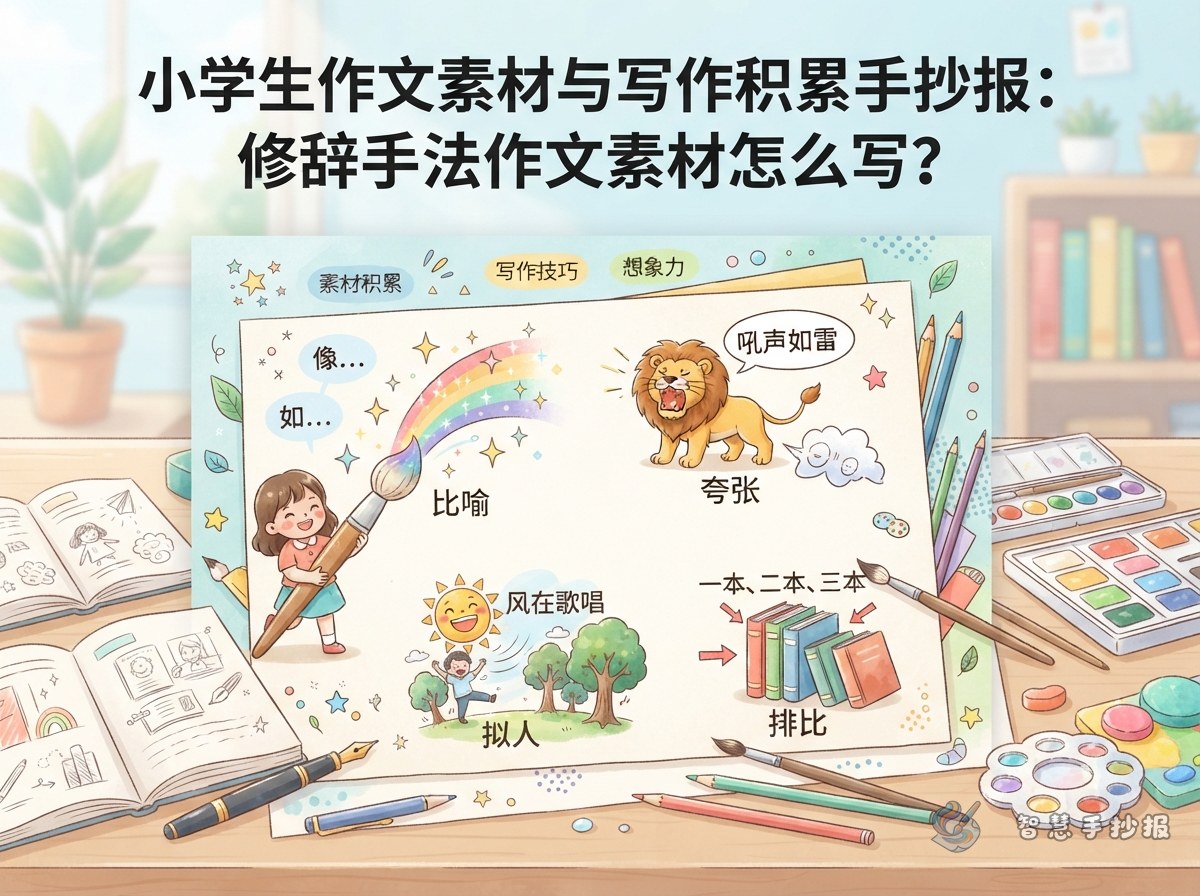
A common mistake is turning the newspaper into a pile of random nice sentences. Before drawing the borders, set a limit: this page will mainly collect simile, personification and parallelism, with one small corner for exaggeration. That way every sentence has a place to go.
- Who is it for: a first look at rhetorical devices, or a writing reference for older students.
- How many: three to five examples for each device, plus one or two lines you wrote yourself.
- What matters most: leave a box for how I use it, not just what I copied.
Four Labelled Boxes That Keep the Page Organised
A Garden of Similes
Write what is being compared with what, then draw a small picture beside it, such as the moon and a boat or dew and glass beads.
A Stage for Personification
Gather sentences where objects behave like people, and decorate the box with grass, wind and flowers that seem to talk or walk.
A Train of Parallel Lines
Draw separate carriages, put one parallel sentence in each, and read them in a row to hear the rhythm.
A Magnifying Glass for Exaggeration
Sketch a magnifying glass and fill it with lines like being so hungry you could eat a whole cow.
Example Sentences You Can Copy Straight onto the Page
Simile
- The crescent moon hangs in the night sky like a small boat.
- Autumn leaves spin in the wind like little yellow butterflies.
- Dew on the lotus leaf shines like tiny glass beads.
Personification
- The grass quietly pokes its head out of the soil.
- The wind taps gently on my window, as if telling me to get up.
- The old locust tree stretches out its arms and hugs the whole path.
Parallelism
- I love the flowers of spring, the rain of summer, the fruit of autumn and the snow of winter.
- In the classroom there is the teacher's voice, the sound of pages turning, and the soft scratching of pens.
Long sentences can be shortened when you copy them, which leaves more space for drawings and keeps the page easy to read.
Laying Out the Page Without Crowding It
- Put the title at the top or in the upper left, in thick lettering with a light outline.
- Leave a finger-wide gap between large sections so the eye can rest.
- Keep the whole page to three or four colours, one colour per rhetorical device.
- Follow a reading order: title, a one-sentence explanation, examples, then my own lines.
- Borders of vines, clouds or stars are fine as long as they do not cover the words.
If writing is slow, measure each box with a ruler first and fill the sentences in afterwards; the page will look much tidier.
Three Checks Before You Hand It In
- Make sure sentences such as he looks like his father, which only compare, are not counted as similes.
- Make sure each section has at least one line you wrote yourself.
- Make sure headings, spelling and punctuation are straight and complete.
When the Layout Is the Hard Part
Some students finish the material and then get stuck on which box comes first or how wide the margins should be. In that case you can open the WeChat mini program 智慧手抄报 (Smart Handwritten Newspaper), choose a rhetorical devices layout, and type your finished sentences into it to see how they fit before drawing on paper. The newspaper still needs your own hand in the end; a layout only answers the question of where things go.