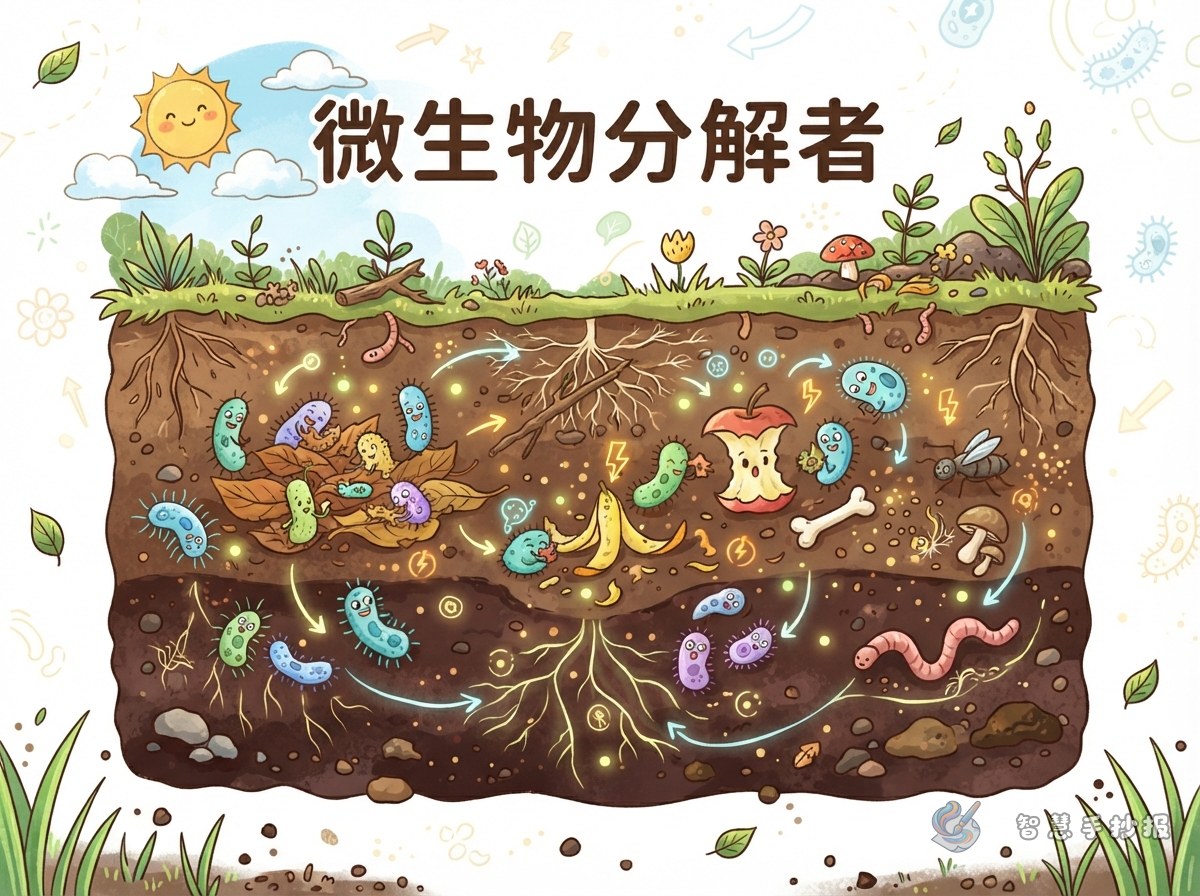
Begin with a Fallen Leaf: Choose a Story for the Page
Instead of focusing on fermentation or handwashing, this handwritten newspaper can introduce the decomposers in soil. After a leaf falls to the ground, bacteria, fungi, and other microorganisms help it gradually break down. The materials in the leaf can then return to the soil environment. Use the idea of a leaf taking an underground journey to make an invisible process easy for children to understand.
- Main picture: A leaf falling from a tree and leading down into a soil cross-section.
- Main characters: Bacteria, fungi, plant roots, fallen leaves, and nutrients in the soil.
- Guiding questions: Why does a fallen leaf not stay on the ground forever? What are soil microorganisms doing?
Turn Decomposition into an Underground Relay
Use curved arrows to show the process and place a short explanation beside each step. This gives the page both a clear science idea and a lively story.
- Leaves, twigs, and other organic materials enter the soil and become food sources for microorganisms.
- Bacteria and fungi work on the surfaces and tiny gaps of the material, gradually changing complex organic matter into simpler substances.
- Some of the materials remain in the soil and take part in nutrient cycling. Plant roots can absorb some nutrients and support new growth.
- New leaves grow on the plant, and those leaves may eventually return to the soil, completing the cycle.
There is no need to fill the page with difficult chemical names. The main line is enough: a leaf enters the soil, microorganisms break it down, nutrients return to the environment, and plants continue to grow.
Four Knowledge Cards for Your Main Text
- What are microorganisms? Microorganisms are living things that are usually too small to see clearly without a microscope. Bacteria and many fungi are common examples.
- What are decomposers? Decomposers use and break down organic materials left by living things. They play an important part in the movement of materials through an ecosystem.
- What do bacteria do? Some soil bacteria take part in breaking down organic matter and help change materials in the soil. Different bacteria have different ways of living and different roles.
- What is special about fungi? Many fungi obtain nutrients from organic materials such as dead leaves. Their threads, called hyphae, can extend into tiny spaces, making them easy to draw as an underground network.
Use a Soil Cross-Section to Organize the Layout
A horizontal or vertical soil cross-section works well for this topic. Draw sunlight, a tree, and fallen leaves at the top. Place an enlarged changing leaf in the middle, then add brown soil layers, roots, and friendly cartoon bacteria and fungi below. Put the title at the top, such as The Soil’s Invisible Cleanup Team or The Underground Journey of a Leaf.
Tell the Story on One Side and Explain It on the Other
Use one side for four arrows showing the changes in the leaf. On the other side, add three small sections: Microorganism Profiles, What Decomposers Do, and Nutrient Cycling. Keep each section to two or three sentences, use consistent lettering, and highlight key words with green or orange.
Choose Friendly Colors and Shapes
Brown, pale yellow, and green work well for the soil layers. Bacteria can be drawn as circles or short rods, while fungi can be shown with small caps and thread-like hyphae. A magnifying glass, work hat, or little flag can make the characters friendly, as long as the page explains that they are science illustrations.
Three Final Checks Before You Finish
- Do not use microorganism and bacterium as if they mean exactly the same thing. Microorganisms include many kinds of life, and fungi are only one part of that larger group.
- Do not write that all bacteria are harmful. Explain that microorganisms have different roles, and many soil microorganisms participate in natural cycles.
- Make sure every arrow has a clear beginning and end. Keep the text short and leave enough room for borders and drawings so the page does not look crowded.
Sketch the soil layers and arrows in pencil first, then add the knowledge cards, outlines, and colors. To organize the sections, adjust the layout, and continue making the page, scan to enter the 智慧手抄报 WeChat Mini Program.