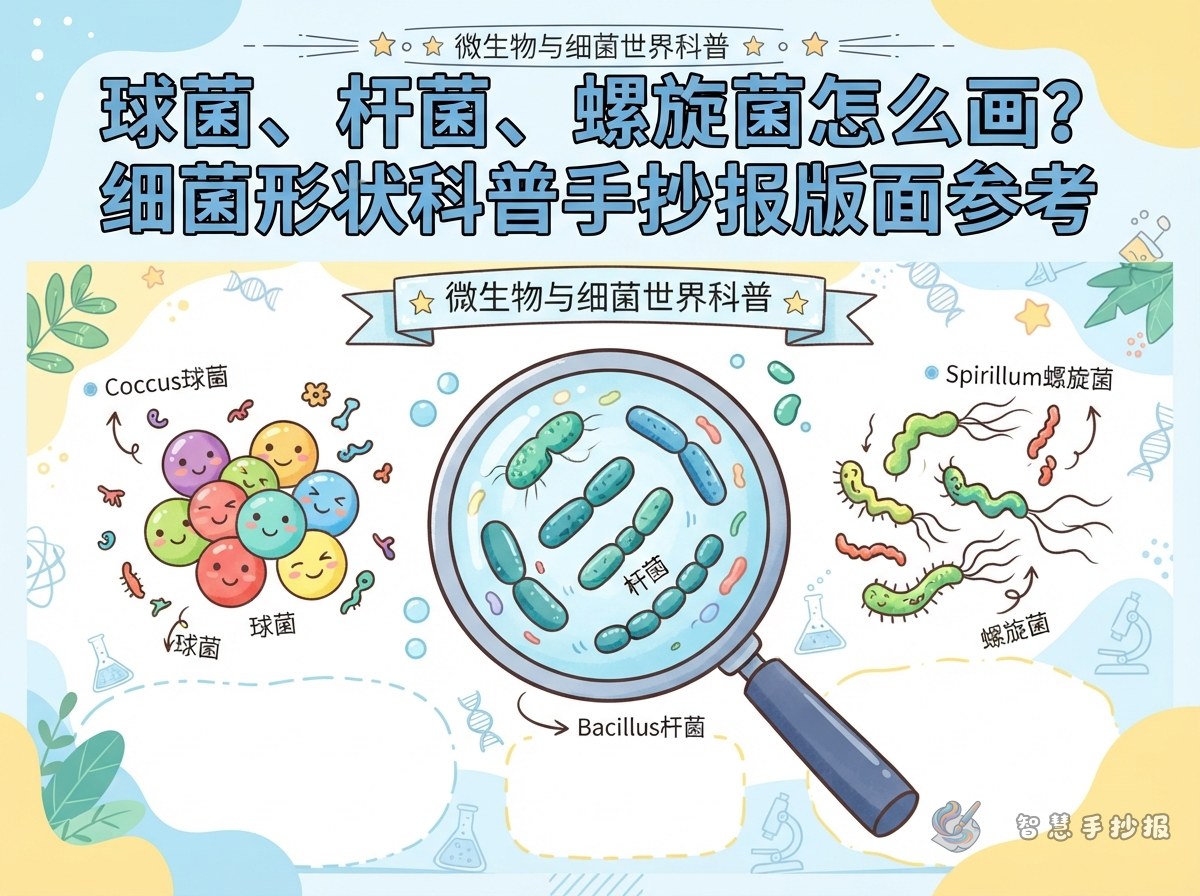
Choose One Clear Focus: The Three Basic Bacterial Shapes
When a handwritten newspaper tries to cover the whole microbial world at once, the page quickly becomes crowded. A much easier approach is to focus on three basic bacterial shapes: cocci, bacilli, and spirilla. There is enough variety to keep the page interesting, but not so much that the writing becomes hard to manage.
Good titles include "Three Tiny Guests Under the Microscope" or "Round, Rod, and Spiral: Bacteria Come in Different Shapes." You can also use a question: "How Many Shapes Do Bacteria Have?" Add a small magnifying glass next to the title to guide the reader's eye.
A Simple Layout: One Big Microscope and Three Round Windows
Use A3 or A4 paper in landscape direction. Plan the large blocks first, then fill in the details:
- Top fifth of the page: the main title in large letters, outlined or decorated.
- Center-left: a large microscope with the lens pointing to the right.
- Right of the lens: three same-sized round "observation windows" in a row or a triangle.
- Below the three circles: three short lines or small boxes for labels and facts.
- Bottom right corner: a small petri dish or magnifying glass as decoration, not as the main image.
What Goes Inside Each Window
Cocci: Round Like Tiny Beads
Write that cocci are sphere-shaped bacteria. Some appear alone, while others form pairs, chains, or clusters. To draw them, trace circles with a compass or bottle cap, then add small dots inside. They can look like a string of beads or a tiny bunch of grapes. Outside the circle, write "Cocci" and add four small word cards: single, pairs, chains, clusters.
Bacilli: Short Rods and Little Capsules
Write that bacilli are rod-shaped or short bar-shaped bacteria, usually with rounded ends. To draw one, start with a rectangle and round off both ends so it looks like a small capsule. Add a short note: "If the name sounds like a rod, it is probably this shape."
Spirilla: Curved, Spring-Like Lines
Write that spirilla have curved, winding bodies, a little like small springs or curly noodles. To draw them, sketch a light spring or wavy line first, then trace over it to give the shape some thickness, and outline it with a darker pen. This shape stands out well, so it can be placed in the middle window and drawn slightly larger.
Colors, Borders, and Small Decorations
- Use a light background such as pale blue, pale green, or cream so the text stays easy to read.
- Give each shape its own main color: warm yellow for cocci, lake blue for bacilli, and orange-red for spirilla. Use a darker shade of the same color for the title and outlines.
- Borders can follow the round shape of a petri dish, or use wavy lines, small dots, or simple cross patterns.
- Do not over-decorate. One small element in each corner is enough, such as a magnifying glass, dropper, petri dish, or question mark.
Step-by-Step Order and Common Fixes
- Sketch the title area, the microscope, and the three circles lightly in pencil.
- Write the main title next, and save the small text for last so you do not run out of drawing space.
- Draw the bacterial shapes inside the circles, and write labels and one-sentence facts outside.
- Add borders and corner decorations, erase extra pencil lines, and outline everything with a black pen.
Common problems: if the bacteria look like tiny black dots from a distance, enlarge the circles to about the size of your fist. If the facts do not fit, shorten them into phrases or word cards. If you want help with the layout, the Zhi Hui Shou Chao Bao (Smart Handwritten Newspaper) WeChat mini program offers microbe-themed templates that you can look at for column ideas, borders, and lettering before drawing your own version by hand.