Build the page around a bacteria escape story
This handwritten newspaper can turn antibiotic resistance into a small science story. An antibiotic is a tool with rules for use. In a group of bacteria, some may be stopped by the medicine, while less-sensitive bacteria may remain and multiply. Make it clear that resistance happens in bacteria, not because a person becomes stronger against medicine.
Main message: Antibiotics should be used only when needed and exactly as directed by a doctor or another qualified health professional.
Arrange the facts as four questions
What are antibiotics?
Explain in simple words that antibiotics are medicines used for some bacterial infections. They are not a cure for every fever, cough, or cold. Many common colds are linked to viruses, so a doctor should decide whether an antibiotic is needed.
How can resistant bacteria remain?
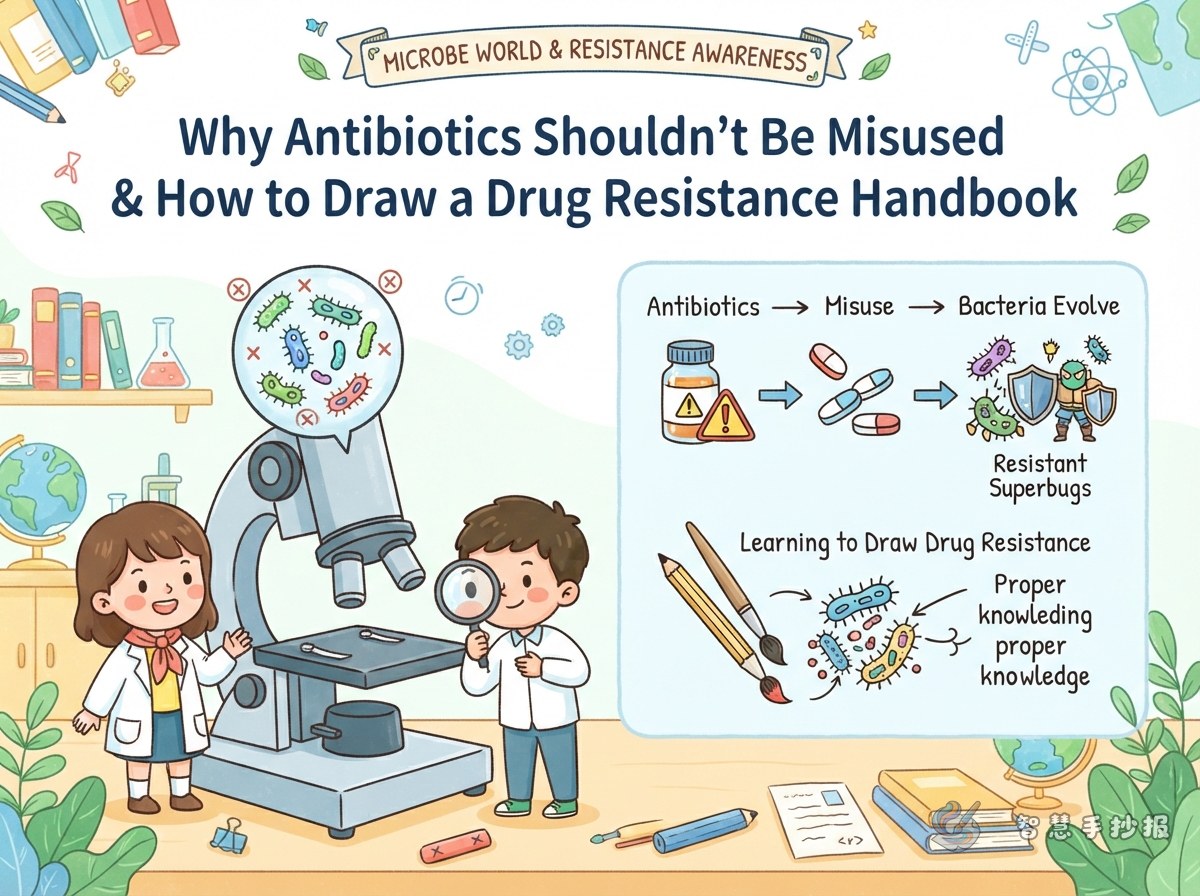
Draw two groups of bacteria: one group is stopped by the medicine, while another group carries a small shield and continues to grow. Add the caption “Less-sensitive bacteria may survive.” Explain that unnecessary use, changing the dose without advice, switching medicines, or stopping on your own can make resistance harder to manage.
Three safe-use reminders
- Tell a parent or guardian when you feel ill and follow medical advice about treatment.
- Do not buy antibiotics by yourself, borrow them, share them, or save leftover medicine for another illness.
- Follow the prescribed instructions and timing; do not change the dose or switch medicines on your own.
What can I do every day?
Create an action box called “Protect the power of antibiotics.” Include good hygiene habits, talking with an adult when sick, and correcting the idea that antibiotics can treat every cold. You can also remind your family not to store or share prescription medicine casually.
Short facts ready for the page
- Key fact: Antibiotics work against some bacterial infections, but they are not a universal treatment for viruses.
- Definition: Resistant bacteria are bacteria that are less sensitive to certain medicines; resistance is not the body becoming immune to an antibiotic.
- Reminder: More medicine is not always better. Correct use is more important than unnecessary use.
- Call to action: Follow medical advice, never share antibiotics, and help protect their usefulness.
Show resistance with color and movement
A landscape layout works well: place the large title at the top, draw a central “bacteria change route,” and put an antibiotic and ordinary bacteria on the left, followed by shield-carrying resistant bacteria on the right. Add a bottom strip called “Safe-use action cards.” Use blue and green for ordinary bacteria and purple or orange for resistant bacteria, without making every microbe look frightening.
- Draw a pill, microscope, or magnifying glass beside the title to signal the topic quickly.
- Use arrows to show “incorrect use—less-sensitive bacteria remain—resistance becomes more common.”
- Turn “follow advice, do not share, do not stop on your own” into three memorable icons.
- Keep each section to two or three key sentences, leaving space for simple microbe outlines and labels.
Do a science check before handing it in
Check three points: Have you avoided calling antibiotics a universal cold medicine? Have you shown that resistance occurs in bacteria? Have you written “follow medical advice” instead of suggesting that children make treatment decisions alone? To continue arranging the title, sections, and page design, open the 智慧手抄报 WeChat mini program and create your own science handwritten newspaper.