Turn the Page into a Microscopic Showdown
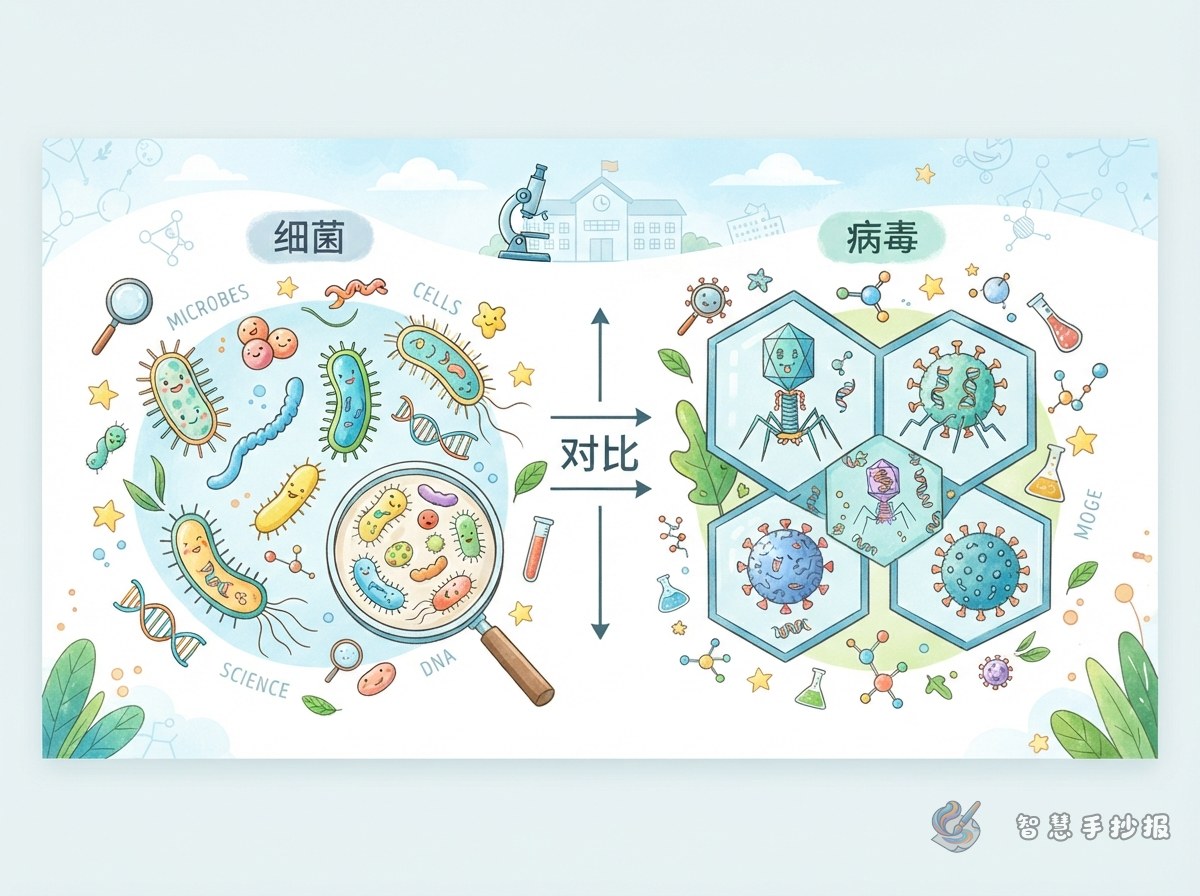
This poster can explore the question “How are viruses and bacteria different?” by turning an invisible world into a fun comparison. Divide the page into two main areas: viruses on the left and bacteria on the right. Connect them with a magnifying glass, microscope, or question mark to create a clear reading path. A suitable title is “A Microscopic Matchup: Viruses and Bacteria”.
Begin with a short hook: “They are both tiny, but they are not the same kind of biological structure.” This introduces the topic and gives the poster the feeling of a small science investigation.
Use a Comparison Chart for the Main Ideas
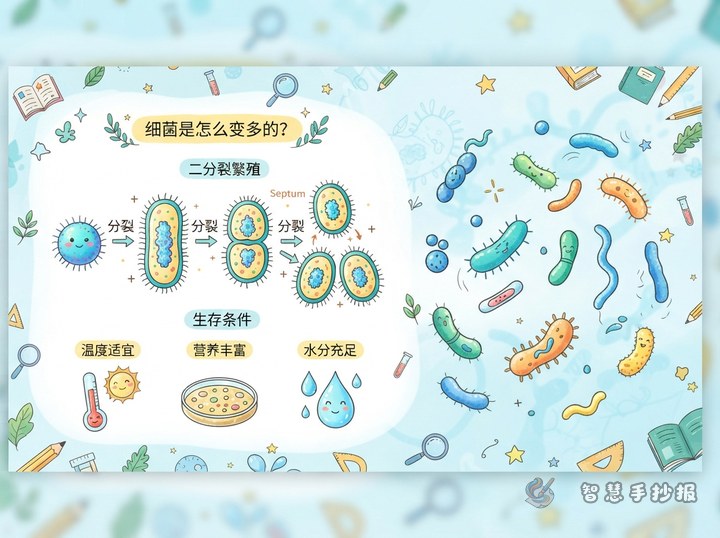
- Structure: Bacteria are tiny living organisms with cellular structure, while viruses are simpler and are generally made of genetic material surrounded by a protein coat.
- Way of living: Many bacteria can grow and reproduce on their own. Viruses usually need to enter a host cell and use the cell’s conditions to make copies.
- Relative size: Viruses are generally smaller than bacteria. You can show this with larger and smaller dots, but avoid drawing the size difference as an exact rule.
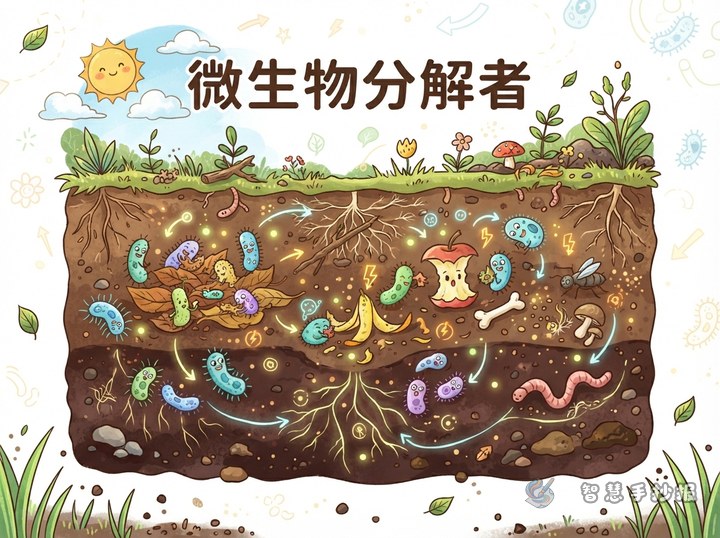
- Not everything is harmful: Some bacteria help with decomposition, fermentation, and ecological balance. Viruses can also be studied to understand how life works.
Turn these points into small “identity cards.” Each card should contain one idea and a simple icon, so the page does not become crowded with long paragraphs.
Four Sections for a Real Science Poster
1. Virus Profile
Write key phrases such as “simple structure” and “needs a host cell to replicate.” Add a simple drawing of a round outer coat or surface spikes. The illustration only needs to show the basic idea, not complicated medical details.
2. Bacteria Observation Station
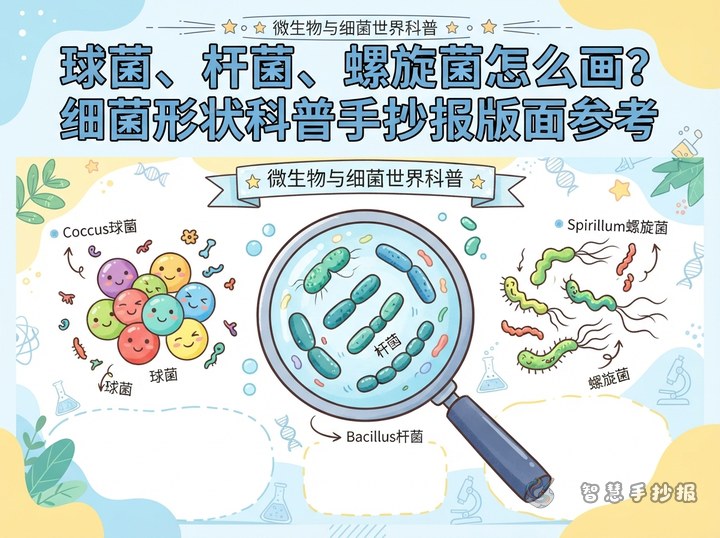
Introduce common bacterial shapes, such as round, rod-shaped, and spiral forms. You can also mention that bacteria live in many environments, including soil, water, air, and on the surfaces of living things.
3. Similarities and Differences
Draw a Venn diagram with two overlapping circles. In the shared area, write “usually cannot be seen with the naked eye and may require tools for observation.” In the separate areas, write differences in structure, reproduction, and living conditions.
4. A Scientific Reminder
Remind readers not to panic when they hear the words “bacteria” or “viruses.” For health concerns, children should follow advice from parents and qualified medical professionals. The purpose of a science poster is to understand differences and respect facts.
Design the Page Like an Open Microscope
Place a bold title at the top, surrounded by a magnifying glass, dots, or colorful circular shapes. Use a vertical line to separate the virus and bacteria sections, and place a small “similarities” circle in the center. At the bottom, add a reflection box titled “What I Learned,” with a sentence such as “Tiny does not mean simple; understanding differences helps us understand microorganisms.”
For color, try blue or purple for the virus area, green or orange for the bacteria area, and bright yellow for the shared section. Keep each paragraph to two or three lines. Outline important words with colored pencils to make the information easier to scan.
Five Steps from Sketch to Finished Poster
- Sketch the title, the two main areas, and the central comparison box.
- Copy the selected facts and make sure they fit the available space.
- Add small drawings of viruses, bacteria, microscopes, and magnifying glasses.
- Highlight words such as “structure,” “way of living,” and “similarities” with different colors.
- Check the science and spelling, then decorate empty spaces with lines, dots, or small arrows.
To finish the layout more efficiently, follow this section order and then enter the WeChat mini program to continue creating with Smart Handwritten Newspaper. It can make topic selection, text arrangement, and page adjustment easier.