Begin with one clear rule, not a scary story
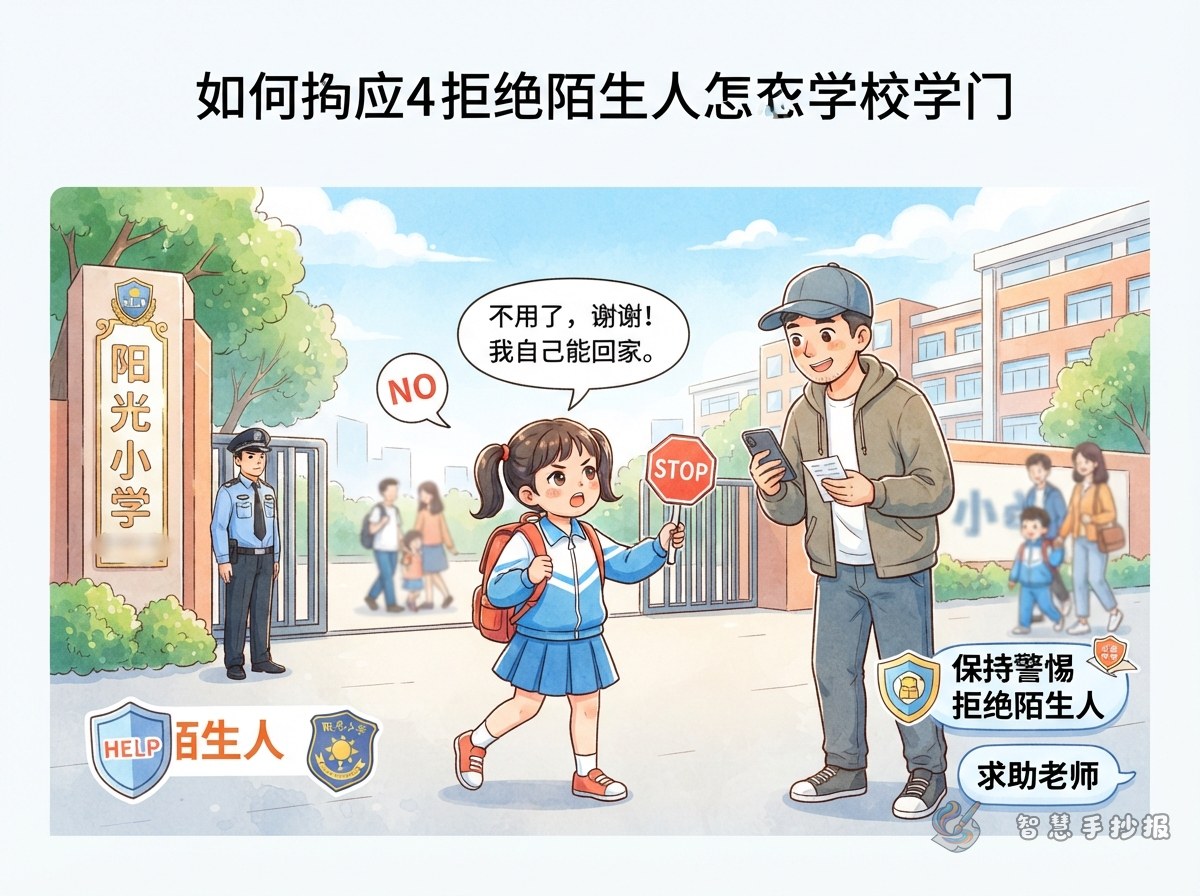
This poster does not need frightening details. It needs one sentence children can repeat: nobody takes you anywhere unless your parents have said so themselves. Lines like “Your mum asked me to pick you up” may sound friendly, but they are still just words from a stranger, not words from your parents.
Build the middle of the poster around three things not to do:
- Do not walk away with them. Stay near the gate, the guard room or a teacher.
- Do not get into a car, even if the driver says they know your family.
- Do not give your address or your parents' phone number to someone you do not know.
Then add the positive steps in bigger letters: find a teacher, make the call, wait for your parent.
Headline ideas for the top of the page
A good title is short enough to remember at the school gate. Pick one of these or write your own:
- Someone Says They Will Pick Me Up: What Do I Do?
- My Family Pick-Up Password
- One Phone Call Before I Go Anywhere
- Three Nos: No Walking, No Cars, No Address
Around the title, draw a simple shield, a small telephone, a school bag or a pair of footprints that have stopped. Keep the shapes clean so the words stay easy to read from a distance.
Four columns that turn checking into a routine
Column 1: My safe list
Draw a box titled “Only these people take me home” and list the family members who usually pick you up. Write the name and relationship, and only part of a phone number, such as 138****, so the page is useful but still private.
Column 2: Check, call, wait
- Stay at the gate or beside the guard room.
- Ask a teacher to call your parents and ask, “Who is picking me up today?”
- After the answer is clear, tell the teacher before you leave.
Column 3: If the person keeps following me
Write the actions clearly: say loudly “I do not know you”, walk towards other people, step into the shop near the gate, the guard room or the office, and ask an adult in uniform for help. Do not run into empty lanes or car parks.
Column 4: Help I remember
List three numbers: your parents, your teacher and 110. Add a small icon beside each one so the information is easy to find at a glance.
Short lines kids can copy straight onto the poster
- Even a believable voice needs one phone call first.
- No walking, no cars, no home address.
- The person who takes me home must be on my family list.
- Standing still with a teacher is safer than running after anyone.
- I know my parents' number and where to find my teacher.
- Saying no and asking for help is a kind of bravery.
If there is still space, add a small question box: “A classmate offers to walk me home. Can I go?” Under it write, “Call Mum or Dad first.” That makes the poster feel like it belongs to real school days.
Layout and colours that keep everything readable
Use three or four vertical columns instead of many small shapes:
- Put the headline in the middle or the top left.
- Use the left column for the safe list in a clear box.
- Use the middle column for check, call, wait, joined by arrows.
- Use the right column for short lines, phone numbers and a few icons.
Blue can mark the actions, yellow can mark the reminders, and red can be saved for “do not” and emergency numbers. Borders shaped like zebra crossings, footprints or telephone wires work well, but leave enough white space for writing.
When the draft is ready, you can open the 智慧手抄报 WeChat mini program, choose a safety-themed template and place these sentences and steps into the columns. Changing the order or the letter size takes only a moment, and the page stays neat and easy to read.