Turn the Poster into a Small Conservation Lab
This poster does not have to repeat only the slogans “Save water” and “Save electricity.” Build it around a question: why should water and electricity be valued, and how can observation help us notice waste? A suitable theme is “A Young Observer Discovers the Wisdom of Saving”. The reader can follow the poster like a visit to a small lab: notice a situation, think about it, and choose an action.
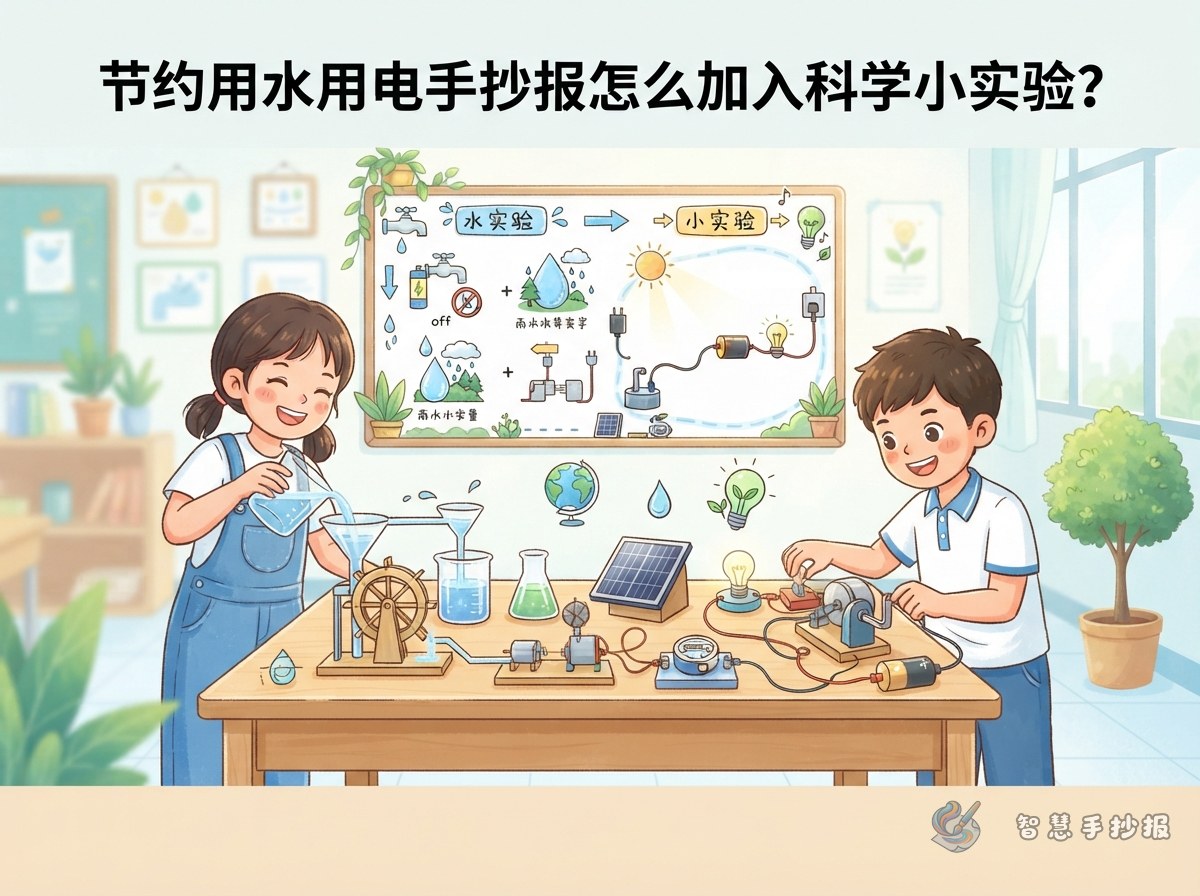
Draw an open science notebook in the center. Place drops of water, a measuring cup, and water-cycle arrows on the left page, and sunlight, a light bulb, and a switch on the right. Put the main theme in the middle and arrange three steps around it: “Ask a Question,” “Record an Observation,” and “Take Action.” This gives the poster a clear story instead of filling it with unrelated pictures.
Three Safe Observations That Are Easy to Draw
- Follow the path of a drop of water: Draw several possible uses for water after it leaves a faucet, then mark which water can be used wisely. You may write, “Use only what you need; clean leftover water can help water plants or wipe surfaces.” Do not run water on purpose just to create an experiment.
- Observe natural light: Create an observation card comparing a desk near a window, a cloudy day, and a situation with insufficient light. The conclusion should be accurate: use daylight when it is bright enough, and turn on a lamp when the light is too weak. Saving electricity should never mean studying in unsafe darkness.
- Make a small electricity survey: Draw icons of common appliances and sort them into “in use,” “not currently needed,” and “ask an adult to check.” You can write, “Look at the switches before leaving a room” and “Turn off devices that are not needed.” Children should never take apart sockets or touch wires; an adult should handle unplugging.
Text You Can Place Directly in the Sections
Question for the experiment: “How can one observation become a daily habit of saving water and electricity?”
Observation conclusion: “Water and electricity can be wasted through small, unnoticed actions. Paying attention to faucets, switches, and usage time helps reduce unnecessary waste.”
Action checklist: Use an appropriate amount of water when washing; tell an adult about a leak; use daylight first; turn off lights and fans when leaving a room; never touch an appliance with wet hands.
Short slogan: “Saving is not being stingy; it means using resources where they are truly needed.” You can add “I observe, I record, I change” at the bottom to connect the whole poster.
Arrange the Page Like an Observation Board
Try a horizontal three-part layout. Draw test tubes, a measuring cup, and a light bulb in the title area at the top. Put a “Water Drop Observation Station” in the lower left with blue and green colors, and an “Energy Observation Station” in the lower right with yellow and orange accents. Leave a strip at the bottom for “Things I Can Do Today,” containing three to five short promises.
Use the same record format in each section: What did I notice, how did I decide, and what will I do? Write headings with a dark, thick pen and keep the body text short. Leave some space beside each drawing so the steps and decorations do not overlap. Simple line drawings of drops, leaves, the sun, and switches are easy for children to make and keep the page neat.
Check These Four Details Before Finishing
- Does the theme show both water conservation and electricity conservation?
- Are the observations safe and simple, without wasting water or electricity to create data?
- Do the words include clear actions that readers can follow?
- Do the title, sections, drawings, and borders have a clear order of importance?
If you would like to try different section placements and color combinations, scan to enter the WeChat mini program “智慧手抄报” and continue designing. You can then replace the sample words with your own observations and decorations to give the science-themed handwritten poster a personal touch.