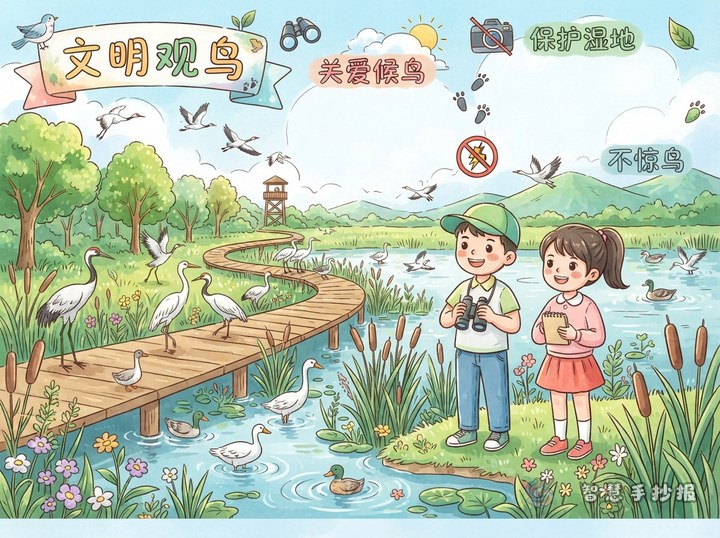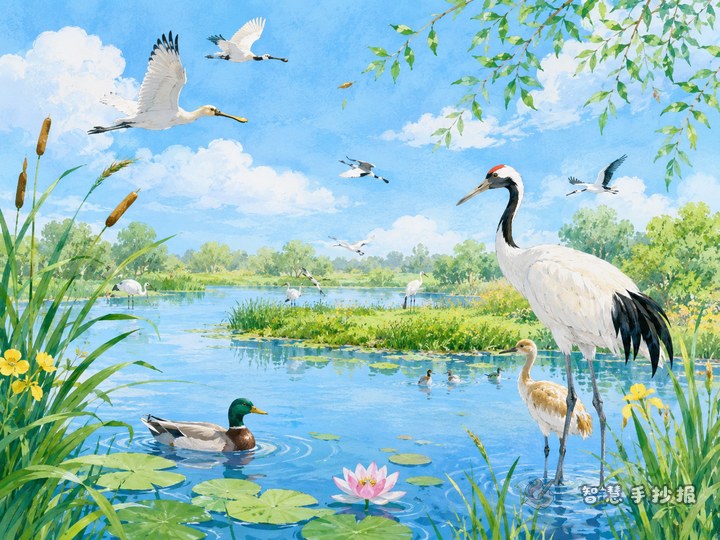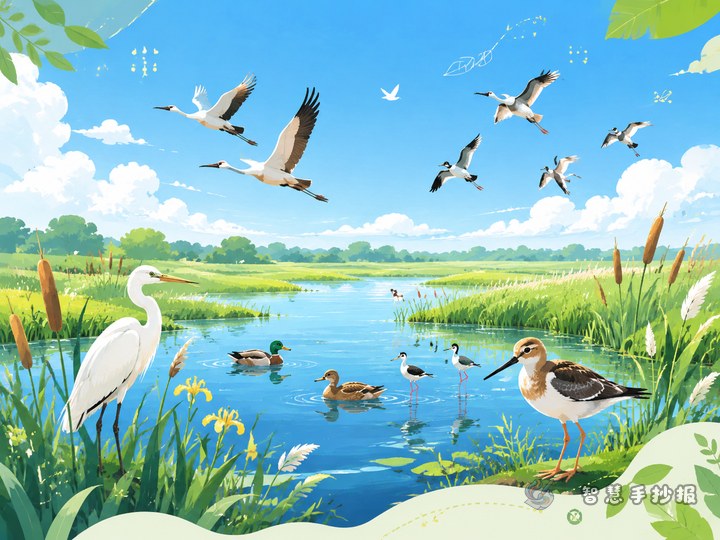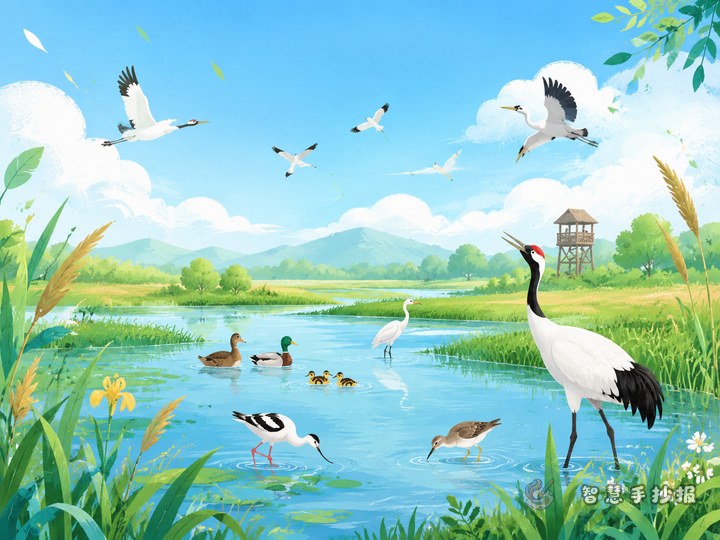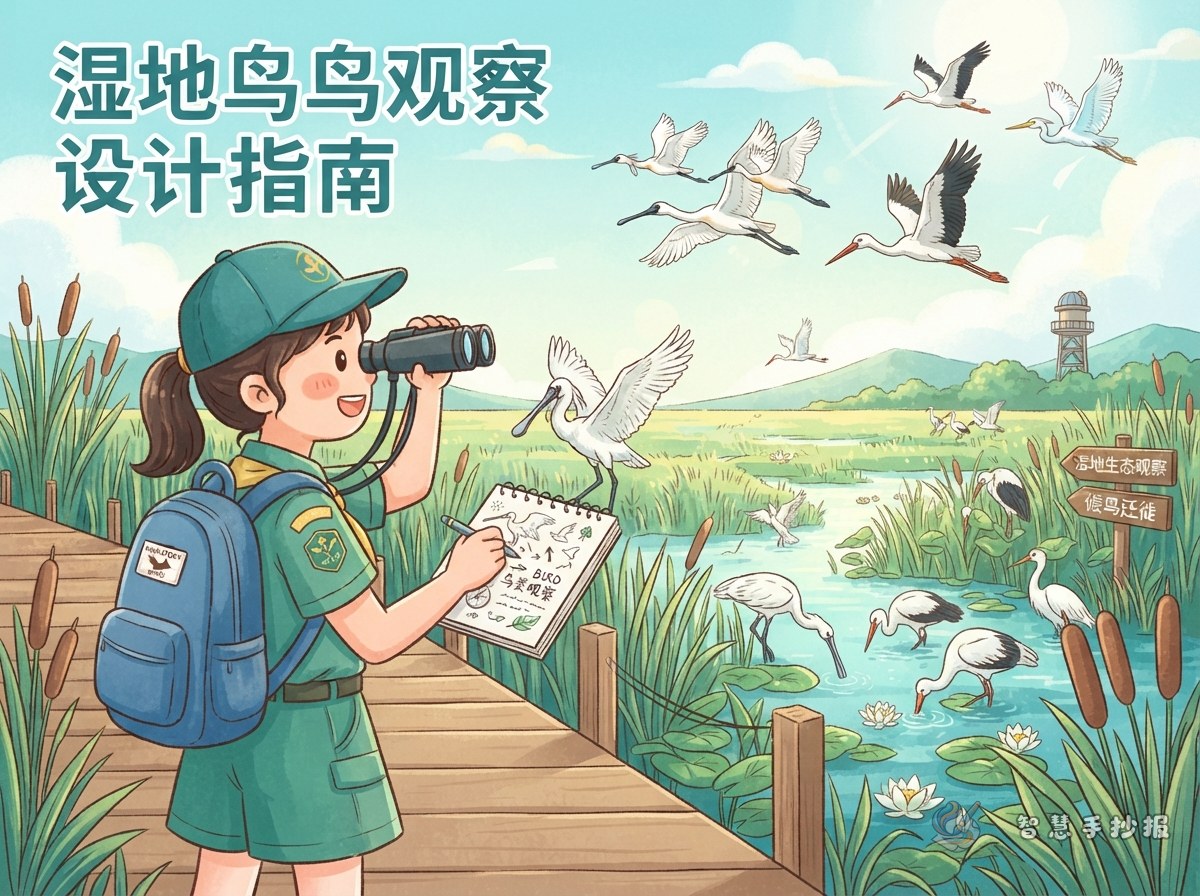
Why the journal style suits this topic
Wetlands and migratory birds are made for looking at: reeds in the water, birds on the mudflats, a flock crossing the sky. If every part of the poster is written as a science explanation, it starts to feel like copied textbook text. An observation journal lets the reader follow your eyes into the wetland instead.
It also makes layout easier. A journal naturally has a time, a place, a subject and a finding, and those four pieces can become four small sections on the page.
Split one sheet into three zones
Zone 1: the cover note
Place the main title and basic information here, like the front of a notebook. Write the place, the date, the weather and your name in two or three small lines. Add a standing bird or a few reeds beside them as decoration.
Zone 2: the bird record table
Draw two to four columns with a ruler. Each column covers one bird and repeats the same four short lines: appearance, movement, where it stayed, and what I noticed. Keep the lines light so mistakes are easy to fix.
Zone 3: the protection pledge
List two or three simple actions, such as not chasing birds, not leaving litter in the water, and not disturbing birds that are resting. Leave a small empty box for "three things I can do" so the poster ends with action rather than information.
Sentences you can copy into the record column
- Its beak was long and pointed, and it kept dipping it into the shallow water.
- It stood still by the water for a long time, resting or waiting for small fish.
- Before taking off, it ran forward a few steps and flapped quickly.
- On the same water, some birds swam while others cleaned their feathers on the bank.
- The wind wrinkled the water, and the shadows of the reeds kept moving.
These lines are short, easy to copy neatly, and create a clear picture. You can add one small question after each line, such as "why is it not afraid of the cold", to show your thinking.
Drawing the scene and choosing colors
You do not need advanced drawing skills. Use three layers: a faint horizon and hill shape in the back, a band of water with a few reed clumps in the middle, and one clear bird silhouette in the front. A bird silhouette can be an oval body, a thin neck, a pointed or flat beak, and two short lines for legs.
Keep the page to blue, green and cream. Paint water with light blue and a darker blue line, use two greens for reeds, and leave the sky and empty areas cream. Then give the main title one dark color, the small headings one color, and the body text another, so the whole sheet looks orderly instead of busy.
Four checks before you hand it in
- Is the title clearly larger than the body text and easy to find from a distance?
- Were the table and border lines drawn with a ruler?
- Does every column of text stay inside its frame with enough white space?
- Are there spelling mistakes, especially in words like migration and habitat?
If you want to save time on layout, sketch the three zones in pencil on scrap paper first, then copy them onto the final sheet. For more wetland and migratory bird layouts and text ideas, you can open the WeChat mini program "智慧手抄报" and keep building your poster from the same topic.