Give the page a “sun-chasing” story
Build the handwritten newspaper around the idea of a sunflower following light. A question such as “Why Do Sunflowers Turn Toward the Sun?” makes a clear title and naturally leads into the science section.
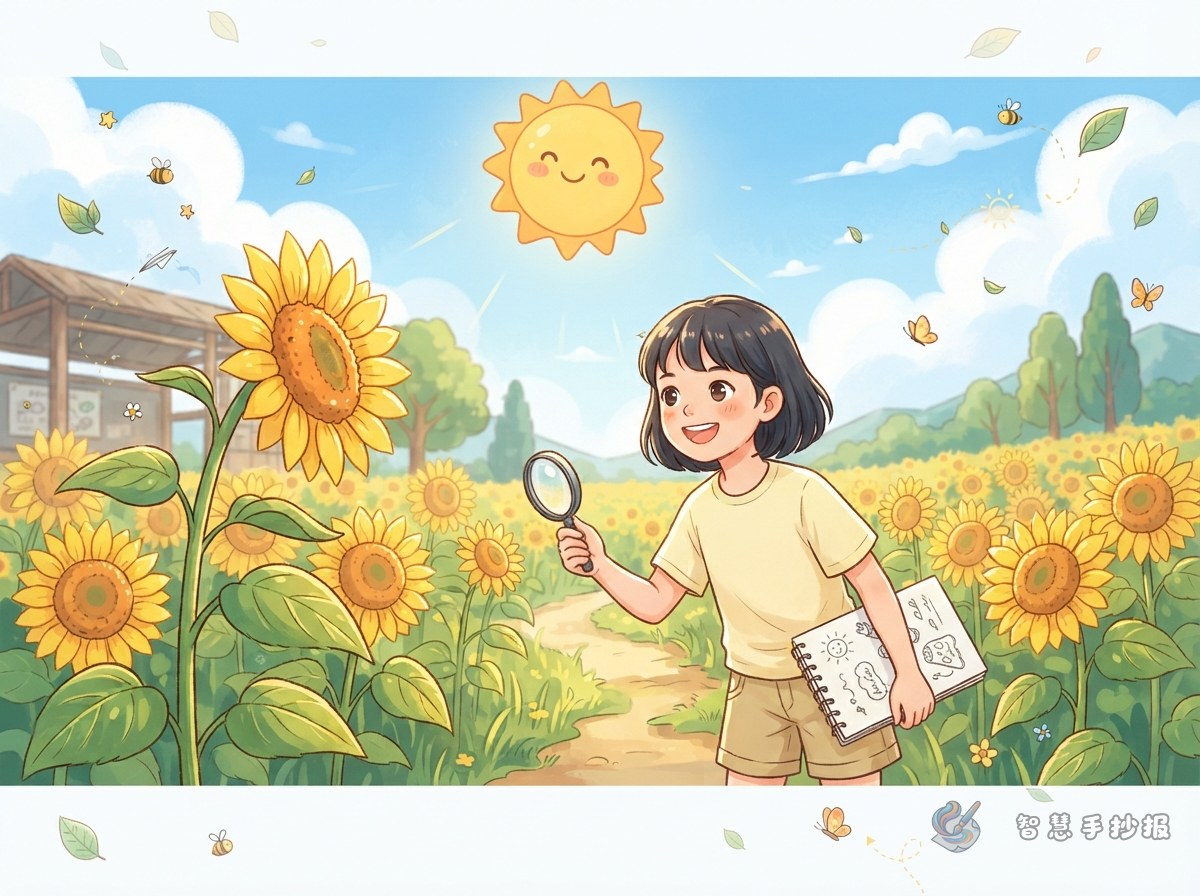
Place a large yellow sunflower in the center, with a sun, rays, and small arrows around it. The arrows can show changes in direction, while the open spaces around the flower can hold short explanations and observation notes.
A simple science box for the middle
Keep the explanation easy to understand but accurate. Young sunflower stems can respond to the direction of light. When the two sides of a stem receive different amounts of light, they may grow at different speeds, causing the stem or flower head to bend toward the light. As sunflowers mature, their flower heads usually face a more fixed direction instead of turning continuously all day.
Short text to copy onto the page
Sunflowers love sunlight. Young plants can show a growth response to the direction of light, so their stems and flower heads may change position as they develop. Mature sunflowers usually face a fairly fixed direction. Although plants cannot walk, their growth allows them to respond to the environment around them.
Turn an observation into evidence
Do more than write that a sunflower “turns.” Make four small observation panels along one side or across the bottom of the page. Draw a simple flower in each panel and add a short note.
- What to observe: Record the plant’s height, number of leaves, flower-head size, and direction.
- When to observe: Write the date and an approximate time, such as morning, afternoon, or evening.
- What changed: Compare the direction on different days or at different times.
- My discovery: Use “I noticed…” and “I think…” to explain what the observation suggests.
A useful sentence frame is: “On day ____, the weather was ____. At ____, I saw the flower head facing ____. Compared with the last observation, ____.” Leave blanks for real information instead of inventing results.
Let the sunlight guide the layout
- Put the main title and a small sun at the top, using warm orange or yellow lettering.
- Place the “How does it respond to light?” science box on the left.
- Use the center for the largest sunflower and label it as the observation focus.
- Arrange the four observation panels on the right or at the bottom, linked by arrows.
- Finish with a short “What I learned” box about light, water, air, and plant growth.
Small details that make it feel like nature study
Decorate the corners with a seed, roots, leaves, petals, or a small bee, but keep the words easy to read. Yellow, green, and light blue create a fresh color scheme. Draw the flower head with circles, add simple leaf veins, and use lines of different lengths for sunlight.
Before coloring, check that the title stands out, each observation includes a time, and the science statement is accurate. When the wording and sections are ready, you can continue arranging the page in the 智慧手抄报 WeChat mini program.