Turn the Poster into a Journey to Earth’s Center
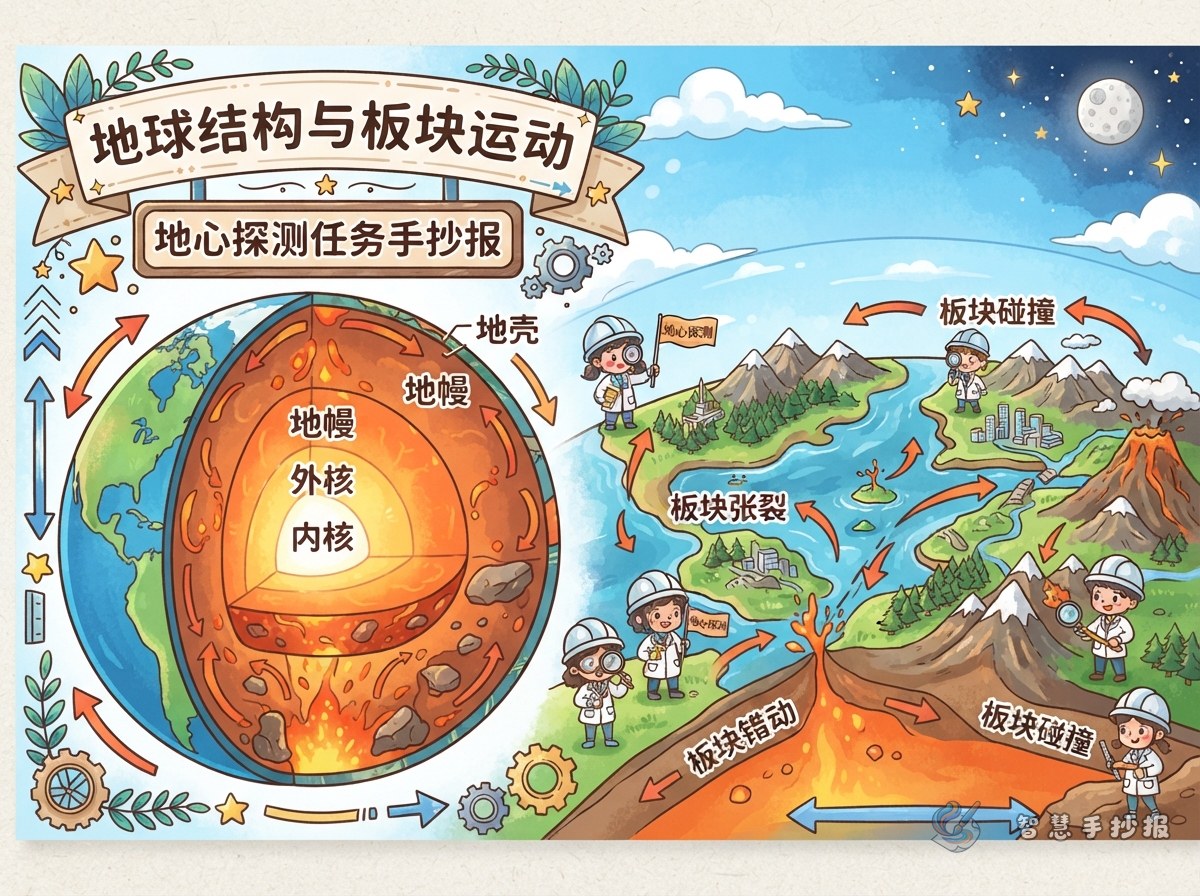
Give the poster the feeling of a scientific exploration map. The reader begins at the surface, travels through Earth’s layers, and follows clues about moving plates. Place a cutaway Earth in the center, then add three information areas around it: “Mission Notes,” “Seismic Clues,” and “Moving Plates.” This structure makes the facts feel like one connected discovery.
A suitable main title is “Mission to Earth’s Center: Why Does Our Planet Move?” A short subtitle could read “Following the clues from seismic waves to plate boundaries.” Use blue, orange, and red to represent Earth, mantle heat, and the hot core.
Read the Four Layers in a Cutaway Earth
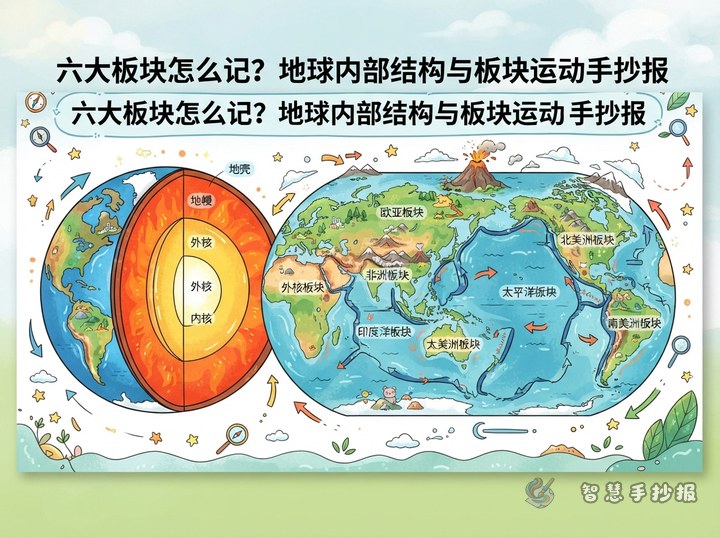
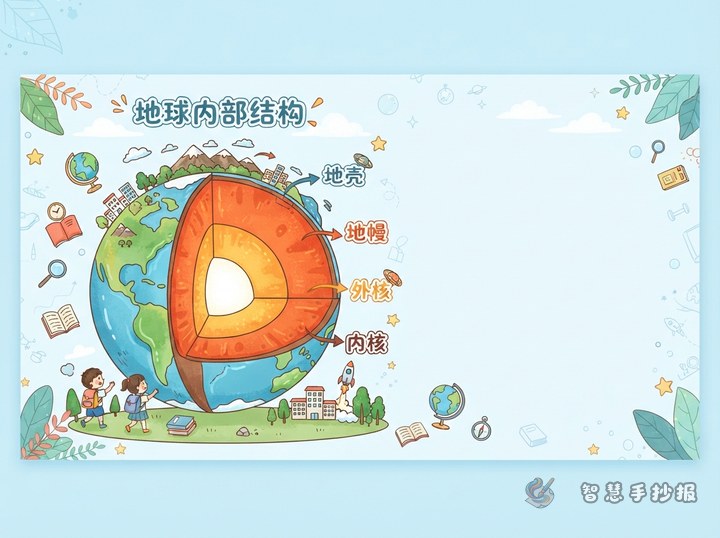
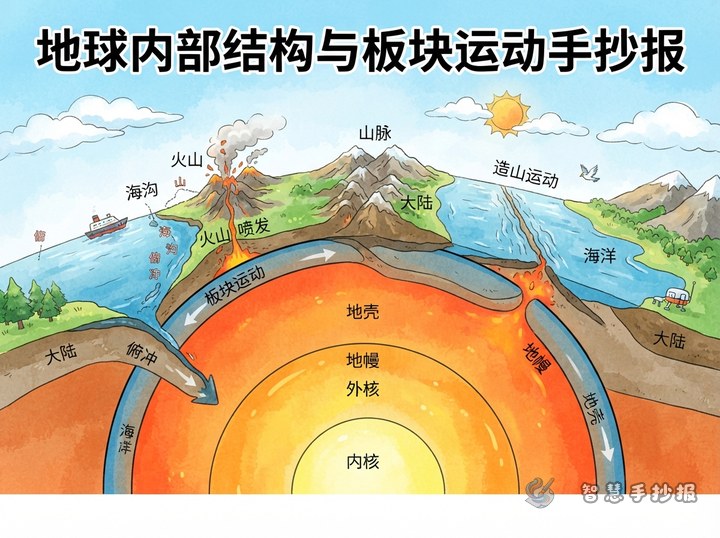
Draw a circular Earth cross-section in the middle of the page. Label the layers from outside to inside: crust, mantle, outer core, and inner core. The crust is the thin solid layer where continents and oceans are found. The mantle lies beneath it and contains slowly moving hot material. The outer core is mainly liquid metal, while the inner core is under enormous pressure and is mostly solid.
- Crust: The thin outer layer where we live.
- Mantle: A large layer connected with slow heat movement.
- Outer core: Liquid metal movement helps relate to Earth’s magnetic field.
- Inner core: The extremely hot, high-pressure center of Earth.
Short labels such as “thin outer shell,” “slow heat flow,” “liquid metal,” and “high-pressure center” are easier for young readers than a page full of measurements.
Use Seismic Waves as Hidden-Earth Evidence
People cannot directly see deep inside Earth, so scientists study how seismic waves travel. Add a small section titled “How Do Scientists Know?” Explain that an earthquake sends waves through Earth. Different materials can change the waves’ speed and path. By recording those changes, scientists have inferred that Earth has several distinct layers.
Draw curved arrows moving outward from an earthquake source, then mark clues such as “speed changes” and “a blocked path.” Make clear that seismic waves are evidence used to study Earth’s interior, not the same thing as plate movement. This small distinction gives the poster a stronger scientific storyline.
Show Plates Moving Like Giant Puzzle Pieces
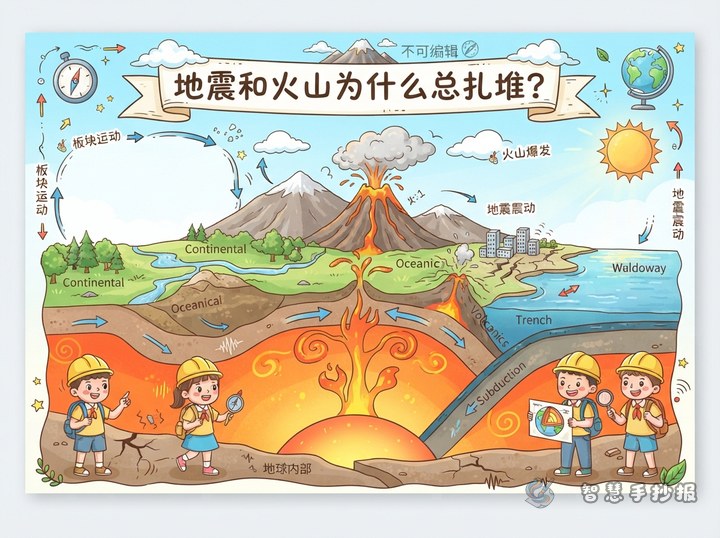
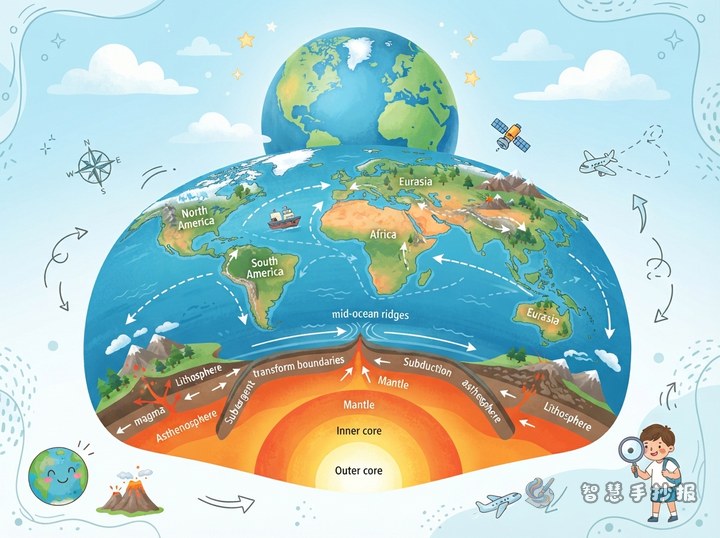
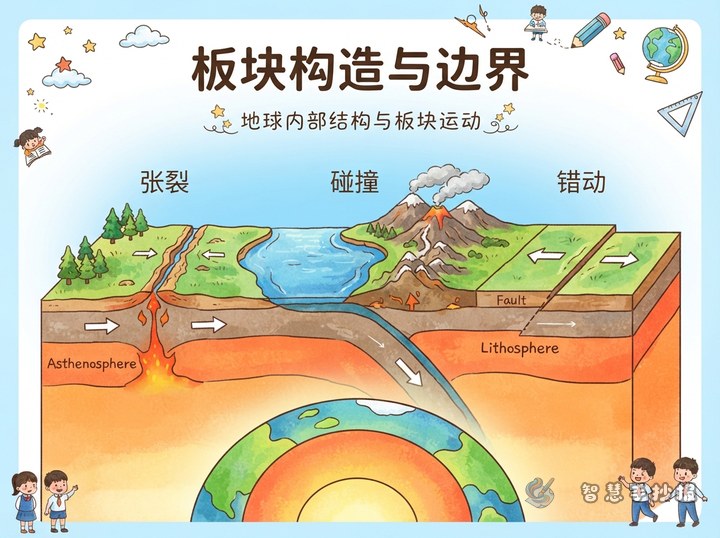
Place a “Moving Plates” section below or beside the cutaway Earth. Draw several hard rock plates fitting together like puzzle pieces. These plates are parts of Earth’s rigid outer shell. They move very slowly as heat-driven activity inside Earth affects them. The motion is difficult to notice day by day, but over a long time it can reshape land and oceans and contribute to earthquakes and volcanoes.
- Moving apart: Two plates separate and new rock may form between them.
- Colliding: Plates push together and may create mountains, trenches, or earthquakes.
- Sliding past: Plates move horizontally along a boundary and can release stored energy.
Use arrows and simple labels such as “pull apart,” “push together,” and “slide past.” The symbols should explain the idea at a glance.
Arrange the Page Like a Science Mission Map
Try a central cutaway diagram with four information islands around it. Put “Layer Code” in the upper left, “Seismic Evidence” in the upper right, “Three Plate Motions” in the lower left, and “Safety Reminder” in the lower right. Connect sections with thin arrows, keeping lines away from the text so the page stays easy to read.
Short Lines for the Poster
- Earth has layers, and its plates move in patterns.
- Seismic waves provide clues about the hidden center of Earth.
- Very slow plate motion can shape mountains and oceans.
- Understanding Earth also means learning how to reduce natural-hazard risks.
Sketch the title, main diagram, and sections lightly in pencil first. Add outlines and color next, then finish with arrows and short sentences. To organize the title, columns, and layout more quickly, continue designing in the WeChat mini program Smart Handwritten Newspaper.