Build the Design Around Blue and White
The beauty of blue-and-white lotus scrollwork comes from restraint rather than many colors. Treat the white paper as the porcelain ground, then use indigo, cobalt blue, or a clear medium blue for the title and ornaments. A pale blue-gray can separate content sections. Limiting the palette to two or three blues creates the calm, elegant appearance associated with blue-and-white porcelain.
Turn the Lotus Scroll into a Flowing Line
Lotus scrollwork combines winding stems, blossoms, buds, and leaves in a continuous pattern. This makes it ideal for borders, title decorations, and dividers. Begin with a lightly penciled wave-shaped stem, then place flowers and leaves along it in alternating directions.
- Connect the main stem with smooth curves instead of sharp corners.
- Vary open flowers and buds to create changes in size.
- Leave wider gaps around writing areas so the text remains easy to read.
- Use smaller leaves or buds to finish corners without overcrowding them.
Choose Four Short Content Sections
Understanding Lotus Scrollwork
Lotus scrollwork is a traditional decorative pattern formed by lotus flowers and continuously winding stems. Its connected branches suggest growth and vitality, and the motif often appears in traditional Chinese decorative arts, including ceramics.
Why Blue and White Works
Blue motifs stand out clearly against a white ground. Dark blue emphasizes the main flowers and stems, pale blue adds depth, and open white space keeps the poster fresh and peaceful.
Finding Beauty in the Pattern
The design combines orderly repetition with changes in the size, direction, and spacing of flowers and leaves. Students can explore its visual appeal through symmetry, repetition, open space, and tonal contrast.
Traditional Motifs in Daily Life
Traditional patterns can decorate bookmarks, greeting cards, notebook covers, and school posters as well as historic objects. Observing a pattern, simplifying its shapes, and rearranging its elements is a practical way to learn about design.
Borrow the Circular Layout of a Porcelain Plate
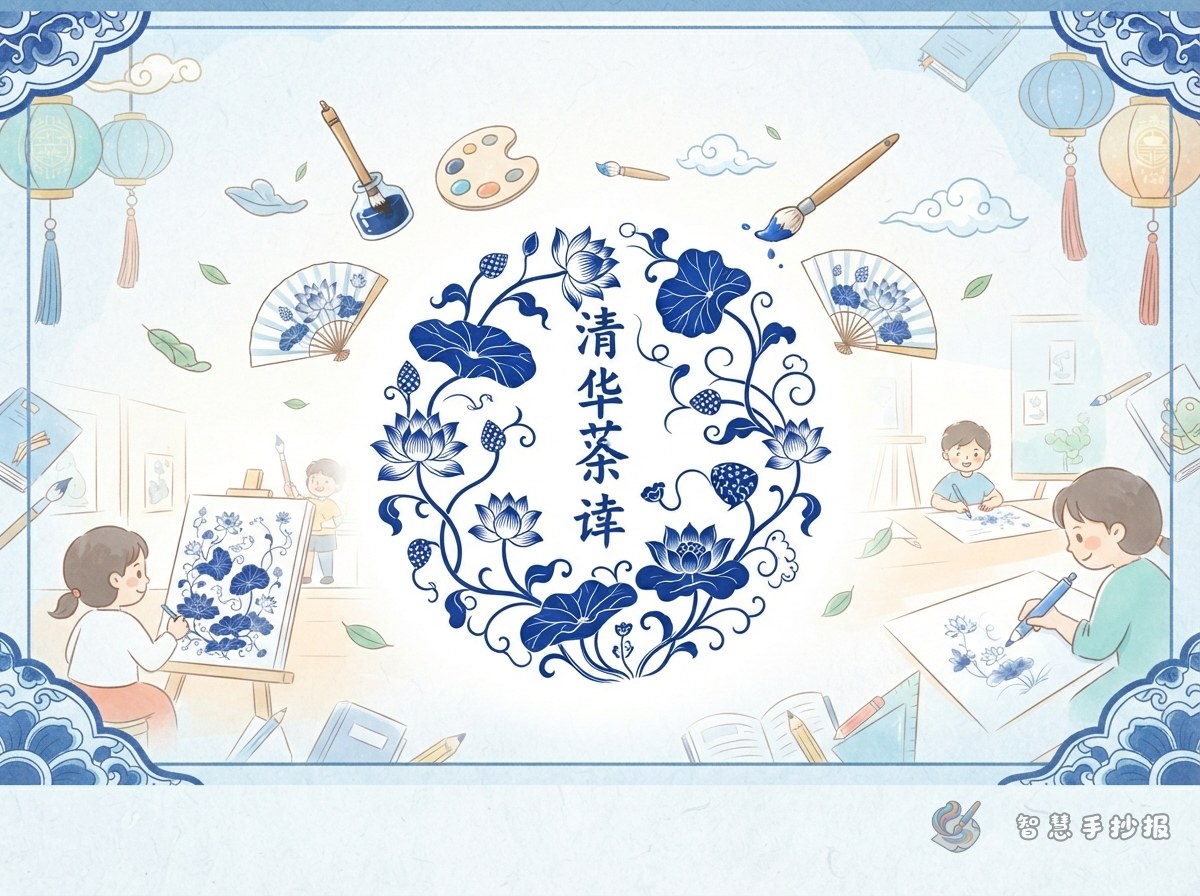
Create a central circle for a title such as “Blue-and-White Lotus Scrolls,” then arrange three or four text sections around it. Let partial stems and leaves enter from the four corners rather than filling every edge. Students who prefer a simpler layout can use decorative bands at the top and bottom with divided text columns in the center.
- Title: Draw outlined dark-blue letters and add a few small petal lines inside them.
- Border: Use a continuous vine, but keep it narrow enough to protect writing space.
- Sections: Separate them with fine pale-blue lines instead of heavy boxes.
- Details: Add small petals, droplets, or simple porcelain shapes without introducing too many colors.
Finish with Careful Coloring and Editing
Write the text before completing the ornament so the pattern does not take over the page. Apply pale blue first, allow it to dry, and then add dark-blue details. Coloring the outside of a flower more deeply than its center can create simple depth. Finally, check that the border is not too dense, the sections align clearly, and the blues feel consistent. To test other titles and layouts, students and parents can continue designing in the Smart Handwritten Poster WeChat mini program and adapt the result to their paper size.