Start with a theme of visible change
If you want the handwritten newspaper to feel rich and lively, do not only explain what Boston ivy is. A better angle is to show the changes you can truly observe on campus. You might see it on a school wall, a fence, or near a garden corner. Its look can change with weather and season, which makes it a great topic for an observation-based poster.
A title built around “what I noticed” or “my campus observation” will make the page feel more real and personal.
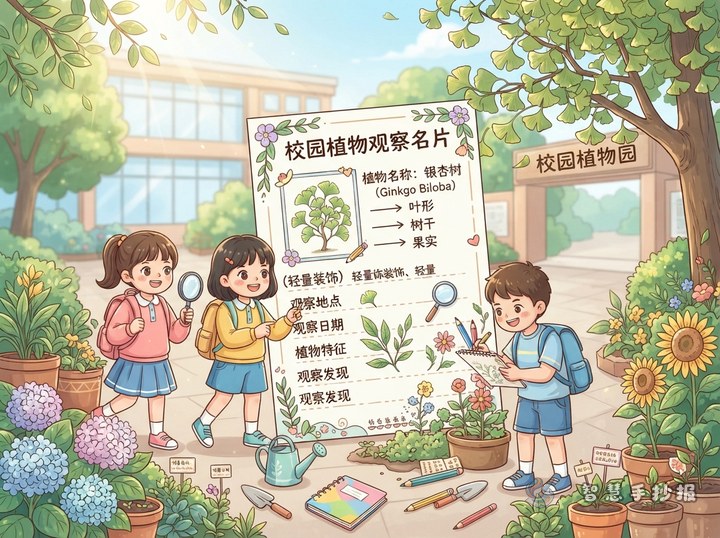
Useful sections to place on the page
Observation notes
- Place: school wall, fence, garden frame, or building corner
- Time: morning, noon, after rain, or in autumn
- What to observe: leaf color, vine length, attachment points, and density
Quick fact card
- The leaves often have a split, palm-like shape
- The vines keep extending upward along walls or supports
- It grows well where there is sunlight and some moisture
My discoveries
Write short findings such as: leaves look brighter after rain; sun-facing leaves are darker; young leaves are smaller and softer; some vines change direction when they meet an obstacle. These details make the work feel like real observation.
Ready-to-use writing material
These lines can be adapted directly into the poster:
- Boston ivy looks like many little green hands climbing slowly up the wall.
- I noticed that young leaves are lighter in color, while older leaves feel thicker.
- In autumn, some leaves change from green to red or dark red.
- This plant makes the campus more beautiful and teaches me to observe nature carefully.
If you still have space, add a short reflection: by watching the plant for several days, I learned that plants are never truly still. Small changes can be seen when we pay attention.
Design the page like a climbing vine
This topic works especially well with a flowing layout. Imagine the page as a wall, and let a curved vine connect each section. Put the main title near the top, arrange observation notes and fact cards on both sides, and place discoveries and conclusions at the bottom.
- Use a large title in green, yellow-green, or red-brown
- Decorate with small leaves, tendrils, or brick patterns, but keep it light
- Highlight key phrases such as leaf change, climbing growth, and seasonal observation
- Leave enough blank space so the writing stays easy to read
Add a sense of ongoing observation
A poster that shows process often feels stronger than one that only gives a simple introduction. You can create a small three-part area: what I saw on day one, what changed a few days later, and what conclusion I reached. Even small changes can show careful observation and thoughtful learning.
After finishing the draft, if you want to improve the title style, section arrangement, or decoration details, you can continue refining your handwritten newspaper in the Zhihui Shouchaobao WeChat mini program.