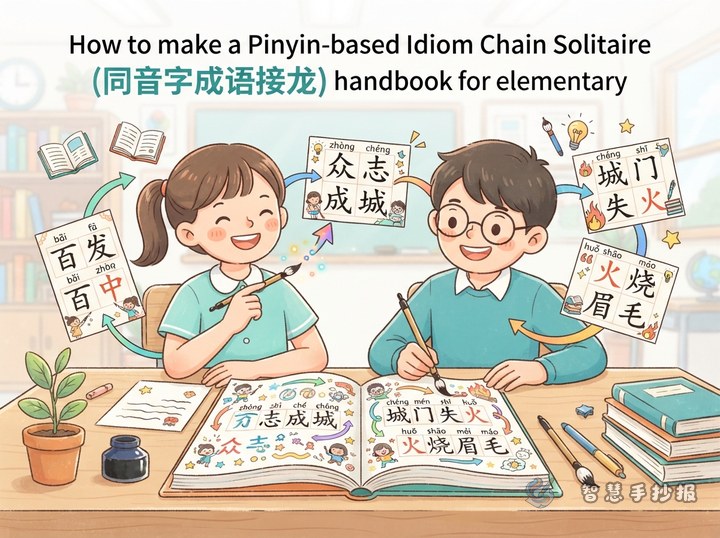

Decide What Each Part of the Poster Is For
The most common problem with an idiom chain poster is that the page fills up too fast. If you write a full explanation under every idiom while you build the chain, you may run out of space and have to squeeze the chain into a corner. A simple plan helps:
- Definitions are for idioms readers may not understand, misread or misspell.
- Example sentences are for idioms you can actually use, shown in one everyday sentence.
- Mini stories are for idioms with a vivid origin or picture behind them.
You do not need equal numbers of each. Three to five definitions, three or four sentences and one or two stories already make a full poster.
Fitting the Three Writing Styles onto the Chain
The chain is the backbone of the poster, so everything else should follow it. Here is a short sample chain:
一心一意 → 意味深长 → 长年累月 → 月明星稀
- Definition: write for 意味深长 only: 'words that carry a deep meaning worth thinking about'.
- Sentence: write for 一心一意: 'He did his homework with full attention and did not even notice the rain.'
- Mini story: write for 长年累月: 'Ten minutes of skipping rope every day adds up over months and years.'
- Nothing: 月明星稀 is easy to understand, so it stays on the chain without a note.
Treating each idiom differently tells readers where to look, and the page no longer feels like a wall of text.
Layout Ideas So Notes Do Not Crowd the Chain
Let the chain run along the middle or the edge of the page, and put notes on both sides with matching numbers. Try one of these layouts:
- Numbered boxes: mark idioms on the chain as ①②③ and leave matching small boxes nearby for notes.
- Top and bottom zones: keep the upper half for the chain only, and divide the lower half into a definition strip and a sentence strip.
- Color coding: write definitions in blue, sentences in green, and keep the chain in black so color becomes the label.
If you are worried about running out of space, sketch light pencil boxes first, place the chain, then fill in the notes and erase the guide lines.
Ready-to-Use Words and Short Sentences
These idioms are common and easy to continue in a chain:
- Focus: 一心一意、全神贯注、聚精会神
- Persistence: 长年累月、持之以恒、日积月累
- Feelings: 兴高采烈、眉开眼笑、心花怒放
- Scenery: 月明星稀、鸟语花香、山清水秀
Base your sentences on small daily moments: homework, rope skipping, setting the table, or watching the weather outside. Short, familiar sentences read well.
A Quick Check Before You Hand It In
- Check that the last character of one idiom matches the first sound of the next.
- Replace empty definitions like 'this idiom is very good' with a real meaning.
- Make sure the numbered notes match the right idioms.
- Look for wrong characters, especially similar-looking ones.
- Leave enough white space so the title and border do not cover the text.
Go through this list once and your poster will be ready.
Save Time on Layout with the Mini Program
If your chain and notes are already written, open Smart Handwritten Poster in WeChat, place your idioms and sentences, and adjust the layout before copying it onto paper. Keep the handwriting for yourself and let the tool handle the spacing and zones.