Choose a central idea: the mysterious smile
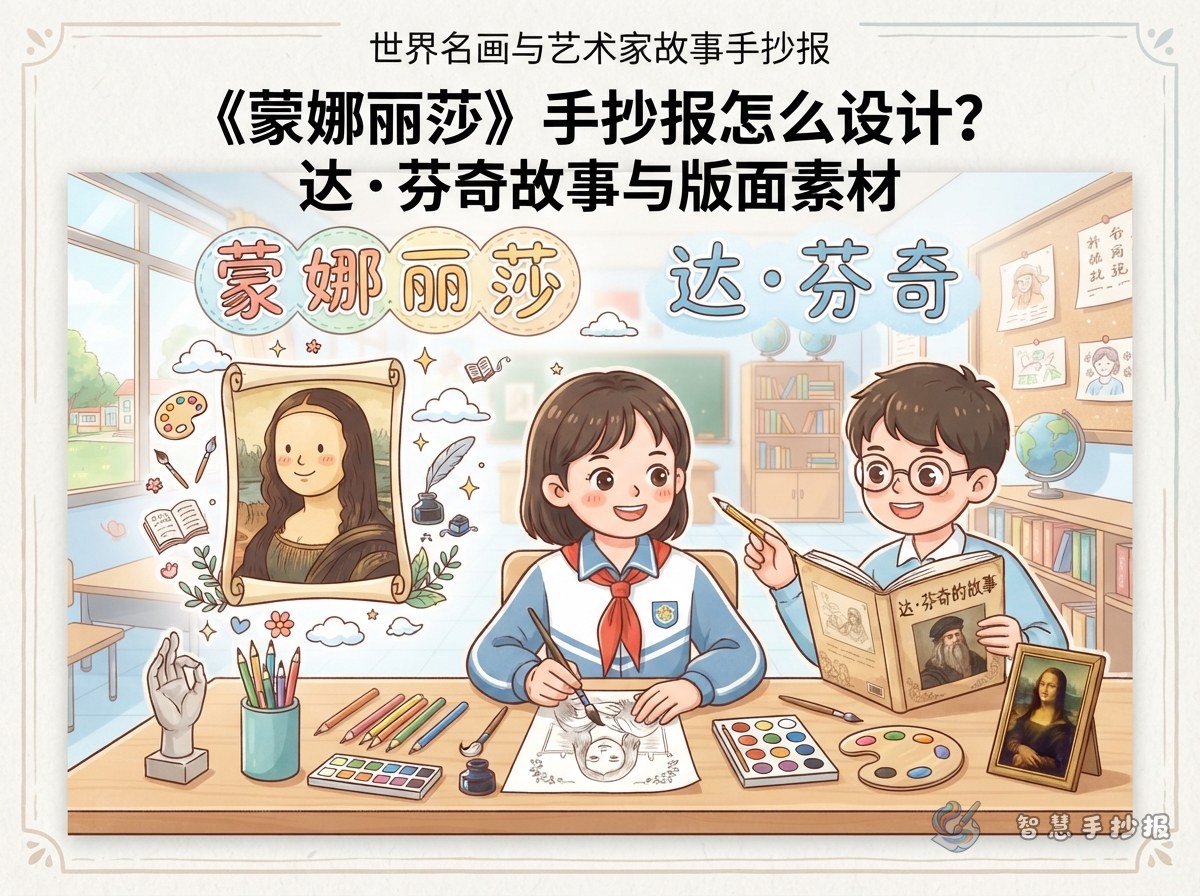
A Mona Lisa poster can be built around two questions: why does the figure seem to smile, and how did Leonardo da Vinci observe the world? Place a simple portrait outline in the center, then add three sections around it: artwork facts, the artist’s story, and my observations. This gives the page both useful information and a personal touch.
What to write on the poster
Artwork fact file
- Title: Mona Lisa.
- Artist: Leonardo da Vinci, an Italian artist.
- First impression: The figure sits quietly with a subtle expression, while a hazy natural landscape appears behind her.
- Observation guide: Look closely at the eyes, the corners of the mouth, the position of the hands, and the sense of distance in the background.
A story about Leonardo
Leonardo da Vinci was interested not only in painting, but also in the human body, nature, and light. When he worked, he paid attention to shapes, changes between light and shadow, and small differences in facial expressions. You can summarize this idea in your poster: making art is not only about drawing an object; it also requires careful looking, patient thinking, and the ability to show delicate feelings.
My interpretation of the smile
Add a small question box: “What do you think Mona Lisa is thinking about?” There does not have to be one correct answer. You might write, “Perhaps she is remembering something pleasant,” or “Her gentle smile leaves room for many ideas.” This makes the poster more playful and shows your own observation.
Build layers like a painting
- Place the portrait in the center or on the right. The drawing does not need to be complicated; focus on the face outline and the gentle expression.
- Create an “Artwork Fact File” in the upper-left corner, using a frame, scroll, or note-card border.
- Design a “Leonardo’s Observation Notes” section at the bottom, with small drawings of an eye, magnifying glass, or pencil.
- Add hills, trees, soft clouds, and a few golden lines in the corners to echo the calm, misty feeling of the artwork.
Try cream, light brown, olive green, and pale blue for the main colors, with a little gold to highlight the title. Leave enough empty space around the writing so decorations do not cover the important information.
Arrange the title and decorative lettering
The main title can be “The Smile of Mona Lisa,” with the subtitle “A Visit to Leonardo da Vinci’s World of Art.” Use large handwritten letters for the title and add a curved smile line or a small frame beside it. Keep section headings short, such as “Artwork Facts,” “Artist Story,” “My Discoveries,” and “Look Closer.” Clear headings make the poster easier to read and copy.
Three practical tips
- Plan the sections with a pencil before using pens or watercolor, so there is enough room for every paragraph.
- Do not copy the entire painting. Choose one focus, such as the portrait, hands, or distant landscape.
- Use short sentences you understand. Phrases such as “I notice,” “I think,” and “I wonder” make the poster more personal.
If you need more help arranging the title, sections, and colors, open the WeChat mini program “智慧手抄报” to continue creating a layout that fits your paper size.