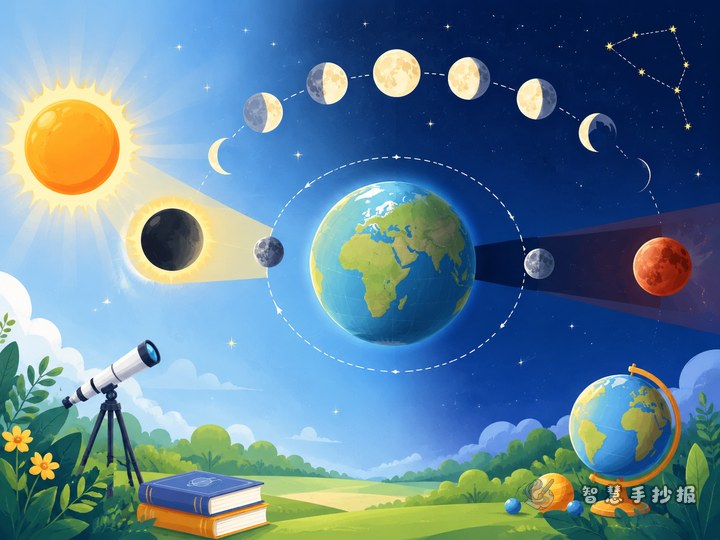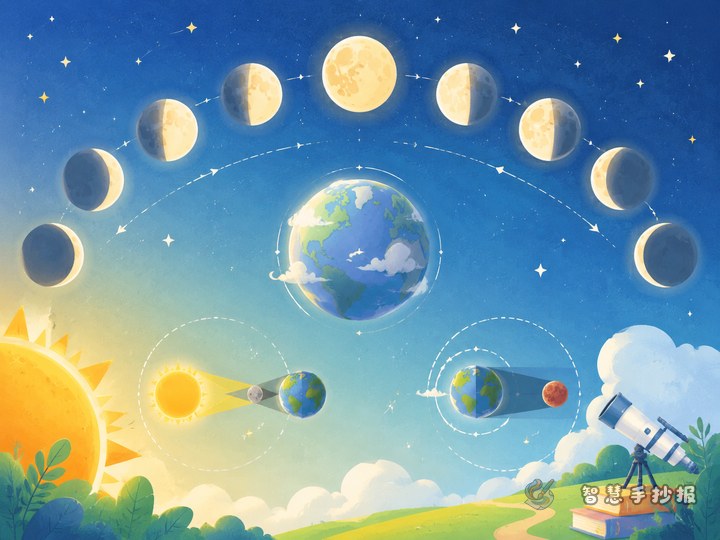
Begin with an alignment picture
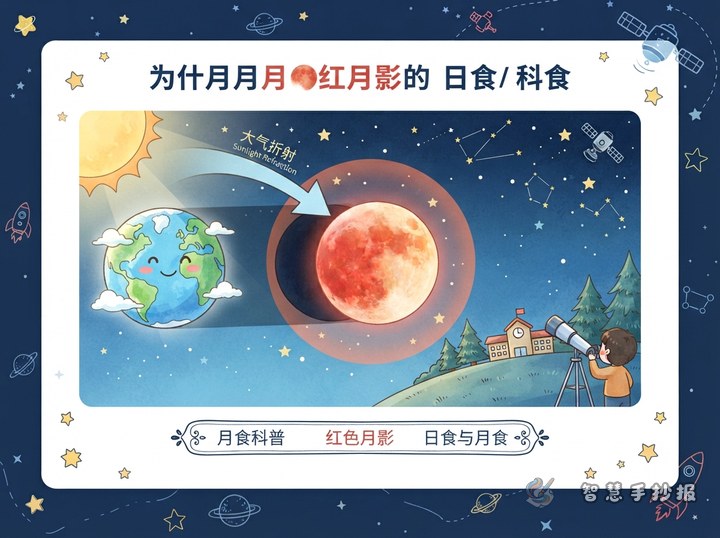
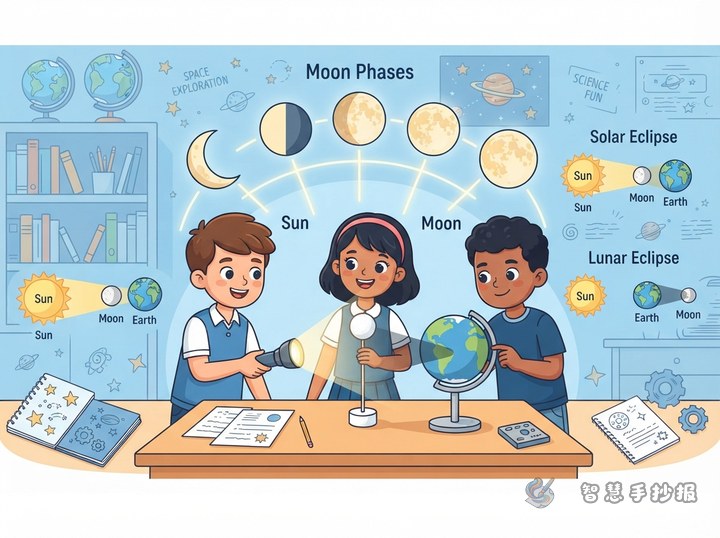
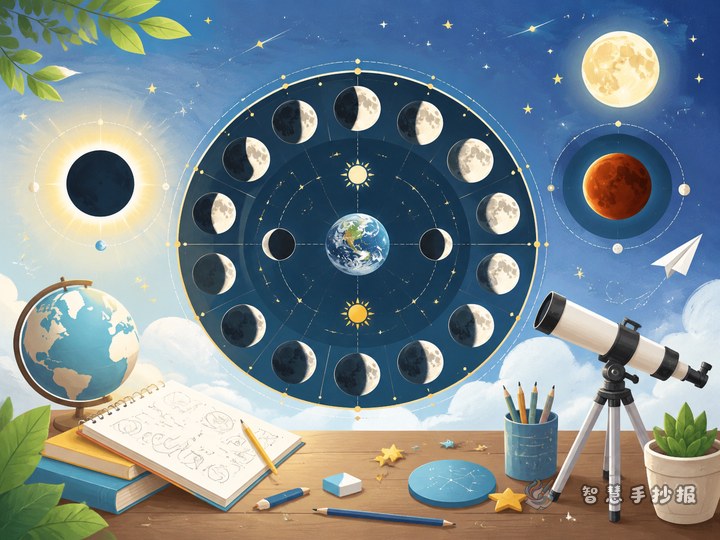
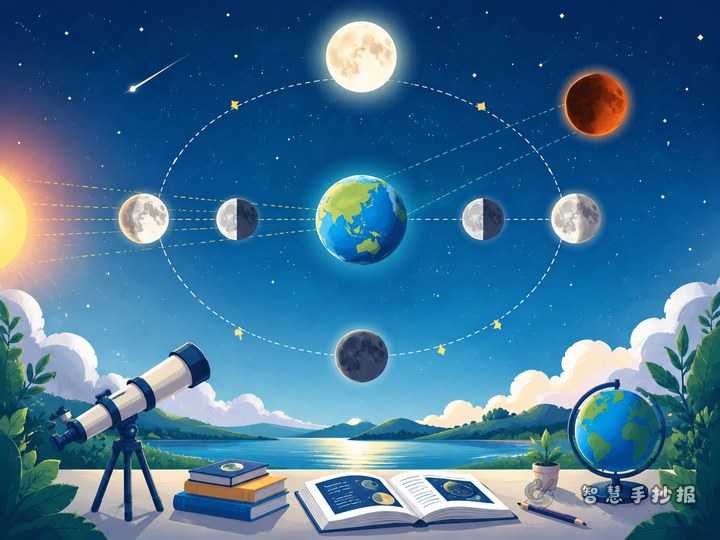
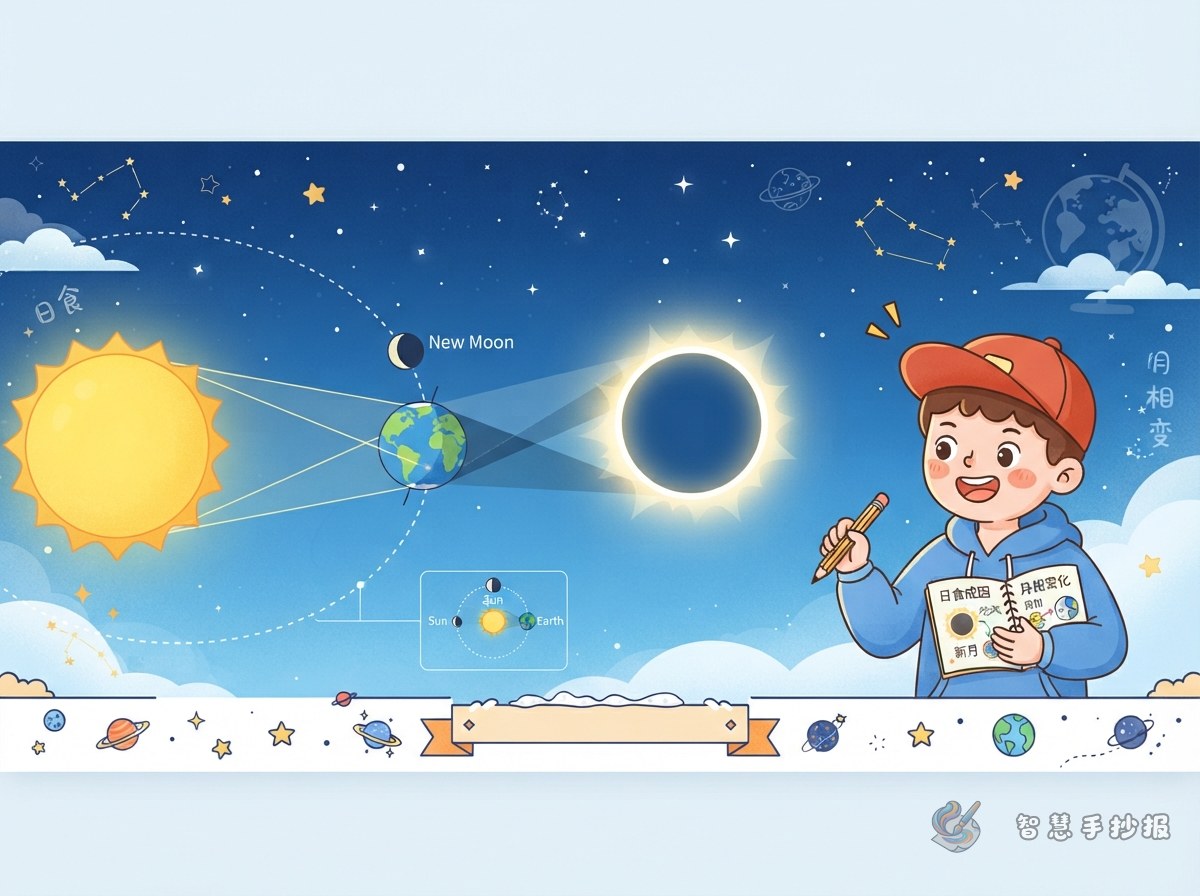
Build the page around one question: Why does a solar eclipse happen near a new moon? Turn the paper sideways and draw the Sun, Moon, and Earth in a row from left to right. Make the Sun bright, keep the Moon smaller, and place Earth at the far side. Parallel rays of sunlight will make the arrangement easy to understand.
A strong headline is Can the Moon Block the Sun at New Moon? Add a few stars, a crescent, and small rays around it, but leave the science diagram easy to read.
Three conditions for an eclipse
- The Sun, Moon, and Earth must be nearly in one straight line.
- The Moon must move between the Sun and Earth, which happens near a new moon.
- The Moon's shadow must fall on part of Earth.
Use this short note beside the picture: A solar eclipse does not mean that the Sun disappears. The Moon temporarily blocks some of the Sun's light. Although the Moon is much smaller than the Sun, it is much closer to Earth.
Add a “common mistake” fact card
Create a small box in the upper right corner called “Easy to Mix Up.” Write that every solar eclipse occurs near a new moon, but not every new moon has a solar eclipse. The Moon's path is slightly tilted, so it often passes above or below the exact Sun-Earth line.
A simple comparison for young readers
Imagine the Sun, Moon, and Earth as objects lined up in a beam of light. Only when the Moon stands in the right spot can its shadow reach Earth. A small shift in position prevents an eclipse.
Show what the Moon's shadow does
Behind the Moon, draw a narrow dark shadow and a wider lighter shadow. Label the dark region “umbra” and the lighter region “penumbra.” Explain that people in different parts of the shadow can see different amounts of the Sun covered.
- Umbra: the area with stronger blocking.
- Penumbra: the area where only part of the Sun is blocked.
- Safety note: Never look directly at the Sun. Use proper eclipse-viewing glasses.
Arrange the page like a science display
Keep the large alignment diagram in the center. Put the three conditions in the lower left, the new-moon reminder in the upper right, and shadow facts plus the safety note in the lower right. Deep blue, golden yellow, and silver gray create a clear space theme. Keep each paragraph to a few lines and frame important words with color.
After drafting the content, use the Wisdom Handwritten Newspaper WeChat mini program to refine the title, sections, and page layout for a neat final project.