Make the Red Moon the Visual Focus
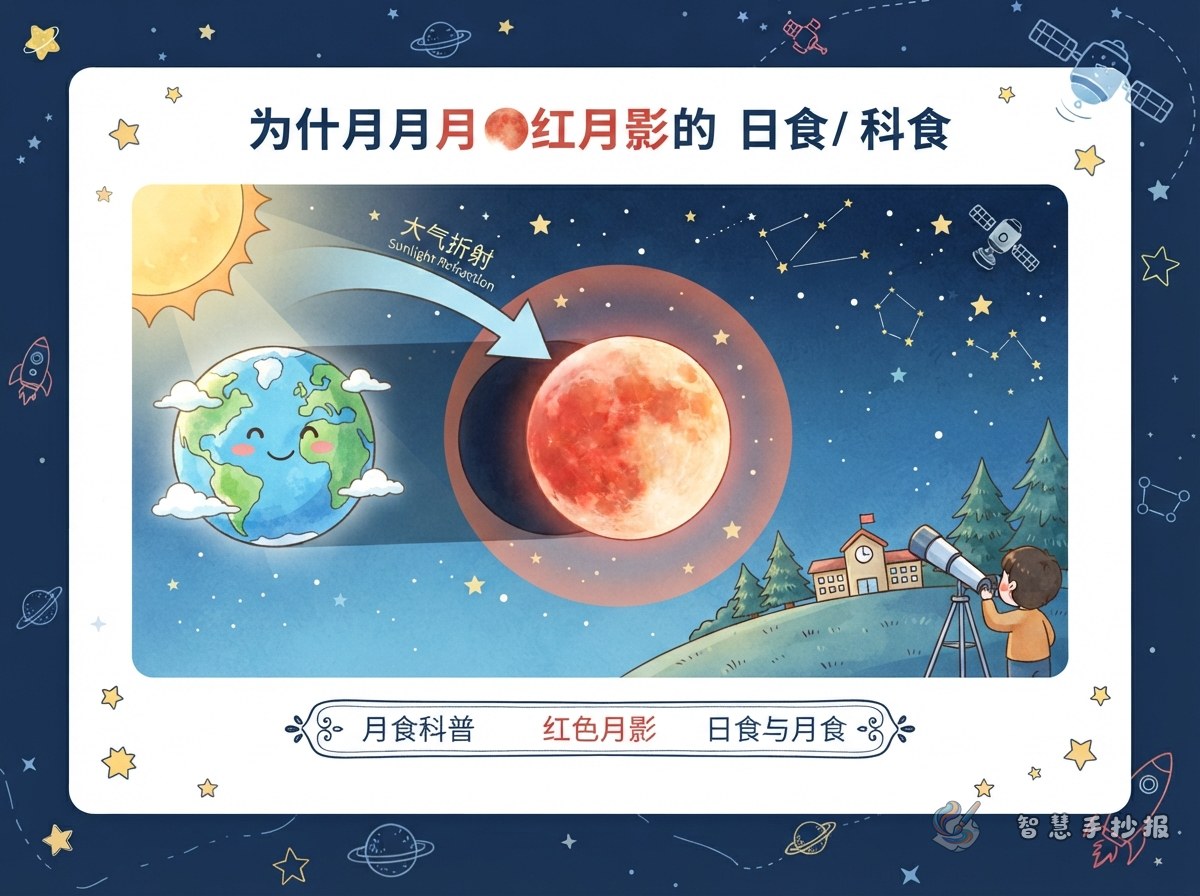
To give a moon phases and eclipses handout a memorable idea, do not spread every fact evenly across the page. Instead, build the design around the question “Why does the Moon turn red during a lunar eclipse?” Draw a reddish-orange Moon in the center, surround it with a deep blue, purple, or black sky, and connect the Sun, Earth, and Moon with thin lines.
- Central image: Draw a red Moon with gentle light and dark shading, and label it “The Red Moon During an Eclipse.”
- Main heading: Try “Why Does the Moon Turn Red?” or “Following the Journey of a Red Moon.”
- Decorative details: Add stars, a telescope, or a small observation card, while keeping the main text easy to read.
Explain the Red Moon in One Clear Paragraph
During a lunar eclipse, Earth blocks the direct sunlight that would normally reach the Moon, so the Moon moves into Earth’s shadow. However, Earth is surrounded by an atmosphere. The atmosphere scatters and bends sunlight, while more red and orange light can pass through the air around Earth’s edge and bend toward the lunar surface. The Moon may then appear dark red, copper-colored, or orange-red. It is not producing its own light; it is reflecting sunlight that reaches it.
A Short Fact Card to Copy
Red Moon fact: During a lunar eclipse, Earth is between the Sun and the Moon. The atmosphere acts like a soft filter and allows some red-orange light to reach the Moon, giving its surface a special color. The exact shade can vary with atmospheric conditions and the observer’s location.
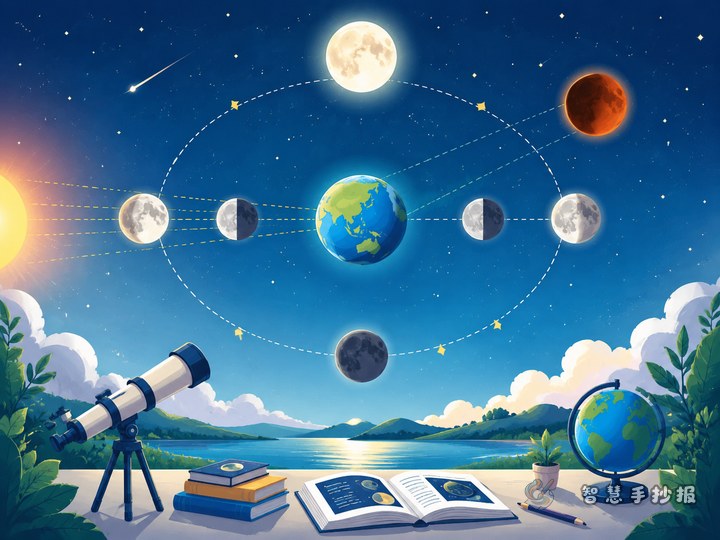
Use a Moon-Phase Ring to Show the Light Journey
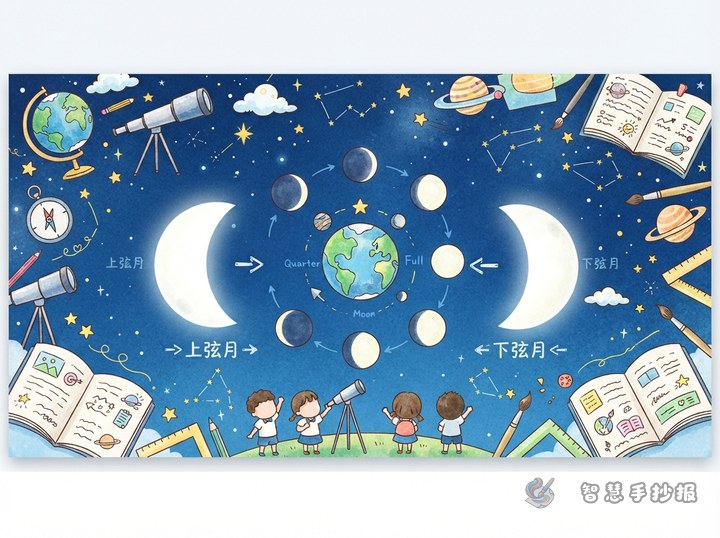
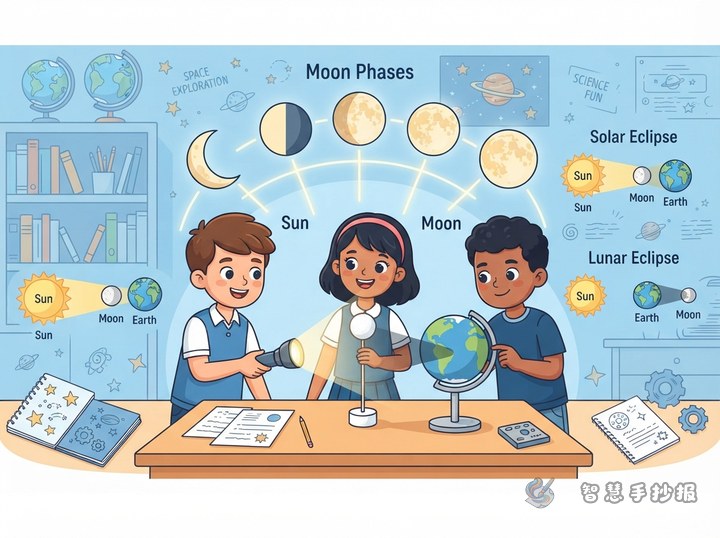
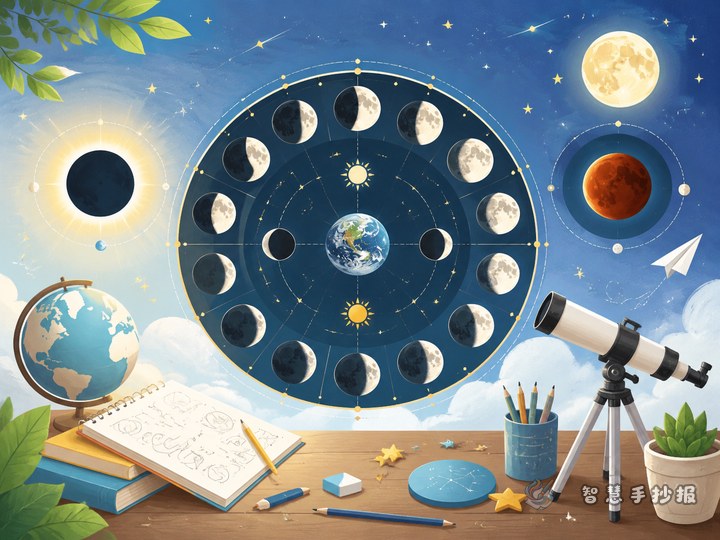
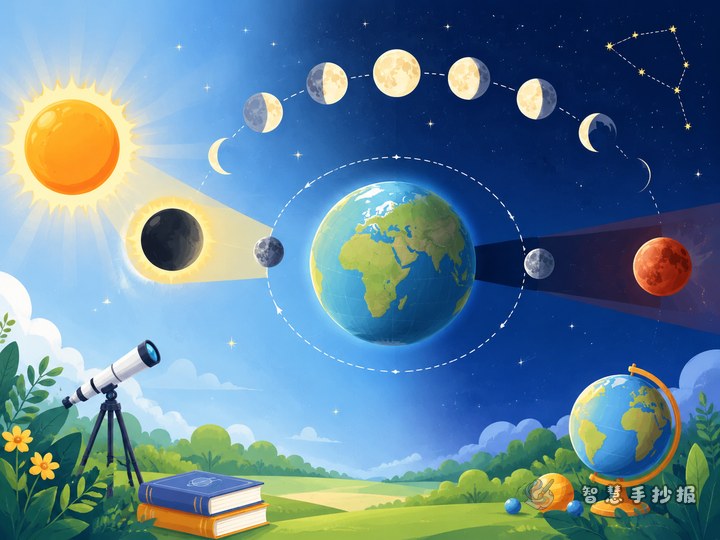
Under the red Moon, create a semicircle or ring showing the Moon as it grows from nearly invisible, becomes brighter and rounder, approaches a full Moon, and then becomes thinner again. Add a reminder that moon phases show changing views of the sunlit part of the Moon. The Moon is not changing shape, and Earth’s shadow is not responsible for every phase.
- New moon: The side facing Earth is mostly dark and difficult to see.
- First quarter and waxing gibbous: The bright part gradually grows.
- Full moon: Most of the side facing Earth is illuminated by the Sun.
- Waning gibbous, last quarter, and waning crescent: The bright part gradually shrinks before returning to a new moon.
Place this sentence beside the ring: “Moon phases are caused by changes in the positions of the Sun, Earth, and Moon relative to one another.” This connects the red Moon theme with the wider story of lunar motion.
Add a Small Comparison Corner for Solar Eclipses
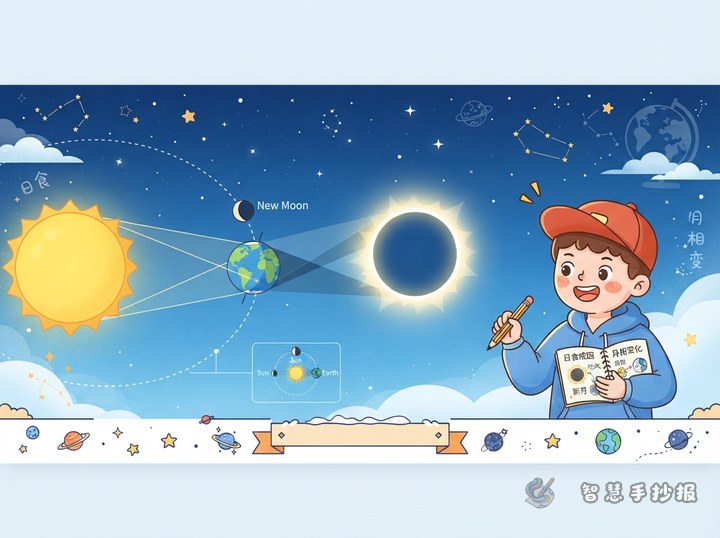
To make the handout more complete, draw two simple position diagrams in a lower corner. During a solar eclipse, the Moon moves between the Sun and Earth, and the Moon’s shadow falls on Earth. During a lunar eclipse, Earth moves between the Sun and Moon, and the Moon enters Earth’s shadow. Three circles and a few arrows are enough; label who blocks the light and where the shadow falls instead of using too many technical terms.
- Solar eclipse keywords: The Moon blocks some sunlight, it happens during the day, and the eyes must be protected during observation.
- Lunar eclipse keywords: The Moon enters Earth’s shadow, it is usually observed at night, and the lunar surface may turn red.
- Shared idea: The Sun, Earth, and Moon need to be nearly aligned for a clear eclipse to occur.
Use Color and Reading Flow to Create a Night-Sky Scene
Keep the page background light, then use deep blue for the night-sky border. Layer orange-red, brick red, and pale yellow on the central Moon. Use white or light-blue fact boxes, black text, and red or gold circles around key terms. Arrange the reading path as “red Moon image—reason for the color—moon-phase ring—solar eclipse comparison—observation note,” guiding readers from an interesting sight to its scientific explanation.
For the closing line, write: “When we look up at the Moon, we see more than changing shapes; we see a story of light, shadow, and motion.” After planning the text and layout, you can open the WeChat mini program “Zhihui Handwritten Newspaper” to arrange the sections and adjust the page before copying or printing it.