Turn “Why does Earth move?” into the main idea
This science newspaper can begin with one simple question: why can earthquakes, volcanic activity, and changing mountains happen when the ground beneath us looks solid? Use “Earth contains internal heat, while surface plates move very slowly” as the central idea so that every part of the page connects to the same story.
Choose a title that catches the eye
A strong main title is “Why Does Earth Move?”, followed by the subtitle “Exploring Earth’s Interior and Plate Motion.” Place the title across the top or in the upper-left corner. Blue, orange, and red lettering can suggest both the planet and its hot interior.
Draw a cutaway Earth in the center
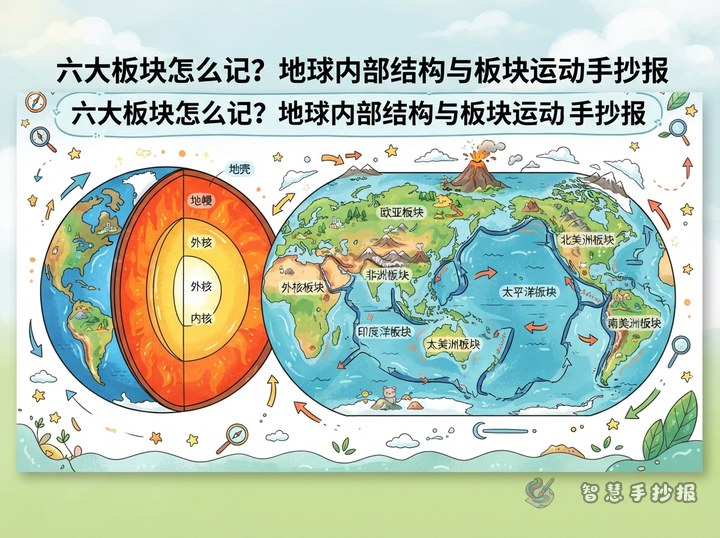
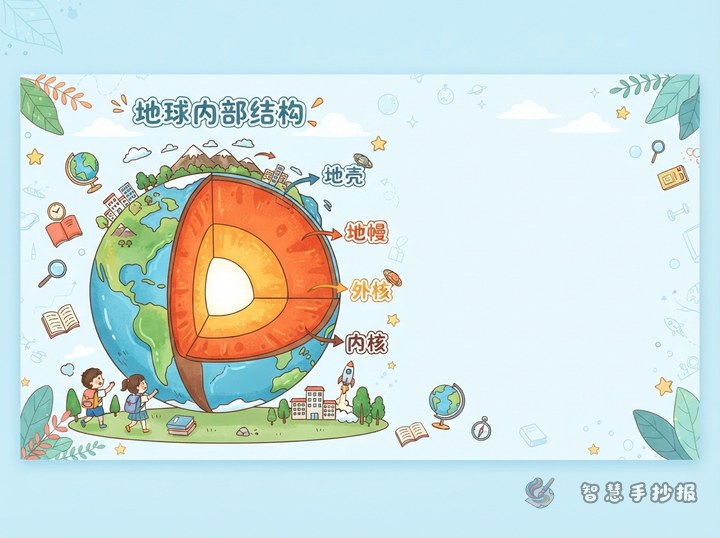
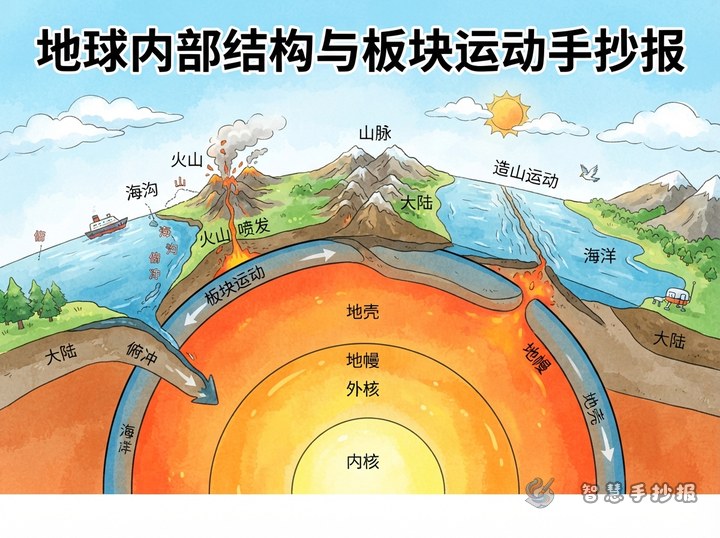
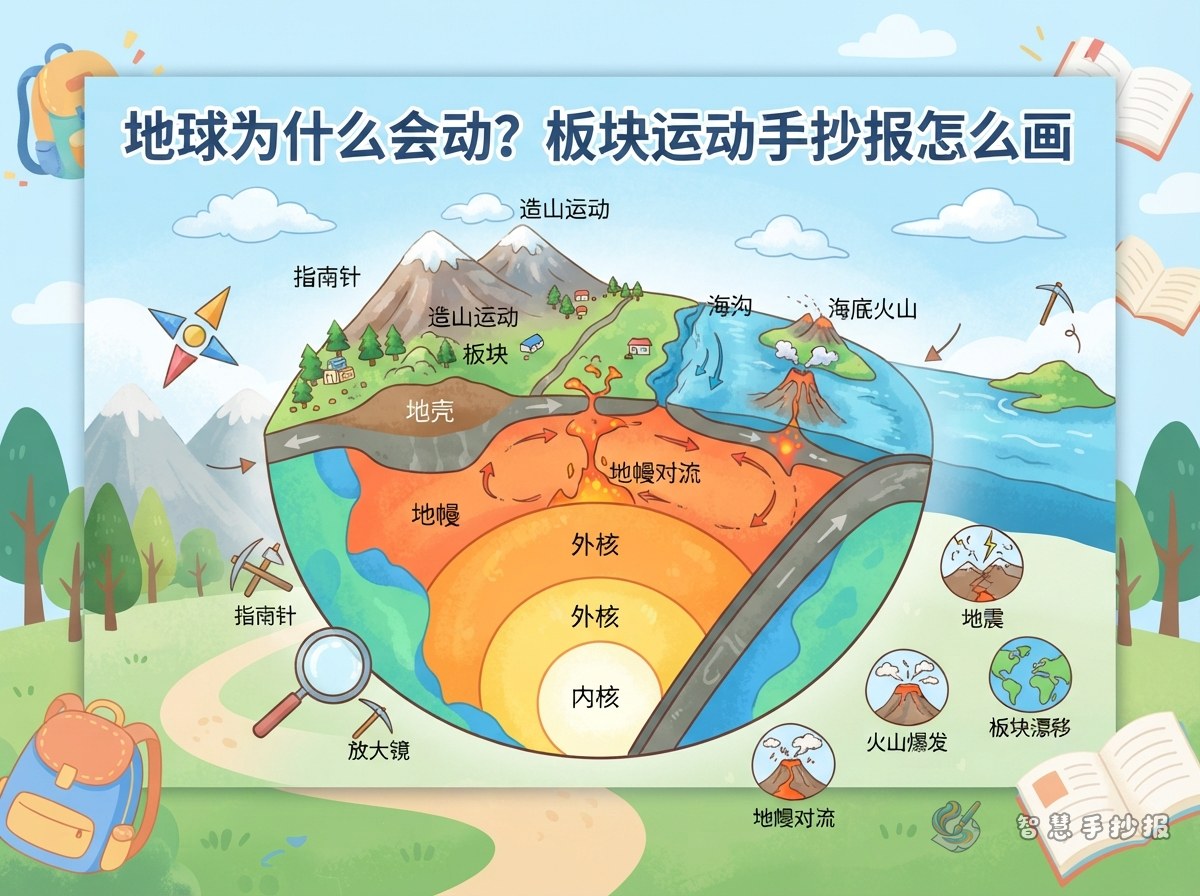
A large cutaway diagram works well in the middle of the page. Draw a circle for Earth and divide it into four layers from the outside toward the center. The diagram does not need to use exact proportions; clear layers and neat labels matter more.
- Crust: The thin outer layer where people live and where most familiar surface activity takes place.
- Mantle: The very hot layer below the crust, where rocks can move slowly over extremely long periods.
- Outer core: A liquid metal layer deep inside Earth, which can be shown with orange-red colors.
- Inner core: The solid central part, drawn as a bright small circle.
Add a short comparison beside the diagram: “Earth is like a layered, warm egg: its outside is solid, while its inside still contains enormous energy.” Label the drawing as a diagram so readers understand that the layers are not shown to scale.
Explain plate motion with three arrow scenes
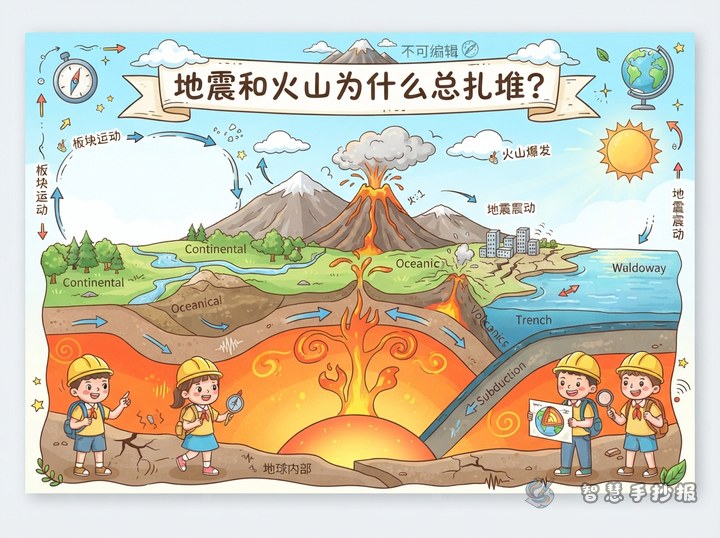
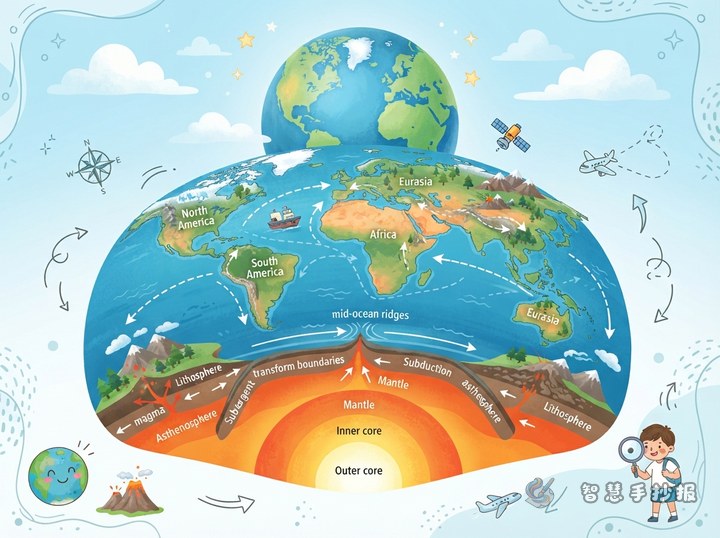
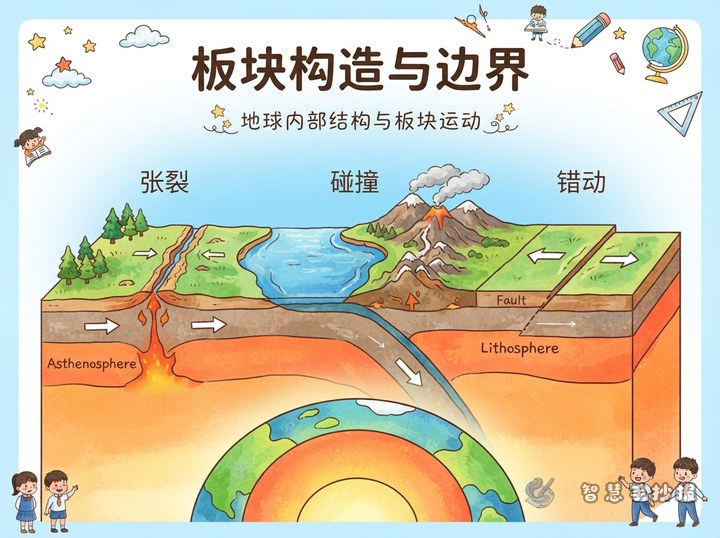
The rocky outer part of Earth is not one unbroken piece. It is divided into several large plates. Under the cutaway diagram, create a three-panel “plate motion theater.” Draw two differently colored plates in each panel and use bold arrows to show their directions.
- Moving apart: The plates separate and the arrows point outward. Add the note “new crust may form in this area.”
- Colliding: The plates move toward each other. Explain that this can be connected with mountains, trenches, earthquakes, or volcanic activity.
- Sliding past: The plates move in opposite directions along their boundary. Write that energy can build up and be released near such boundaries.
For accuracy, add that plate motion is extremely slow and cannot normally be felt as a quick movement. Over long periods, however, it can reshape the surface. Heat and material movement inside the mantle, together with several forces acting on plates, influence this motion.
Organize the facts into four readable sections
If the page has empty spaces, divide them into four small sections. Put “Earth’s Four Layers” on the left, the plate-motion arrows in the center, “What Can Plate Motion Cause?” on the right, and a “Science Reminder” strip along the bottom.
- Possible results: Plate motion can be related to earthquakes, volcanoes, mountains, and trenches, although each surface feature may have more than one contributing cause.
- Keyword cards: crust, mantle, outer core, inner core, plate, boundary, spreading, collision, and sliding.
- Science sentence: “Slow-moving plates can shape the land over a very long time.”
- Safety corner: During an earthquake or another emergency, follow directions from teachers, parents, or trained professionals and learn proper safety procedures.
Use colors and arrows to make the page easy to read
Try light brown for the crust, orange for the mantle, red for the outer core, and yellow for the inner core. Use blue and green for the two plates in the motion diagrams, and draw thick arrows to show movement. Let each color have one clear purpose instead of using too many colors.
First lightly sketch the title, central diagram, and section boxes with a pencil. Then outline, color, and copy the text neatly. Before finishing, check that every arrow points in the intended direction, all four layers are labeled, and no paragraph is too long. To explore more layouts, continue creating and adjusting the project in the 智慧手抄报 WeChat mini program and give the science newspaper a tidy design with your own ideas.