Why “home alone” deserves a full column
When people think of anti-trafficking safety, they often start with “do not follow strangers.” Yet children may spend more time alone at home than on the street. A voice outside saying “I'm your dad's colleague” or “I'm here to read the water meter” is harder to judge than a stranger on the pavement, because a closed door hides the person's face and gives the child no time to ask an adult. Writing this into a handwritten newspaper puts the safety rule where the child passes every day.
- It is close to daily life: after school, at weekends, or when a parent steps out for a while.
- It has clear actions: look, ask, do not open — three steps that are easy to remember.
- It does not rely on fear: the focus is on rules and asking for help, not on frightening the child.
Use the main column for the three-step doorbell rule
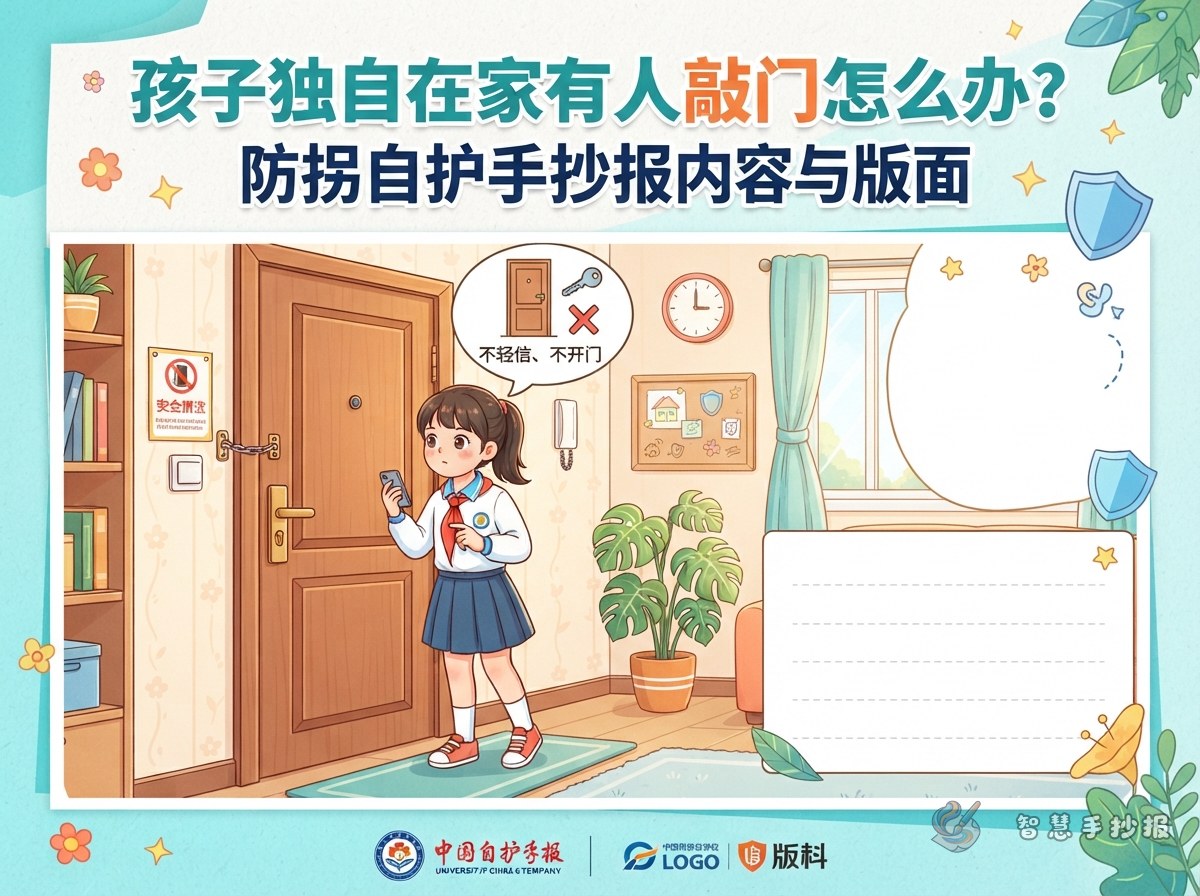
Draw a large door in the most eye-catching part of the page, with the inside and outside written on either side and arrows linking them. Keep the words few and put the actions in order.
- Step one: look before you speak. Do not rush to the door when you hear a knock. Stand behind the peephole or door viewer first and see who is there. You can also stay quiet for a moment to check.
- Step two: ask through the door. Do not open it. Ask through the closed door, “Who are you looking for?” or “What do you need?” The more the visitor hurries you, the calmer you should be.
- Step three: do not open, and do not say “I am here by myself.” Whether the person claims to be a delivery worker, a repair worker, a meter reader or a parent's colleague, answer, “My parents are not available right now. Please come back later,” then call your parents to check.
Picture panels: five knock excuses and what to do
Along the bottom of the page, draw five small panels. In each one, show a door and one short line of text. It reads like a comic strip and is much clearer than a long paragraph.
- “I'm delivering a parcel.” Ask them to leave it outside or contact your parents. Do not open the door.
- “I'm here to fix the pipes or read the meter.” Say the adults are not at home and ask them to come another day, then call your parents straight away.
- “I'm your father's colleague.” Do not open the door unless the identity is confirmed. You can ask them to call your father directly.
- “I'm a neighbour from upstairs and need to borrow something.” Answer through the door and ask them to speak to an adult in the family.
- They keep knocking, rattling the handle or refusing to leave. Do not keep answering. Move back inside, lock the door, and call 110 or a trusted neighbour or the building manager.
Page layout: one big door with two facing columns
A self-protection page does not need lots of characters. Making the door the main image gives the layout a strong identity. Try this arrangement:
- Draw a door in the middle, taking up about one third of the page, and write the key words “do not open, ask first” on it.
- On the left of the door, list “common excuses from outside” in small grey letters or speech bubbles.
- On the right, list “what to do inside” with coloured arrows and numbers.
- Below the door, draw a phone and the number 110, with the line “call your parents first, then 110.”
- Leave a promise card in the bottom corner: “When I am home alone, I do not open the door to strangers.”
Short lines and a rhyme you can copy straight onto the page
- A knock at the door — look first, ask next, stay calm.
- Do not open, do not show off, keep your parents' number in mind.
- Home alone? Never say “there's only me.”
- The more they rush you, the less you open; the more they hurry, the calmer you stay.
- Rhyme: Ding-dong goes the bell, check the peephole well; ask who is there, do not turn the lock; call your mum and dad, keep the safety talk.
The promise card can say: I promise not to open the door when I am home alone; not to tell strangers that I am by myself; and to lock the door first and call for help if something feels wrong. Three short lines fit neatly in a corner and remind the child every time they look at the page.
Act it out once, and the page becomes truly useful
After finishing the newspaper, ask a parent to play the visitor and try several different excuses. If the child does not open the door, asks through it and calls a parent, the practice is a success. Writing the scenes they have acted out makes the page more vivid and easier to remember. If you want a neater layout, you can open the Smart Handwritten Newspaper mini programme on WeChat, choose a door-shaped or panel-style template, fill in your sentences, rhyme and panel drawings, and then print or copy it by hand.