Start with a Fruit Cut Open
A handwritten newspaper about seeds inside fruits can begin with a simple observation. Cut open an apple, orange, tomato, pomegranate, pea pod, or pumpkin with help from an adult, then look for where the seeds are hidden. Instead of writing like an encyclopedia, describe what you really see, smell, and touch.
- Observation object: Choose one common fruit with clear seeds.
- What to notice: The peel, pulp, seed position, seed number, and seed shape.
- Safety note: Ask an adult to help with cutting and clean the table after observing.
Short Texts Students Can Put on the Page
Opening Paragraph
Today I observed the inside of a fruit. I found that a fruit is not only something delicious to eat, but also a small protective house for seeds. Different fruits have different seed shapes, numbers, and patterns. These details help me understand how plants continue their life.
Nature Journal Cards
- Fruit I observed: Write its name, color, size, and outside shape.
- Where the seeds live: In the center, inside sections, under a shell, or in a row inside a pod.
- What the seeds look like: Round, flat, black, white, striped, smooth, or rough.
- My discovery: Some fruits have many seeds, while others have only one. Plants use different ways to reproduce.
Column Ideas for a Clear Handwritten Newspaper
To avoid making the page too text-heavy, divide the content into small columns that show the observation process clearly.
- Fruit Profile: Name, season, color, taste, and where it grows.
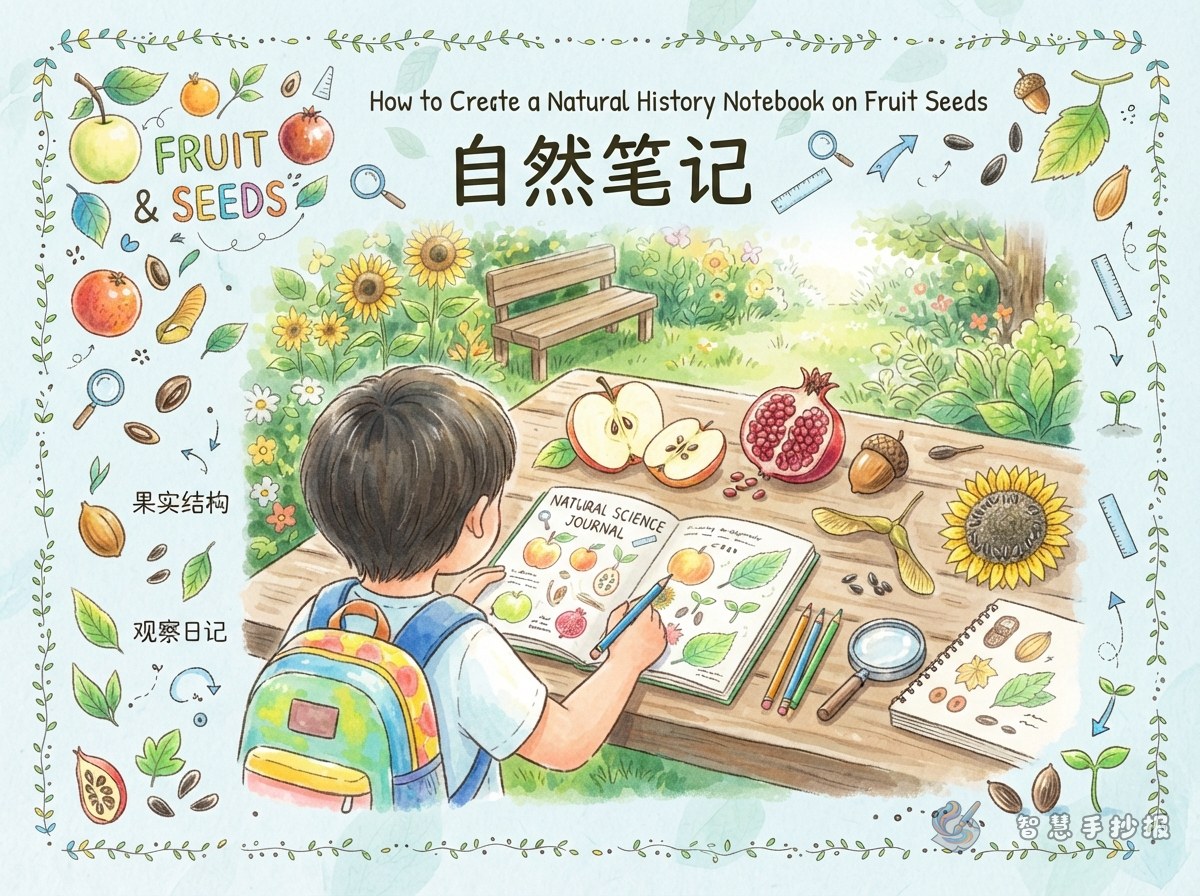
- Seed Map: Draw a cross-section and label the peel, pulp, and seeds.
- Magnifying Glass Notes: Record seed texture, size, number, and arrangement.
- Question Box: Add questions such as why fruits protect seeds and how seeds travel.
- My Observation Thought: End with one or two sentences about what you learned.
Make the Page Look Like a Fruit Observation Notebook
A useful layout is to place a large fruit cross-section in the center and surround it with small information cards. Put the title at the top, then decorate the page with leaves, small seeds, pencils, and a magnifying glass.
- Color plan: Use red and green for apples, orange and yellow for oranges, red and green for tomatoes, or pink and deep red for pomegranates.
- Border idea: Draw vines, leaves, fruit dots, and tiny seeds as a continuous frame.
- White space: Leave space between text boxes so the page does not feel crowded.
Simple Making Tips
First sketch the title, main picture, and columns with a pencil. Then write the text and add color at the end. Younger students can use short observation words, while older students can add a brief explanation about how fruits help seeds spread. If you want to build a layout more quickly, you can continue creating and adjusting the design in the WeChat mini program of Zhihui Handwritten Newspaper.